

For decades, R&D has faced a hard-economic reality: costs rise, cycles remain long, and breakthrough productivity rarely scales with investment. In pharmaceuticals, this pattern is known as Eroom’s Law, the inverse of Moore’s Law, but the problem now extends across industries.
Most organizations are no longer short on ideas. They are short on throughput: the ability to validate, prioritize, and convert promising concepts into market-ready outcomes.
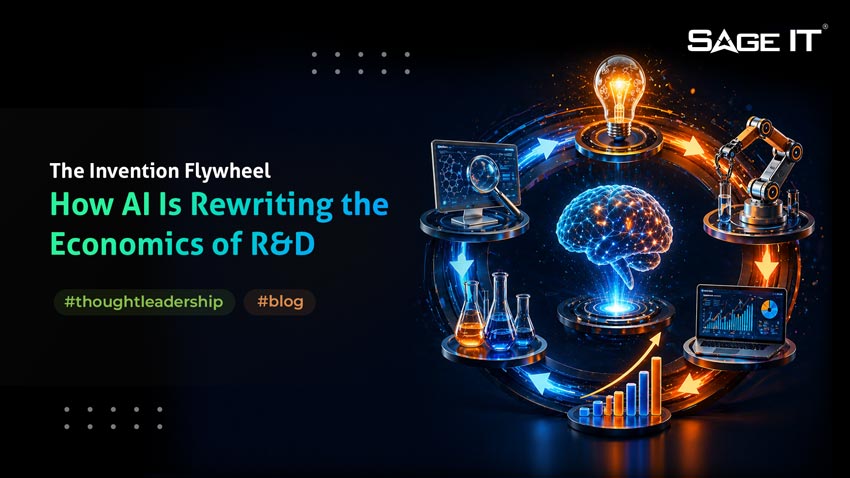
AI is beginning to change that, not by replacing scientists, engineers, designers, or product leaders, but by transforming R&D from a linear process into a compounding invention flywheel where discovery, simulation, validation, learning, and delivery reinforce one another.
This reflects the deeper lesson of Human + Machine: AI does not automate creativity; it amplifies human judgment, expertise, and accountability.
The next R&D advantage will not come from generating more ideas. It will come from learning faster, validating faster, and turning that learning into shipped advantage.
Why Traditional R&D No Longer Scales
Traditional R&D was built as a linear process:
Observe → Hypothesize → Experiment → Analyze → Decide
That model worked when experiments were scarce, data was limited, and idea generation was the main bottleneck.
Today, the constraint has shifted.
Organizations can generate more hypotheses than they can test, simulate more designs than they can physically validate, and collect more data than teams can interpret.
The problem is no longer idea scarcity. It is validation throughput.
This creates innovation congestion: full pipelines, slow movement, and too few ideas making it through validation, engineering, production, and commercialization.
AI does not solve this by making each step slightly faster. It changes the model itself.
If legacy R&D was a pipeline, AI-enabled R&D is a learning loop.
The Invention Flywheel
The emerging R&D model is no longer linear. It is a closed loop:
Generate → Simulate → Prioritize → Test → Learn → Regenerate
At each stage, AI expands capacity while humans retain judgment: defining the problem, weighing trade-offs, approving progression, and deciding what is ready to ship.
The flywheel is not about removing human responsibility. It is about giving experts a faster, evidence-rich system for learning.
Generate: Expand the Search Space
Generative models can propose molecules, materials, product designs, architectures, algorithmic variants, and engineering alternatives.
Most suggestions will not be viable. That is not the point. The value is that AI dramatically expands the search space beyond what teams can imagine, recall, or test manually.
AI becomes a force multiplier for human imagination, not the inventor of record.
Simulate: Fail Earlier and Cheaper
AI makes simulation more powerful by learning surrogate models, predicting outcomes before physical testing, and identifying constraints earlier.
Digital twins are central to this shift. Already used in manufacturing, they are becoming R&D assets that allow teams to ask “what if?” at scale before prototypes or trials begin.
The later a bad idea fails, the more expensive it becomes. AI helps teams fail earlier, cheaper, and with more learning.
Prioritize: Choose What Is Worth Testing
AI can rank candidates by predicted performance, expose trade-offs, identify high-risk/high-reward options, and surface possibilities humans might overlook.
This does not replace expert judgment. It improves the evidence available to it.
The best organizations will not use AI to make blind decisions. They will use it to make better-informed decisions faster.
Test: Move Toward Agentic Experimentation
AI does not eliminate experimentation. It changes how experiments are designed, executed, and adapted.
The first wave focused on automation: faster analysis, better documentation, AI-generated protocols, and computer vision-based result analysis.
The next wave is agentic. AI systems can adjust parameters using real-time data, orchestrate multi-step workflows, detect anomalies, and redirect exploration without waiting for every instruction to be manually defined.
Researchers move from executing fixed experiments to supervising and steering adaptive discovery systems.
Learn and Regenerate: Compound the Advantage
Every experiment feeds the system.
Models are retrained. Assumptions are refined. Decision logic improves. The next generation of ideas becomes stronger.
That is the flywheel: not just better ideas, but a better learning system, one that becomes harder to copy over time.
From Generative AI to Agentic R&D
The first wave of enterprise AI in R&D was largely generative: more designs, molecules, options, summaries, and documentation.
That was useful. But the bigger shift is agentic.
Agentic R&D systems do not simply produce outputs. They participate in the loop of discovery, validation, learning, and regeneration.
Generative AI expands what teams can imagine. Agentic AI expands what organizations can continuously test, learn, and improve.
The future of R&D will not be defined by isolated AI tools. It will be defined by closed-loop systems that connect models, data, simulation, experimentation, governance, and human decision-making.
Biology Proved the Model. Other Domains Are Following.
The clearest early proof point has been biology, especially protein structure prediction and drug discovery.
Breakthroughs such as AlphaFold showed that AI can compress discovery timelines in domains defined by massive search spaces, high uncertainty, and expensive experimentation.
But the lesson extends beyond biology.
The same conditions exist in advanced materials, energy storage, semiconductor design, aerospace, industrial manufacturing, consumer products, and complex software systems.
The domain changes. The pattern does not.
AI expands exploration, improves prioritization, reduces wasted effort, and helps promising ideas move downstream.
Why Shipping, Not Discovery, Is the Real Constraint
Faster discovery alone does not create business value. The real test is whether discovery survives the journey into engineering, manufacturing, and market launch.
Most R&D organizations do not fail because they lack insight. They fail because insight does not translate.
That hidden cost is the translation tax.
As discoveries move across teams, critical context is often lost. Assumptions get buried in static documents. Decisions separate from data.
The result is delay, duplication, and lost momentum.
AI’s real breakthrough is not only generating more possibilities. It is preserving the context needed to move those possibilities forward.
AI systems can capture experiment rationale, maintain traceability from hypothesis to outcome, summarize evidence, document decision logic, and keep the discovery context open across teams.
That is how AI reduces the translation tax and turns R&D into a shipping engine.
From AI Pilots to R&D Operating Systems
Many organizations still treat AI in R&D as isolated initiatives: a data science project here, a prototype there, a pilot disconnected from production.
That will not scale.
The winners will not be the companies running the most AI experiments. They will be the ones integrating AI into the R&D operating system.
That means AI is embedded into workflows. Data, models, simulations, experiment results, and validation criteria are shared across teams. Governance is designed in from the beginning.
The goal is repeatability, not heroics.
A pilot proves technical feasibility. An R&D operating system creates compounding organizational learning.
Governance: Speed Without Chaos
As the flywheel accelerates, leadership must answer a harder question: how do we increase speed without increasing chaos?
Three areas matter most.
Intellectual property and ownership: Who owns AI-generated designs? How is originality assessed? What training data was used? Which outputs can safely move into commercial development?
Reproducibility and traceability: An AI-suggested breakthrough that cannot be reproduced is not a breakthrough. It is a liability. R&D systems need versioned models, logged inputs, documented assumptions, experiment lineage, and visible human decisions.
Validation and quality gates: AI can accelerate exploration, but humans define what is ready to ship. Quality gates must clarify required evidence, performance thresholds, approval owners, and escalation risks.
Speed without control creates noise. Control without speed kills innovation. Leadership has to design for both.
What Leadership Must Get Right
Transforming R&D is not about adding tools. It is about changing how the system behaves.
Leaders should focus on four priorities.
Build platforms, not point solutions. Fragmented tools create fragmented learning. Shared data foundations, reusable modeling environments, simulation infrastructure, and common evaluation frameworks create compounding advantage.
Fund two portfolios. One portfolio should focus on no-regrets productivity: document search, literature review, experiment summarization, analysis acceleration, and knowledge retrieval. The other should fund strategic invention: AI-driven discovery platforms that can reset competitive baselines.
Redesign roles and incentives. AI shifts scientists, engineers, designers, and product leaders away from manual analysis and repetitive documentation toward problem framing, interpretation, assumption testing, and cross-disciplinary decisions.
Measure shipping metrics. Move beyond vanity metrics such as AI pilots, generated ideas, or automated experiments. Better measures include cycle time from concept to prototype, hit rate of prioritized candidates, reduction in redundant experiments, downstream adoption, and revenue or cost impact.
The measure of AI in R&D is not activity.
It is market impact.
From AI-Enabled Learning to Shipped Impact
AI is not just improving R&D productivity. It is challenging the broken economics of innovation.
The invention flywheel shifts R&D from linear execution to cumulative learning, expanding exploration, accelerating validation, preserving context, and connecting discovery more directly to delivery.
Organizations that build this capability will fail earlier, learn faster, make better decisions, and ship innovation with greater confidence.
Those that treat AI as another R&D experiment may generate insight, but others will turn that insight into advantage.
The leadership question is no longer:
Can AI improve R&D?
It is:
Can we turn AI-enabled learning into shipped, measurable impact?
In the next era of innovation, winners will not simply invent faster. They will convert invention into impact faster than everyone else.
Primary Source
Daugherty, Paul R., and H. James Wilson.
Human + Machine: Reimagining Work in the Age of AI.
Harvard Business Review Press, 2018.
Attribution Note
This article builds on the foundational concepts of human-machine collaboration introduced in Human + Machine: Reimagining Work in the Age of AI and extends them with original analysis, current enterprise practices, and recent developments in AI-driven R&D systems, agentic workflows, innovation operating models, and enterprise transformation.