

I just watched a $25 million mistake happen in real time.
A finance officer joined a video call.
He saw his CFO. He heard his leadership team.
They discussed real projects, real timelines, real numbers.
Nothing felt unusual.
It wasn’t a hack.
It was a symphony of synthetic reality.
On the same day, in another organization, an AI system detected something subtle – a service account accessing a database it had never touched before.
No alert stood out.
No human would have prioritized it.
The AI connected weak signals, elevated the risk, and triggered containment.
The threat was neutralized in under a minute.
Two events. Same technology.
One enabled the attack. The other stopped it.
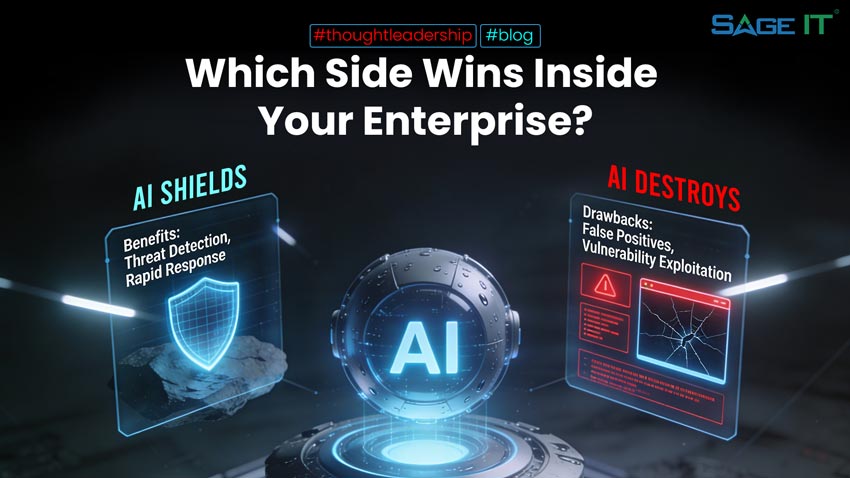
AI Destroys. AI Shields. This Is Already Happening
This is not a metaphor.
This is a live contest, inside your enterprise.
AI Destroys – With Precision and Scale
AI is amplifying attackers beyond human limits.
We are seeing:
This is not incremental improvement.
This is industrialized offense.
What once required time, skill, and coordination
now requires intent and minimal effort.
The Erosion of the Human Control Layer
For years, organizations trained employees to identify threats.
That model is breaking.
It wasn’t a hack.
It was a symphony of synthetic reality.
We are witnessing the erosion of the human control layer.
The signals we trained people to detect, poor grammar, unusual tone, suspicious requests, are disappearing.
AI has removed them.
We can no longer rely on human judgment alone
to defend against machine-speed deception.
AI Shields, With Speed and Precision
On the defensive side, AI is not just improving detection.
It is changing the model.
Modern AI-driven security systems can:
This is not alerting.
This is decision-making at machine speed.
In advanced environments, threats are contained
before they escalate into incidents.
The Speed Gap, Where Most Organizations Lose
The defining challenge in cybersecurity today is speed.
Attackers operate continuously and adapt instantly.
Most enterprises still rely on:
If your SOC is waiting for a “critical alert” to fire,
you are not defending.
You are performing an autopsy.
The Reality Most Organizations Are Missing
Your biggest exposure is not always external.
It is internal.
Your lead developer pasting proprietary code into an unsecured LLM.
Teams connecting AI tools to core systems without governance.
Internal exposure is scaling faster than external threats.
The Emerging Grey Zone
A less visible risk is emerging.
It is not just about attacks.
It is about the integrity of the systems themselves.
In these cases, systems behave normally, but outcomes are subtly compromised.
This is a different class of risk.
And most organizations are not yet prepared for it.
What Needs to Change
This is not about adding more tools.
It requires a shift in approach.
These are not future practices.
They are already in place in organizations that are ahead.
The Battlefield Has Moved
Security is no longer defined by the perimeter, which is why modern enterprise security must cover cloud, identity, applications, and AI-driven workflows.
Risk exists across:
And increasingly, inside your own environment.