


In our work with clients across industries, we see organizations at every stage of the AI journey. Some are just beginning, paralyzed by the question of where to start. Others have launched impressive pilots but find themselves stuck, unable to define what success looks like beyond the demo. Still others are now grappling with the sprawl of citizen developers spinning up AI agents across teams, each accessing data and systems without governance.
In a recent conversation, a customer put it plainly: “AI is a double-edged sword for us.” The real concern? It can accelerate everything they do or create chaos faster than ever before. The promise and the peril live side by side.
The excitement of experimentation has given way to harder questions. When a leadership team gathers for an AI showcase and someone asks, “When can we roll this out to the other divisions?” – the silence that follows isn’t about technology. It’s about readiness. There are data access issues, governance gaps, cost controls, and the business owner still isn’t sure how to measure success beyond the pilot.
Recent research paints a sobering picture. McKinsey’s 2025 State of AI report found that while 78% of organizations now deploy AI in at least one function, MIT’s 2025 study revealed that only 5% of custom enterprise AI tools reach production—a 95% failure rate.[1]
This is because organizations are approaching AI adoption with an industrial-era mindset in a digital-era world. The real question to ask is: “Have we built the AI supply chain to repeatedly deliver AI capabilities that are secure, compliant, observable, cost-controlled, and tied to business outcomes?”
This is the moment that separates organizations that experiment with AI from those that scale it.
Why the Supply Chain Metaphor Matters
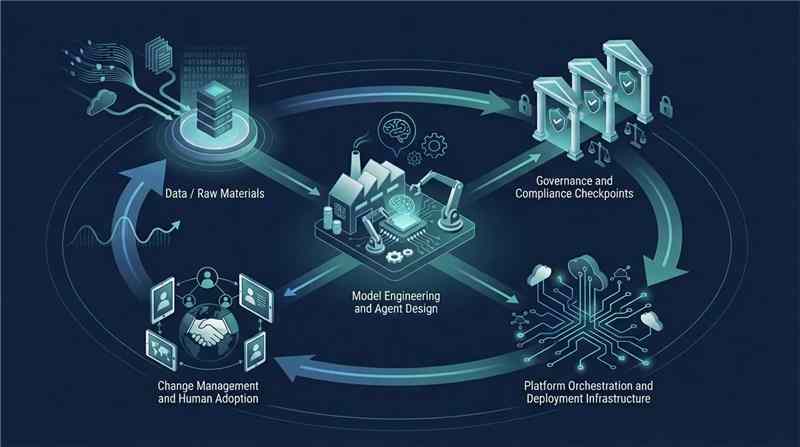
Think about a physical supply chain for a moment. Raw materials arrive from vetted suppliers. Quality gates catch defects before they compound. Logistics systems route products through the most efficient channels. Inventory systems prevent shortages and waste. When one link breaks – a supplier delay, a failed quality check, a logistics bottleneck, the impact cascades through the entire system.
AI capability works exactly the same way.
The parallels are striking:
| Supply Chain Element | AI Maturity Equivalent |
| Raw Materials | Data, process context, domain expertise, policy requirements |
| Factories | Model development, agent design, evaluation, testing, integration |
| Quality Gates | Governance, security, privacy, risk controls, compliance checks |
| Logistics | Deployment infrastructure, monitoring |
| Distribution | Change management, training, adoption measurement |
| Returns/Recalls | Rollback, continuous improvement |
This is why that customer conversation about the ‘double-edged sword’ resonates so deeply. Without the full supply chain – data pipelines, model governance, deployment infrastructure, adoption frameworks, you are not scaling AI. You’re scaling risk.
At Sage IT, we’ve seen this pattern repeatedly: successful AI adoption requires aligning interdependent capabilities – Data and Infrastructure, Models and Tools, Orchestration, Deployment and Adoption.
Building Your AI Supply Chain
Demand Shaping (Business Intent)
The strongest AI initiatives begin when the business owns both the outcome and the risk. In our engagements, the projects that scale fastest are those where business owners can answer: ‘What decision changes if this works?’ and ‘What’s the cost of being wrong?’
This clarity of measurable outcomes, defined constraints on risk tolerance and cost, clear accountability, is what separates strategic use cases from generic “AI for everything” mandates that stall at pilot stage. Without business ownership, AI remains a technology experiment searching for a problem to solve.
Data Readiness (Not Just Volume)
“We have lots of data” does not equal “We can use this data for AI at scale.” Most of our discovery work is mapping where data lives, who can access it, and what policies govern its use. AI exposes data debt faster than any audit.
Data readiness means having lineage, access governance, quality controls, and the infrastructure to serve it reliably to AI workloads, not just volume sitting in a data lake somewhere.
Knowledge + Process Mapping
For a health provider, we streamlined their change and document control process using agentic automation. The solution delivered an 80% reduction in manual effort, 90% improvement in turnaround time, and 75% projected faster approval.
The technical implementation was straightforward. The challenge was redesigning workflows and that is where process mapping matters. AI needs documented workflows, decision logic, exception handling, and human expertise to augment or automate effectively. Without these foundations, AI reveals process gaps rather than magically fixing broken processes.
Model/Agent Engineering with Evaluation
Most organizations start with copilots and RAG implementations for customer service or implement a predictive maintenance model, and it’s where most get stuck. They can’t scale because they didn’t consider how these tools integrate into existing workflows.
Productionizing AI requires golden datasets, test harnesses, benchmarks, and measurable reliability thresholds. We help clients set up evaluation frameworks before the first model ships, not after the first incident. Without this rigor, you’re not building AI systems, you’re deploying science experiments and hoping they work.
Governance-by-Design
According to PwC’s 2025 Responsible AI Survey, nearly 60% of executives say responsible AI boosts ROI and efficiency, yet nearly half report that turning principles into operational processes remains their biggest challenge.[3] The gap is implementation infrastructure.
Governance as a compliance checklist slows teams down. Governance as a platform service with automated approvals and embedded controls enables scale. Think back to our supply chain analogy: quality gates catch defects before they compound.
A tax compliance organization we work with illustrates this. They enabled citizen development of AI agents across teams but quickly realized that without a control plane, they would create ungoverned chaos. A Zero Trust Agentic Architecture that separates agent reasoning from enterprise system execution is an inherent expectation. Agentic platforms handle the intelligence; an enterprise control plane mediates all data access and system actions through governed APIs with centralized identity, authorization, audit trails, and least-privilege access. Business teams innovate freely yet maintaining control. Governance channels velocity instead of blocking it.
Platform and Integration
The most sophisticated AI model is useless if it lives in a silo, disconnected from how work actually happens. In our supply chain metaphor, this is logistics routing products through the most efficient channels. For AI, this means orchestration, observability, security controls, and integration into existing business systems and tools.
We built Archestra™ to solve exactly this problem, a multi-agent workflow orchestration framework that automates complex business processes across your existing technology stack, with governance, security, and observability embedded directly into the orchestration layer.
Operations
Scaling AI is operating AI. Organizations getting ROI treat AI like they treat other production systems- monitored, maintained, continuously improved.
We see clients learn this lesson the hard way. Their pilots work beautifully at small scale. When they try to scale, everything breaks – data latency increases, error rates spike, user trust evaporates. The supply chain metaphor holds here too: without continuous monitoring, maintenance, and improvement, the system degrades.
We help clients apply production engineering principles: staged rollout, capacity planning, quality gates, and feedback loops. This is sustainable agentic transformation that delivers value at enterprise scale, not fragile demos that collapse under load.
The Human Component
But here’s a critical piece that most organizations miss: the human component. Back to the supply chain metaphor one last time – distribution is where products reach end users. For AI, that’s change management, training, and adoption measurement.
Companies that treat AI as a technology project fail. Companies that treat AI as a workforce transformation succeed. The difference isn’t the sophistication of your models, it’s whether people trust them enough to change how they work.
AI maturity isn’t where your organization stands on a benchmark. It’s whether you can ensure AI is effectively adopted, implemented, and delivering value – under scrutiny, at cost, and at scale.
The organizations winning with AI aren’t the ones with the most pilots. They’re the ones that built the supply chain to go from idea to production repeatedly and safely.
So if your answer is no to this question – “Have we built the supply chain to make AI a repeatable business capability?” – then that’s the work.
And it’s work we help organizations do every day, bridging the gap from pilots to enterprise-wide impact. Not by running more experiments, but by building the orchestration, governance, and operational discipline that lets you scale.
And like any supply chain, it’s never finished. There’s always a new capability to integrate, a new process to optimize, a new risk to mitigate. The companies that thrive won’t be those with the highest maturity scores. They’ll be those with the most resilient, adaptable, and human-centered AI supply chains.