

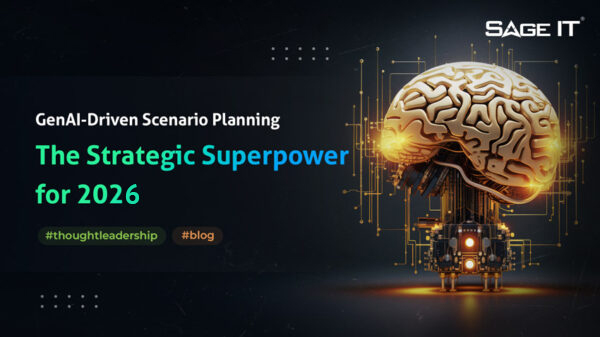
What if your five-year plan is already obsolete, and you will not know until it is too late?
In 2026, volatility is not episodic. It is continuous. From persistent inflation and rapid AI disruption to climate-driven instability and geopolitical fragmentation, CEOs face cascading pressures that overwhelm traditional foresight.
Scenario planning is no longer optional. But legacy approaches are manual, narrow, and slow, and they cannot keep pace with live signals.
Enter Generative AI. Not just a productivity boost, but a shift. GenAI helps leaders simulate futures at scale, stress-test assumptions, and turn uncertainty into a competitive edge.
This article explores how GenAI can move scenario planning from abstract theory to operational advantage, using real-world use cases, practical frameworks, and governance patterns built for trust.
Because in a world that will not slow down, GenAI helps you rehearse the future before it happens.
The Imperative for Agile Scenario Planning
Traditional scenario planning is buckling under pressure. Built for static cycles, it is struggling in a world of compounding disruption.
During COVID-19, organizations with rigid planning lost momentum, burned capital on reactionary pivots, and watched more agile competitors seize advantage. Many legacy players were crippled, with billions lost as plans lagged reality.
Lesson learned? Speed alone is not enough. Strategic velocity, rapid and directionally sound action, is the new currency.
GenAI does not replace strategists. It amplifies them. It clears bottlenecks, accelerates scenario iteration, and turns planning into a continuous, adaptive discipline.
In today’s landscape, agility is not reactive. It is predictive. As Gartner notes, prediction is protection now. GenAI is the engine powering this shift.
Redefining Scenario Planning with GenAI
From Noise to Signal: Uncovering What Others Miss
GenAI operates as a tireless analyst, scanning oceans of unstructured data such as news, academic journals, social media, and industry reports to detect weak signals and emerging trends long before they hit the mainstream.
For example, a logistics company used GenAI to pick up early whispers of a potential port strike on fringe forums, enabling preemptive supply chain rerouting.
By casting such a wide net, organizations move beyond conventional lenses and account for high-impact, low-frequency risks, such as niche regulatory shifts or viral consumer movements.
From Static Futures to Immersive Storylines
Modern multimodal GenAI transforms abstract prompts into richly detailed, interactive scenario narratives. Ask it to model a 2030 energy market with doubled renewables, tripled carbon taxes, and a battery breakthrough.
It delivers layered storylines complete with behavioral shifts, market dynamics, and AI-generated dashboards.
Leaders can instantly adjust variables, such as “Now assume slower adoption,” and receive new perspectives in real time. This makes foresight not only visual but deeply engaging for cross-functional stakeholders.
From Guesswork to Strategy: Synthesizing the Playbook
Generative AI does not just create scenarios. It also enables smarter decisions. Researchers at MIT’s Center for Transportation and Logistics teamed up with a leading pharmaceutical company, with annual spend over $35B, to pilot a procurement chatbot. The assistant helps category managers negotiate more effectively by surfacing targeted trend insights, including how prices are moving for specific materials and where supplier risk is rising. It is designed to answer common supplier questions and reduce analysis time for categories.
The pilot equipped negotiators with data-backed context, improving speed without manual legwork. Category managers could access benchmarks and real time intelligence, enabling stronger terms and more consistent negotiation prep.
This MIT documented use case shows how GenAI turns scenario planning into actionable strategy by surfacing negotiation levers, risk signals, and cost saving opportunities that busy teams might otherwise miss.
From Qualitative to Quantified Risk
GenAI is not just about narratives. When paired with simulation tools, it turns assumptions like “20% demand drop” or “30% cost spike” into quantified risk profiles. Monte Carlo simulations can model a range of outcomes, so teams see downside, probability, and impact instead of gut feel.
In pharma, BenchSci’s ASCEND platform reflects this shift. By embedding AI into preclinical workflows, it helps scientists evaluate disease biology, experimental variables, and target viability at scale. BenchSci says its platform is used at 16 of the top 20 pharma companies globally today.
This kind of integration makes foresight data-rich and decision-ready.
From Playbooks to Live Protocols
In high-stakes crises, GenAI becomes a real-time foresight engine. During a ransomware attack, a global bank used a GenAI system to detect abnormal encryption patterns, isolate compromised servers, and neutralize the threat before any data was lost.
This marks the rise of Contingency Scenario Planning (CSP), where GenAI compresses decision cycles from months to hours. By continuously ingesting live data, it transforms static playbooks into adaptive protocols that evolve with the threat landscape.
Avoid Costly Downtime
One of the key advantages of partnering with a Managed Services Provider (MSP) is the shift from reactive to proactive IT management.
- Through continuous remote monitoring and diagnostics, MSPs detect and resolve issues before they disrupt operations.
- This proactive maintenance approach minimizes unplanned outages and keeps systems performing optimally.
- Industry reliability research models downtime at $100,000 per hour in large environments, so the impact adds up fast.
- An experienced MSP helps mitigate this risk, not only by preventing problems but also by ensuring rapid recovery when disruptions occur.
- With expert-led backup and disaster recovery services, MSPs restore operations efficiently, preserving revenue, trust, and reputation.
A Real-World Shift: Reinventing Procurement with GenAI
Facing volatile commodity markets, procurement teams are adopting AI-powered price forecasting and negotiation tools to reduce risk and optimize cost. For example, Roland Berger’s CostIQ, an AI-driven commodity price optimization solution, explains how AI and analytics can deliver cost savings of up to 5% on raw material procurement, even in volatile markets.
By integrating internal data with external indicators like macroeconomic trends and weather patterns, these models help buyers anticipate price swings and renegotiate contracts proactively. This approach streamlines decisions, strengthens supplier relationships, and shifts procurement from a reactive, transactional activity into a strategic advantage.
This mindset shift, preparing for multiple futures without overcommitting to any single one, has become a blueprint for enterprise agility.
Turning Strategy into Systems
GenAI’s strategic potential is undeniable, but potential alone does not build advantage. To move from vision to execution, enterprises must embed GenAI into the very fabric of their planning operations.
This is not a one-off tech rollout; it is a systemic transformation. Here is how future-ready organizations are scaling it with intent:
Start with a Purposeful Pilot
Focus on high-uncertainty, high-impact domains like regulatory shifts or AI-native competition. Keep the scope focused, define success metrics (like decision velocity), and generate 3–5 scenario options to test foresight capability.
If you’re shaping that first proof-of-value, our GenAI Consulting services help you pick the right use case, design the pilot, and define success metrics—so you can scale with confidence.
Co-Create with Human Oversight
Build multidisciplinary teams to interrogate AI outputs using meta-prompts: “What’s missing?” “What if this reversed?” “Does this reflect non-Western realities?” This iterative loop, often termed human in the loop (HITL), ensures that AI doesn’t replace judgment but enhances it.
Build a Living Scenario Library
Scenarios should never gather dust. Future-ready organizations are building dynamic, continuously refreshed scenario libraries. These are integrated systems that evolve alongside real-world signals. The libraries house dozens of GenAI-generated futures, each tagged by thematic drivers and strategic relevance.
As disruptions unfold, leaders can retrieve, refine, and re-simulate scenarios within hours rather than weeks. This shift, moving from static foresight archives to living strategic infrastructure, is quickly becoming a new benchmark for agility in volatile environments.
Red-Team for Resilience
GenAI’s polished outputs can sometimes project false certainty. Red teams help distinguish exploratory foresight from overconfident narrative fiction.
They challenge logic: Are assumptions too linear? Too Western-centric? Are multiple variables falsely correlated? This adversarial lens boosts trust and durability in scenario design.
Visualize to Mobilize
Abandon static slides. Use GenAI to create interactive dashboards, animated video walkthroughs, or even speculative AR simulations of future environments. The goal isn’t flash; it’s engagement. Strategic alignment accelerates when stakeholders can see the future, not just read about it.
Building Trust into AI-Driven Foresight
Resilient foresight isn’t just accurate. It must also be explainable, auditable, and ethically governed. Leaders must embed trust at every layer of GenAI integration.
Bias Scrubbing by Design
Forward-leaning teams prompt GenAI to reveal its blind spots, validate across diverse datasets, and use synthetic data to address skew. Leaders should prompt for polarity by exploring optimistic, pessimistic, and neutral perspectives to ensure robust scenario variation.
Make Explainability Non-Negotiable
GenAI should disclose why it emphasized specific drivers, what influenced its conclusions, and where uncertainty exists. This is foundational to Explainable AI (XAI), transforming GenAI from a black box into a strategic partner.
Govern with Clarity and Control
Establish usage policies, track data provenance, document prompt histories, and assign ownership to outputs. Many firms now launch AI ethics boards spanning legal, tech, and strategy functions to monitor integrity at scale.
Recenter the Human
GenAI should elevate what only humans can offer: intuition, empathy, ethical discernment, and vision in the face of ambiguity. AI extends the canvas, yet it is leaders who continue to paint the picture.
Conclusion: From Foresight to Action
GenAI isn’t just another digital tool; it is a strategic superpower for those prepared to lead through uncertainty.
But this shift isn’t just about technology adoption. It’s about leadership evolution. The executives who embrace GenAI for scenario planning signal more than digital fluency. They demonstrate foresight fluency, a trait that increasingly defines effective leadership in an unpredictable world.
The path forward is clear. Identify your top three strategic uncertainties, whether they are competitive, regulatory, or operational. Assemble a foresight team that brings together expertise in strategy, risk, and AI. Challenge them to generate and test high-velocity scenarios.
Engage a trusted AI partner, such as a platform provider, a transformation specialist, or an innovation consultancy, to move fast, learn faster, and scale what works.
Now is the time. Launch your GenAI scenario pilot within the next quarter.
Because the future isn’t something you wait to discover.
It’s something you prepare to shape.
And those who lead with foresight won’t just survive the turbulence; they will define what comes next.