

Few technologies in recent memory have delivered productivity gains as immediate and visible as generative AI.
Across organizations, employees are using it to draft faster, analyze faster, summarize faster, and automate work that once required more time or specialized skill. People who were never technical are now doing things that used to sit behind expertise barriers.
That is the promise of GenAI, and it is real.
But so is the tension many organizations are now feeling.
As GenAI scales, quality becomes uneven. Output increases, but decision-making does not always improve with it. Employees move faster, but often without clear standards for what is trusted, what is allowed, and what good use looks like. Leaders see more activity, yet not always more clarity.
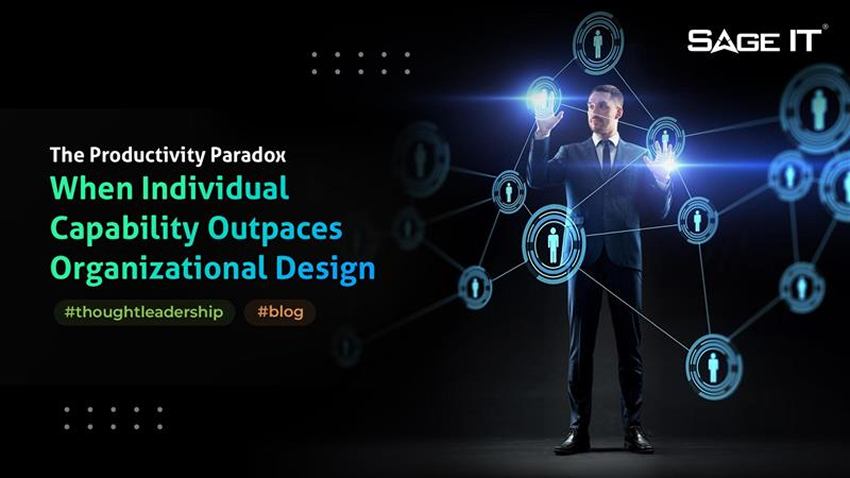
This is the productivity paradox of generative AI: it empowers individuals quickly, while exposing how unprepared many organizations are to absorb that new capability coherently.
This is not a failure of the technology. It is a failure to redesign the way work gets done.
That idea was anticipated in Human + Machine, which argued that technology alone does not create advantage. Advantage comes from rethinking work in the “missing middle,” where humans and machines complement each other by design. Without that redesign, even powerful tools can create fragmentation instead of leverage.
In 2026, this is no longer a future concern. It is a leadership issue now. To understand why, leaders first need to understand why GenAI has spread so quickly across the workforce.
Why GenAI Is Spreading So Quickly
GenAI is different from most enterprise technologies because it lowers the barrier to capability.
First, language becomes the interface. Employees do not need to write code, build models, or master complex systems to get useful results. They can ask, refine, compare, and iterate in plain language.
Second, competence arrives faster. GenAI helps people structure analysis, draft communications, and navigate unfamiliar tasks at a level that would previously have taken much longer to develop.
Third, it reduces friction. It helps people start faster, move faster, and produce more in less time.
At the individual level, this feels like a breakthrough.
At the organizational level, it creates a harder management challenge.
Where the Problem Starts
The issue is not that GenAI underperforms. It is that it performs well enough, quickly enough, and broadly enough to outpace institutional adaptation.
When everyone can produce more, the system fills with more emails, more reports, more summaries, more presentations, and more recommendations. But more output does not automatically create better decisions.
In fact, it often creates the opposite.
Managers spend more time reviewing and validating. Teams spend more time reconciling competing versions of the same story. Work looks polished before it is fully sound. Fluency improves faster than judgment.
That is where the paradox begins.
The organization appears faster, while coherence starts to weaken.
Why Organizations Are Struggling
It is easy to frame this as an employee problem: people are using AI too casually, trusting it too quickly, or relying on tools they do not fully understand.
That is the wrong diagnosis.
The deeper problem is organizational.
Most management systems were built on assumptions that no longer hold. They assume effort is visible, output reflects progress, and more documentation signals more value. GenAI breaks all three.
Effort becomes less visible. Output becomes easier to generate. And the presence of more material says very little about whether the thinking behind it is stronger.
That leaves many managers in an uncomfortable position. Some respond with excessive control. Others disengage and accept polished work at face value. Neither response is sustainable.
The bigger issue is that, in most companies, workflows have not been redesigned. GenAI is being layered onto existing processes without enough clarity about where human judgment matters most, what good quality looks like, or how accountability should work in AI-assisted tasks.
This is where the real risk sits. And the window to get this right is narrower than it looks. The next wave of AI capability, autonomous agents and multi-step decision systems, is arriving before most organizations have stabilized the current one.
The Hidden Cost: Quality Debt
One of the least discussed consequences of GenAI adoption is quality debt.
Quality debt builds when organizations increase output faster than they improve validation, standards, and judgment. It accumulates quietly through weak reasoning, unverified analysis, inconsistent practices, and growing reliance on machine-generated fluency.
At first, this can be hard to see. Everything looks faster. Teams appear more productive. The volume of work increases.
But over time, the hidden cost shows up:
Eventually, what looked like acceleration starts to feel like drag.
That is the moment when leaders realize the problem is not adoption. It is design.
What Leaders Need to Understand
The organizations that will benefit most from GenAI will not be the ones that simply roll out the most tools. They will be the ones that redesign work most effectively around them.
That means shifting the conversation from tool usage to operating model.
It means being explicit about where AI should assist, where human judgment must remain central, and how work should be reviewed when AI is involved.
It means managing outcomes, not just outputs. Output is what AI helps produce – the report, the summary, the recommendation. Outcome is whether it led to a better decision, a clearer direction, a stronger result. Most organizations are measuring the first and calling it progress.
And it means treating governance as an enabler of responsible scale, not as a delayed reaction to risk.
This is where leadership matters most.
Employees do not just need access to AI. They need clarity. They need to know where it is encouraged, where it is constrained, and what responsible use looks like in practice.
Permission matters. Boundaries matter too.
Without permission, people hide usage.
Without boundaries, usage fragments.
Without redesign, productivity gains do not convert into institutional advantage.
What Stronger Organizations Do Differently
The organizations making real progress are doing a few things well.
They define practical AI use cases by role and workflow, rather than relying on generic training.
They train managers to evaluate reasoning, decision quality, and business relevance not just speed or polish.
They make human judgment visible by asking teams to be clear about what AI contributed, what assumptions remain, and what decisions were made by people.
And they use mistakes to improve the system, not just to police behavior. When AI-assisted work misses the mark, the question they ask is not who relied on the tool, it is what the process lacked that allowed weak output to move forward unchallenged.
That is how GenAI becomes part of a stronger organization rather than a source of quiet instability.
The Leadership Agenda for 2026
For most companies, the next step is not another broad statement about AI ambition. It is a more practical reset.
Identify the workflows where GenAI is already being used informally. Map them clearly. Decide where AI adds value and where human review is essential. Set standards that people can actually follow. Train managers to assess AI-assisted work with confidence. Then refine from experience.
This is not about slowing adoption.
It is about turning individual productivity into organizational capability.
The Real Takeaway
Generative AI is helping everyday people in powerful ways. That is why adoption has moved so quickly.
But that same speed is exposing weaknesses in how many organizations manage work, judgment, and accountability.
The productivity paradox is not ultimately about AI. It is about whether institutions can evolve as quickly as individual capability now can.
The companies that get this right will not be the ones that simply move faster. They will be the ones that become more coherent as they scale AI.
GenAI can amplify human capability almost overnight.
Organizational capability still has to be built.
Attribution
Primary Source
Daugherty, Paul R., and H. James Wilson.
Human + Machine: Reimagining Work in the Age of AI
Harvard Business Review Press, 2018.
Attribution Note
This article is inspired by the concepts introduced in Human + Machine: Reimagining Work in the Age of AI by Paul R. Daugherty and H. James Wilson. The perspectives presented here extend those foundational ideas with original analysis, current enterprise practices, and recent (2024–2025) developments in artificial intelligence, operating models, and workforce transformation.