

The Shift: From Connectivity to Autonomy
As the Vice President of Integration and AI Solutions, I believe 2025 was the year we redefined the role of integration. It was the moment we moved beyond connectivity and entered the era of autonomy.
Last year was about Generative AI as an assistant, a tool for content and summarization. This year, AI evolved into an Agent, a system that can plan, reason, and act across our ecosystem.
Any CXO AI toolkit for integration should start with this principle: an AI agent is only as good as the systems it is integrated with. Gartner’s 2025 survey found only 15% of leaders are considering autonomous agents, making the integration backbone decisive for 2026. Our AI integration Solution is no longer just a data pipeline; it is the operating system that gives Agentic AI its eyes (data access), hands (API action), and memory (context).
Agentic AI: The Integration Challenge and Opportunity
The autonomous AI Agent understands a goal, breaks it into steps, chooses actions, executes them, and learns from outcomes. The challenge is clear: Gartner found only 15% of leaders are considering agents, with governance and sprawl slowing scale.
The Integration Imperative: The biggest bottleneck for Agentic AI is not the LLM’s intelligence, but access to critical systems (ERP, CRM, Supply Chain) without disrupting workflows. Gartner warns many agentic projects will stall without risk controls. As the analogy goes: an AI agent is a brilliant mind, but without governed APIs and data streams, it’s locked in a basement.
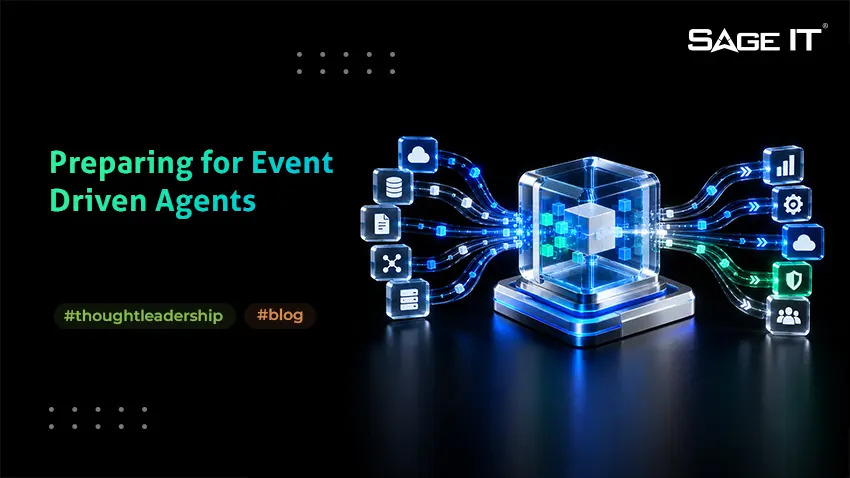
The “Tool Use” Foundation: Our focus on API Governance and Event-Driven Architecture (EDA) was critical this year. EDA provides event streams agents need to perceive change (e.g., “Order Status: Delayed”), and governed APIs are the auditable tools the agent uses to act. MCP is emerging to standardize these connections across tools and systems consistently.)
AI Adoption in iPaaS: The New Architectural Standard
The Integration Platform as a Service (iPaaS) market, $15.63 billion in 2025, is shifting from a data-mover to an AI enabler. In 2026, BOAT platforms accelerate this shift. This evolution has four key elements:
| iPaaS Feature | Impact on AI Agent Capabilities | Fact/Insight |
|---|---|---|
| Model Context Protocol (MCP) | Standardizes how agents securely query and augment data from external systems (e.g., pulling live stock from ERP). | Solutions are adopting MCP to create a model-agnostic, consistent interface for agents. |
| AI-Driven Mapping & Design | Automates the most tedious part of integration—data field mapping and initial workflow design | Vendors like Boomi and Workato are leveraging millions of prior integration patterns to provide intelligent recommendations, accelerating deployment. |
| Hyperautomation | Merges Agentic AI with traditional BPM/RPA for end-to-end process orchestration. | iPaaS is becoming the control plane for Adaptive Process Orchestration, where human oversight, deterministic workflows, and AI agents collaborate. |
| Low-Code/No-Code Empowerment | Democratizes integration, allowing business users to define agent workflows without relying solely on specialized developers. | This supports the scaling phase, where 71% of all customer engagements now occur in digital format, demanding agile front-line system connectivity. |
Distinct Views on Agentic Adoption
The path to autonomy looks different depending on the stakeholder:
The Looming Challenge: Trust and Governance
As we close the year, our focus shifts squarely to governance. We must embrace the power of autonomy while managing the risk of Shadow AI and unmonitored actions.
AI Governance and Integration Governance are inseparable. Our strategy for 2026 focuses on three core pillars:
Conclusion: Looking Ahead to 2026
2025 was about proving that Agentic AI works in real business. 2026 will be the year of scaling it across the enterprise. Gartner predicts over 40% of AI agent projects will be canceled by 2027, so integration backbone we build today matters.
Is your organization’s integration architecture ready to securely empower a workforce of autonomous AI agents? Let’s discuss the foundational modernization needed to capture this next wave of productivity.