

In “Navigating the Data and Information Maze,” we mapped the strategic terrain—identifying operational friction, envisioning Zero UI interfaces, and recognizing the value latent in epistemic boundaries. The four phases outlined there provide the why and the what; what follows is the how. This piece examines the architectural foundations required to transform those strategic ambitions into operational reality.
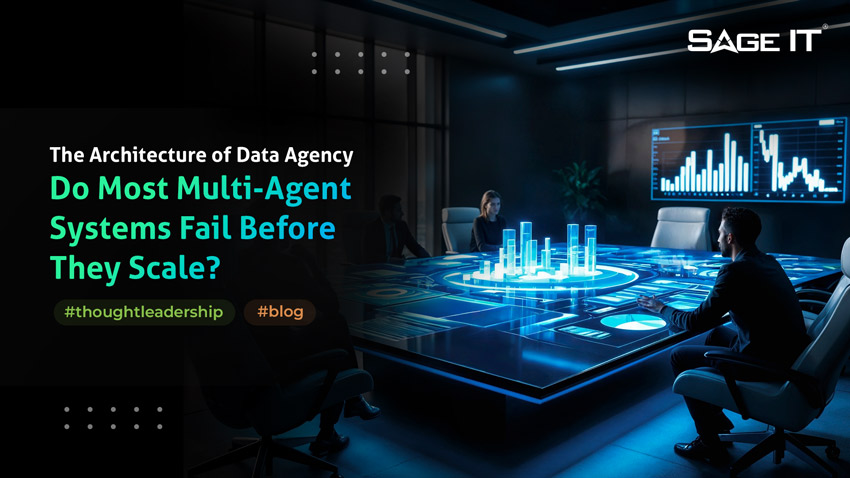
Agentic AI promises to transform enterprise data operations, yet most implementations collapse under the weight of architectural decisions made in week one. The failure isn’t algorithmic—it’s structural: how agents remember, disagree, and recover determines whether they become strategic assets or operational liabilities. This piece examines the architectural foundations that separate pilot success from production resilience.
Why now? Enterprise data teams have spent years building lakehouses and unifying catalogs. The infrastructure is finally sufficient—but the interface layer remains broken. Analysts still context-switch across multiple tools to answer questions that should require zero. Multi-agent systems offer an escape from this interface fragmentation, but only if architected for the friction points that actually exist.
Agency (Who/How Smart?) Orchestration (How they connect) State Management (What they remember together) Failure Modes (What happens when memory conflicts) Integration Surface (How the result changes the world)
A Taxonomy of Agency
To build true enterprise resilience, we must first understand what different levels of “intelligence” actually look like in practice. This requires a disciplined understanding captured by the Taxonomy of Agency. Not all agencies are equal. Map capability to operational requirement or watch your “intelligent” system degrade into expensive automation.
| Agent Type | Function | State Demand | Human Elevation |
| Reactive | Event response—KPI breaches, schema drift, pipeline failures | Minimal; predefined contexts | Exception-only |
| Deliberative | Sequence planning—decomposing “explain Q3 margin compression” into lineage, correlation, counterfactuals | Sophisticated; multi-step context persistence | Strategic judgment |
| Hybrid | System 1/System 2 architecture at machine velocity | Bifurcated; fast cache + deep memory | Calibrated handoffs |
- In Practice: Reactive agents monitor with posture; deliberative agents perform analysis without fatigue.
- The Crucial Caveat: Zero UI does not mean zero human involvement. It means shifting human intervention to moments of strategic judgment, rather than getting lost in operational mechanics—a vital distinction often lost on teams optimizing solely for demo-day dazzle.
From What Intelligence is Needed To How They Connect
The taxonomy establishes the necessary intelligence level (the “what”), but complexity demands a blueprint for interaction. How do these varied agents—some reactive, some deep-thinking—coordinate their efforts without creating chaotic noise or dead. This leads us to the Orchestration Patterns, which are the established blueprints (Hub-and-Spoke, Mesh, Hierarchical) that dictate how this various agent types will communicate and delegate tasks across the enterprise landscape.
Orchestration Patterns
How agents coordinate determines what they achieve. The primary choice for coordination architecture is between three dominant patterns
- Hub-and-Spoke Centers authority in a coordinator that delegates to specialized peripherals—structured query, semantic search, anomaly detection.
- Excels where friction points are well-mapped (Phase 1).
- Risk: The hub becomes bottleneck and single point of failure.
- Mesh Networks: Enable peer-to-peer negotiation across diverse ontologies. Directly serves Phase 3: Epistemic Arbitrage—financial, clinical, and operational agents translating without central mediation.
- Risk: Coordination overhead scales quadratically; consensus adds latency.
- Hierarchical Command: Embeds human authority at tactical, operational, and strategic levels. Acknowledges that Phase 2‘s Zero UI aspiration has limits: regulatory reporting, capital allocation, clinical interventions retain human accountability.
- Virtue: explicit elevation pathways.
- Vice: friction reintroduced at handoffs.
Synthesis of Patterns:
From How They Talk To What They Remember
The coordination patterns define the immediate interaction—the handoff, the negotiation, the command chain. But coordinating multiple steps requires more than just a protocol; it demands continuity. If agents are constantly passing tasks and making inferences across departmental silos, the system’s most profound challenge becomes retaining the context of those agreements, discussions, and evolving hypotheses over time. This brings us to State Management.
The State Management Problem
The defining challenge of deliberative agency is coherence across extended workflows. An agent investigating supply chain root cause may traverse dozens of sources, each query refining hypotheses formed ten steps prior. Without state management, Phase 2 collapses into disconnected micro-interactions.
| State Type | Function | Implementation | Architectural Tension |
| Short-term | Working memory: current hypothesis, active sources, pending sub-queries | In-memory structures, fast key-value | Volatility vs. speed |
| Long-term | Organizational memory: fruitful hypotheses, correlating sources, dead ends | Persistent graph stores, embedding indexes | Accumulation vs. relevance decay |
| Shared | Multi-agent collaboration: common references for Phase 3 translation | Distributed consensus protocols, semantic bridges | Consistency vs. availability |
The Core Misalignment: Most teams over-engineer long-term state and under-invest in shared state. The result: brilliant individual agents that cannot negotiate across departmental boundaries—exactly where enterprise value lives. State persistence creates attack surfaces (adversarial manipulation of agent memory) and consistency challenges (distributed synchronization). Determine: which state is essential, which ephemeral, which cryptographically verifiable.
From Remembering The Past to Handling Conflict In The Present
State management solves the problem of linear decay—the loss of context over time. But what happens when the shared memory becomes too rich? What happens when disparate, high-confidence agents, operating with perfect historical recall, arrive at fundamentally contradictory conclusions about a single event? State ensures coherence, but it does not guarantee agreement. The next architectural layer must govern how the system processes productive conflict. This is the domain of Failure Modes.
Failure Modes: When Agents Disagree
Phase 4 treats agent disagreement as signal, not error. Architecturally, this requires:
Prompt injection at scale, through agentic workflows, is not a future risk. It is a present-tense attack vector and there is still no mainstream detection tooling built against it.
From Recovering Internally To Acting Externally
We have established how agents should communicate (Orchestration), how they must remember everything that happened (State Management), and what to do when their memories clash (Failure Modes). However, an internally robust system remains theoretical if it cannot interact with the physical world. The ultimate test of agency is not its internal consistency, but its ability to act within operational constraints. This necessity brings us to Integration Surfaces.
Integration Surface: The Last Mile Problem
The most elegant multi-agent system fails if outputs cannot act upon operational systems.
| Mechanism | Purpose | Phase Enablement |
| API Orchestration | Composability: anomaly output → optimization input without human translation | Phase 2 seamless negotiation |
| Event Streaming | Real-time responsiveness: Kafka/Pulsar subscription vs. database polling | Phase 1 continuous monitoring; Phase 2 millisecond insight |
| Human Elevation | Structured options at confidence thresholds, ethical boundaries, undefined contexts | All phases; ultimate accountability |
The Transformation of Interfaces: Zero UI doesn’t eliminate interfaces—it transforms them. Human elevation must present synthesized alternatives with risk-weighted recommendations, not raw data dumps. Minimize cognitive load; preserve meaningful choice.
System Map: Architectural Interdependencies
These five architectural pillars:
Taxonomy →Orchestration →State →Failure Modes →Integration Surface
are not sequential stages but concurrent concerns.
They map together to form the resilience required for modern data operations:
“Agent Taxonomy”→”Orchestration Pattern”→”State Requirements”→”Failure Mode Handling”→”Integration Surface”
Interconnected consequences:
Best AI Workflow Architecture: Multi-Step Agents, Templates, Logging, and Content Automation
The best AI workflow architecture for multi-step agents, templates, logging, and content automation is a controlled hub-and-spoke model. A coordinator agent manages the workflow, while specialist agents handle research, outline creation, drafting, editing, SEO review, compliance checks, and publishing preparation.
This structure works because content automation needs more than one prompt chain. Each step must have a clear owner, a defined input, an approved template, a quality check, and a logged output.
A practical architecture should include:
From Architecture to Operation
These foundations – taxonomy, orchestration, state, failure recovery, integration – translate the four-phase framework into implementable systems. They are not sequential stages but concurrent concerns.
Phase 1 friction mapping informs agent specialization. Phase 2 Zero UI drives state and integration design. Phase 3 epistemic arbitrage requires mesh orchestration and shared ontologies. Phase 4 antifragility emerges from adversarial validation and graceful degradation.
The enterprise that builds deliberative agents without failure recovery, or mesh networks without shared state, or Zero UI without elevation pathways, will discover strategic ambition outpacing operational capability.
The architecture of agency is ultimately the architecture of organizational adaptation – systems that improve through operation, negotiate across boundaries, and transform data functions from cost center to strategic engine.
What this doesn’t mean: That architecture alone guarantees success. Organizational readiness, data quality, and change management remain critical. But poor architecture guarantees failure regardless of other investments.
What happens next: The teams that master state management and failure recovery will operate at decision velocities their competitors cannot match. The question is no longer whether to adopt multi-agent systems, but whether your architecture can survive the adoption.