

5–10 min
analyst time per renewal,
down from 30–60
Days → min
audit prep, the trail
is built as you go
2 clicks
to any renewal's full
evidence trail
The problem
Your best analysts are doing data entry
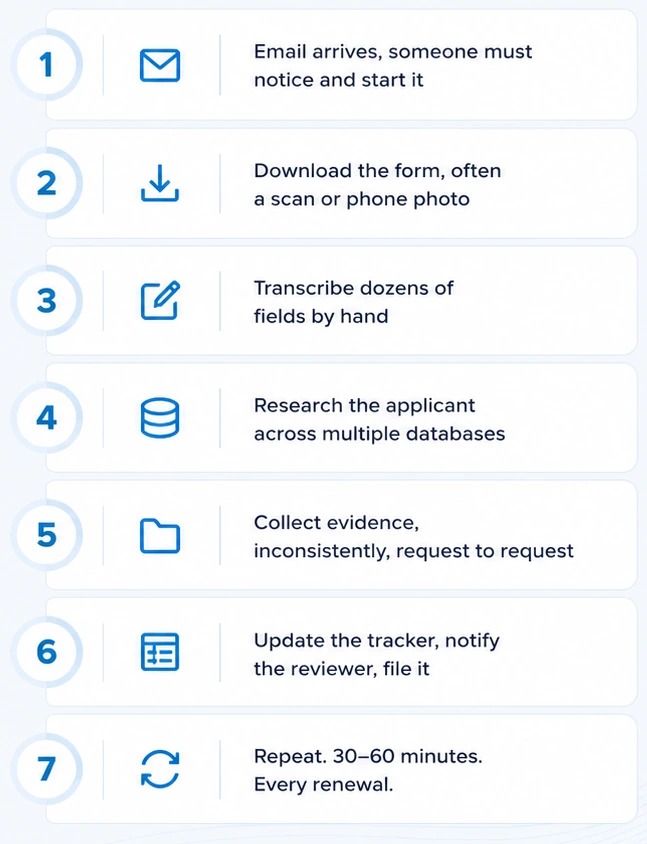
Every renewal follows the same grind, and it only ends when someone burns 30–60 minutes on it by hand.
It’s 4 p.m. A renewal email lands in the shared inbox. Someone has to notice it, open a blurry phone photo of the form, and retype dozens of fields. Then run the checks by hand, address, exclusion lists, licensing status, screenshot whatever they find, update the spreadsheet, and ping a reviewer.
Forty-five minutes later, one renewal is done. There are forty more in the queue. And if an auditor calls next week, the evidence is scattered across inboxes and drives.
How EzEmbark works
Four enforced phases. Nothing files unverified.
Intelligent agents do the processing; a named human makes the call. One request ID, first email to final decision.
Interpret
Reads the email and form,
even rough scans, and
extracts every field.
Verify
Validates the applicant,
captures screenshot
evidence, returns a
risk score.
Review
Routes to a named
reviewer who must
approve before anything
files.
File
Logs the decision with
a full audit trail, in one
dashboard.
Capabilities
Everything the manual workflow did, done consistently
Email intake automation
Monitors the inbox continuously, extracts intake data, and opens a tracked record. No email missed, no manual triage.
AI form extraction
Reads every field of clean PDFs, rough scans, and phone photos, registrant data, addresses, schedules, personnel, operations.
Automated verification
Address validation, exclusion-list and licensing checks, evidence capture, then a LOW/MEDIUM/HIGH risk score and a recommendation.
Address validation
Validated against authoritative maps. Residential, unverifiable, or mismatched addresses flagged before they reach an analyst.
Duplicate detection
Semantic search links related and duplicate requests across name and address variations. Redundant processing eliminated.
Unified dashboard
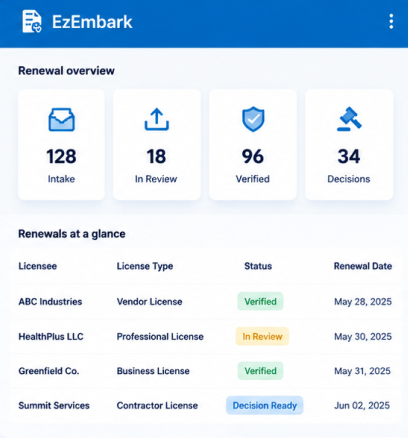
Every request tracked at every stage. Full history, email, data, findings, evidence, decision, in two clicks for any audit.
The outcomes
What changes the week you turn it on
5–10min
analyst review per renewal,
from 30–60 min of
manual work
2clicks
to any renewal’s full
audit documentation
Days→min
audit preparation, fully
documented by design
0
extra headcount needed
when volume grows
Proof, case study
What changes the week you turn it on
EzEmbark wasn’t validated on a low-stakes form. It runs in production on DEA controlled-substance license renewals, where a single bad filing is a federal violation, not a clerical slip. If it holds there, it holds for your renewals too.
Bureau-scale renewals,
under a hard federal deadline
Controlled-substance distributors and renewal service bureaus process hundreds of registrant renewals per quarter against the 21 CFR 1301 deadline window. That work used to live across inboxes, fax lines, and shared drives, slow, inconsistent, and hard to defend on demand.
EzEmbark replaced it with the four-phase workflow: parse every packet, verify every registrant with screenshot evidence and a risk score, route to a named reviewer, and file only after a documented sign-off, every field pulled automatically:
DEA is the proof case, not the limit. The same Interpret → Verify → Review → File engine applies to any high-volume, deadline-bound license or registration renewal across BFSI, healthcare, and government. Time and cost figures are baselined per deployment, never a generic industry estimate.
Who buys EzEmbark
Built for the people accountable for the filing
Chief Compliance Officer /
VP Regulatory Affairs
Regulatory risk, audit readiness, defensibility.
- Consistent verification across every renewal
- A complete audit trail for every decision
- Pipeline visibility without status meetings
Compliance / Regulatory
Affairs Manager
Productivity, consistency, deadlines, evidence quality.
- One standardized workflow on every request
- Real-time pipeline view, backlog gone
- Documentation that survives an audit
Compliance Analyst /
Coordinator
Clearing the queue with the right info to decide.
- Requests arrive pre-processed, findings organized
- The day is review, not transcription
- Risk-scored recommendations to prioritize
Security & deployment
Defensible by construction,
deployed your way

Security & governance
Complete audit trail stored for every processing event.
Managed-identity auth and role-based access control on all services.
Credential management through a dedicated key vault.
Data encrypted in transit, with a static outbound IP for firewall allowlisting.
Deployment models
Run it fully managed on Azure with auto-scaling, or deploy all seven services on your own infrastructure via Docker, no cloud dependency, for high-security environments. Bring your own LLM.
Capacity scales with volume. When renewals grow, EzEmbark absorbs them, your constraint shifts from processing throughput to decision throughput, the work that actually needs a human.
Questions, answered
What teams ask before they buy
What is license renewal automation?
Intelligent agents handle every step of a recurring license or registration renewal, reading the inbound form, extracting the fields, verifying the applicant against authoritative sources, and recording the evidence, so your team reviews and decides instead of doing data entry.
Is EzEmbark only for DEA licenses?
No. DEA Form 224/224A is the proven production case, but the same engine handles any high-volume, deadline-bound license or registration renewal across BFSI, healthcare, and government.
How much time does it actually save?
Renewals that took 30–60 minutes of manual work become 5–10 minutes of analyst review. Audit preparation drops from days to minutes because the trail is built as the renewal is processed.
Can it read poor-quality forms?
Yes. It extracts fields from clean PDFs, rough scans, and phone photographs. Field staff don't re-scan or resubmit.
How is it deployed and secured?
Cloud-native on Azure or fully on-premises and air-gapped via Docker. Security includes managed-identity authentication, role-based access control, key-vault credential management, encryption in transit, and a complete audit trail for every event.