

Do not let your factory
floor flatline.
Detect failures weeks before they happen, tell your team exactly what to fix and what it costs to wait – then closes the loop with an automated work order. Learn more about SEER 5.0.
<30 sec

From anomaly to work order fired
50%

Unplanned downtime reduction
30%

Maintenance cost saved per site
20+

Industries and asset classes deployed
The Problem
Most “predictive” tools are just smarter dashboards.
Asset-intensive operations are drowning in sensor data, but the signal still isn’t translating into action. The gap between anomaly and resolution costs American industry $50B+ annually in unplanned downtime. The culprit isn’t a lack of data. It’s a lack of intelligence that spans the full service lifecycle.
 01
01
Blind Spots
Siloed Sensor Data
IoT platforms read one signal at a time. They miss the failure pattern that only emerges when vibration, temperature, energy draw, and weather collide in the same moment.
 02
02
Reactive Mode
Alerts Without Action
A yellow flag on a dashboard doesn’t dispatch a technician, check parts inventory, or generate a work order. Your team still has to connect all the dots manually, under pressure.
 03
03
Lost Knowledge
Institutional Memory Walks Out
When a senior technician retires, decades of fault pattern recognition leave with them. There’s no system capturing what they knew until the next failure proves you needed it.
 04
04
Bad Timing
Calendar-Based PM Is Wasteful
Scheduled maintenance ignores actual equipment condition. You’re replacing parts that have life left, and missing the ones already running on borrowed time.
 05
05
Wrong Diagnosis
Root Cause Stays a Mystery
Knowing a motor is drawing high current tells you something is wrong. It doesn’t tell you whether to clean the filter, check the belt, or call the OEM. First-time fix rates suffer accordingly.
 06
06
Disconnected Stack
Systems That Don’t Talk
Your BMS, CMMS, ERP, and FSM platforms all hold a piece of the picture. None of them were designed to share it. Coordinating across them in real time requires a human middle layer, and that doesn’t scale.
The Platform
Six stages. One continuous loop. Every fix makes the next one smarter.
SEER 5.0 is not a monitoring layer bolted onto your existing stack. It is a full-stack service lifecycle engine purpose-built to take an asset from first anomaly signal all the way through root-cause diagnosis, autonomous dispatch, guided repair, and closed-loop learning.
The platform runs continuously. Every resolution feeds back into the models. Every misdiagnosis triggers a retraining cycle. Over time, SEER 5.0 accumulates the institutional knowledge that no technician retirement can erase.
Designed for live deployment across enterprise portfolios, not proof-of-concept sandboxes.
Sense - Ingest Everything
Connect any data source - IoT, BMS/BAS, weather APIs, energy feeds, ERP, CMMS, CRM. Normalized into a unified, time-indexed data fabric. No rip-and-replace.
Predict - See What's Coming
ML models run continuous inference - anomaly detection, failure forecasting, remaining useful life estimation, equipment health scoring. Edge or cloud, with automatic drift-triggered retraining.
Diagnose - Know Why, Not Just What
Domain-specific AI generates ranked root-cause hypotheses with probability scores and evidence citations from your OEM documentation, repair logs, and SOPs.
Act - Orchestrate Autonomously
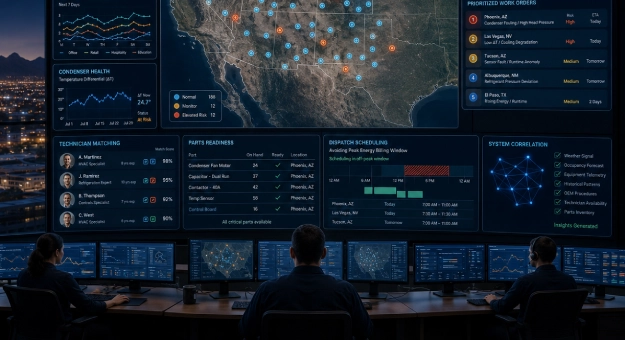
Agentic AI generates work orders, checks parts inventory, matches technicians by skill and proximity, and dispatches - with human-in-the-loop approval at every high-consequence step.
Guide - Empower the Technician
AR-assisted repair instructions, a conversational AI copilot, step-by-step procedures, and a living knowledge base - all on mobile or smart glasses at the job site.
Learn - Close the Loop
Every resolution feeds back into the models. Novel fixes become new SOPs. Misdiagnoses retrain the AI. Institutional knowledge that no retirement can erase.
Beyond Telemetry
Sensors tell you what.
SEER 5.0 tells you why, when, and what to do about it.
Most platforms stop at anomaly detection. SEER 5.0 correlates every signal that affects your operations, temperature, demand, schedules, geography, and service history, and turns cross-domain patterns into autonomous action.

Environmental
Weather feeds, ambient temperature, humidity, air quality indices, correlated in real time with asset performance to predict load-driven failures before they occur.

Energy & Demand
Utility rate structures, peak demand windows, grid load signals, enabling preemptive load-shifting and preventing costly demand-charge penalties during high-stress periods.

Service History
Work orders, repair logs, warranty status, fault codes, building institutional memory that makes every future diagnosis smarter than the last.

Events & Schedules
Production calendars, occupancy forecasts, local events, seasonal patterns, anticipating demand surges before they stress critical assets.
IoT & Telemetry
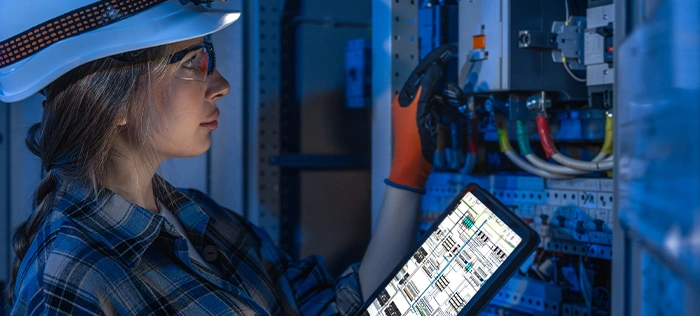
Vibration, pressure, flow rates, temperature differentials, current draw, the raw sensor foundation, enriched by every other signal layer for full-context analysis.

Parts & Inventory
Real-time stock levels, supplier lead times, cross-asset part compatibility, so the right part is staged before the technician arrives on site.
Environmental
Weather feeds, ambient temperature, humidity, air quality indices, correlated in real time with asset performance to predict load-driven failures before they occur.
Energy & Demand
Utility rate structures, peak demand windows, grid load signals, enabling preemptive load-shifting and preventing costly demand-charge penalties during high-stress periods.
Service History
Work orders, repair logs, warranty status, fault codes, building institutional memory that makes every future diagnosis smarter than the last.
Events & Schedules
Production calendars, occupancy forecasts, local events, seasonal patterns, anticipating demand surges before they stress critical assets.
IoT & Telemetry
Vibration, pressure, flow rates, temperature differentials, current draw, the raw sensor foundation, enriched by every other signal layer for full-context analysis.
Parts & Inventory
Real-time stock levels, supplier lead times, cross-asset part compatibility, so the right part is staged before the technician arrives on site.
How It Works in Practice








Measurable Outcomes
Numbers that show up on the P&L
Every SEER 5.0 engagement is tied to a maintenance window, a production hour, or a safety record. If it can’t be measured, it isn’t done.
Industries
One platform. Every asset-intensive operation.
SEER 5.0 is domain-aware, not domain-locked. The intelligence engine adapts across verticals — from HVAC-GPT to MFG-SLM and beyond — while the service lifecycle remains universal.
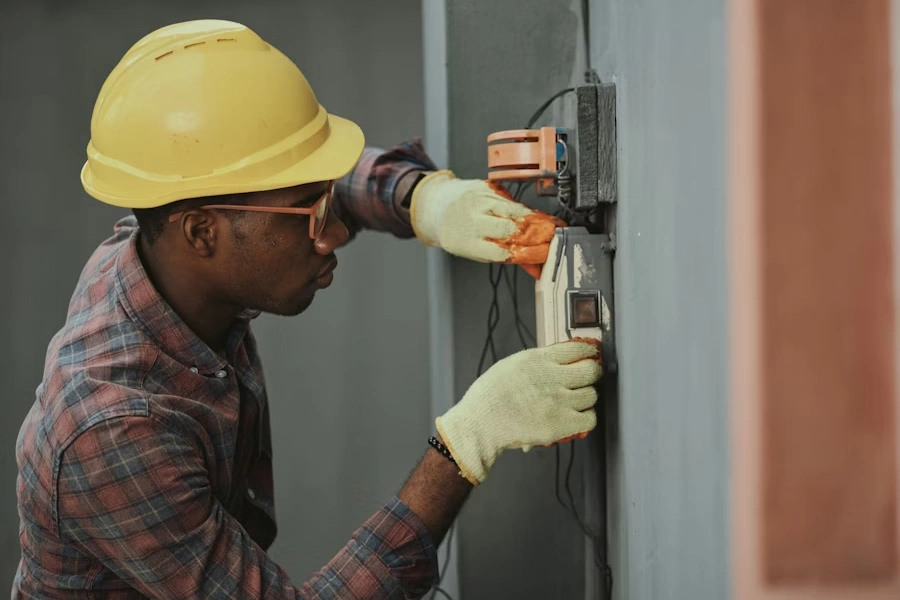
Weather-Correlated Asset Predictions
Rooftop units, chillers, and air handlers across commercial portfolios. Weather-correlated predictions support energy-optimized dispatch windows.
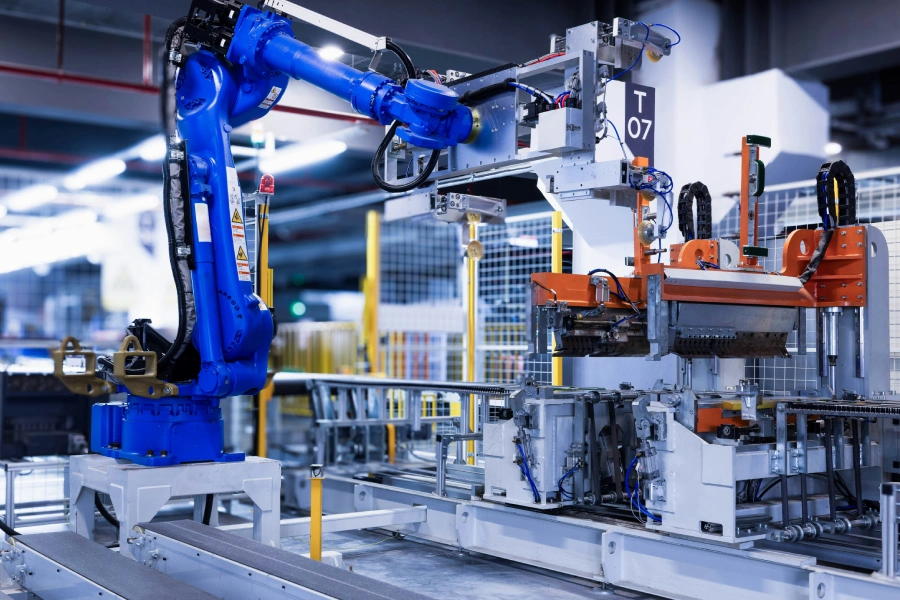
Zero-Surprise Downtime for Production Assets
CNC machines, assembly lines, and robotic cells. Vibration analysis meets production scheduling for zero-surprise downtime and maximum OEE.

Grid-Aware Load Forecasting
Transformers, substations, and distributed generation assets. Grid-aware load forecasting with demand-charge avoidance built into every dispatch.

Route-Optimized Maintenance
Vehicle fleets, EV charging infrastructure, and logistics hubs. Route-optimized maintenance with parts pre-staging before the driver returns.
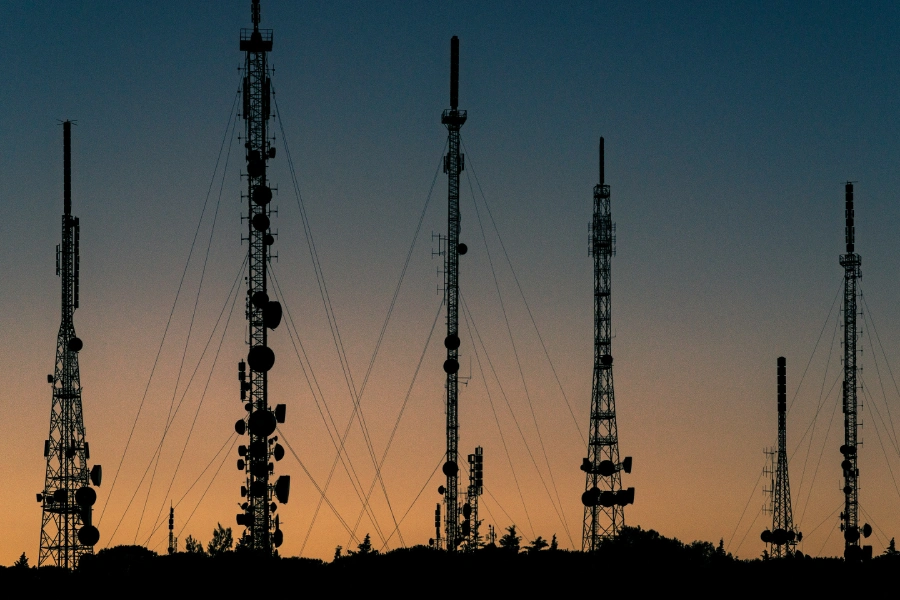
Protect Uptime-Critical Infrastructure
Cooling towers, UPS systems, diesel gen-sets, and network infrastructure. Uptime is the product, SEER 5.0 is built to protect it.

Audit-Ready Asset Management
GMP-compliant asset management for production and lab equipment. Audit-ready maintenance records, automated and always current.

Status
Not a prototype. Not a POC. Ready to go.
SEER 5.0 ships with pre-trained domain packs for 10+ asset classes across 6 industries, covering 243 signals out of the box. There’s no months-long model training phase. No data lake migration. No rip-and-replace of your OT stack. Connect your existing sensors, configure your CMMS integration, and SEER 5.0 is live, typically within 90 days. The first anomaly it catches pays for the deployment.
Ready to Close the Loop?
Start with one site. Prove it in weeks.
SEER 5.0 ships with pre-trained domain packs for 10+ asset classes across 6 industries, covering 243 signals out of the box. There’s no months-long model training phase. No data lake migration. No rip-and-replace of your OT stack. Connect your existing sensors, configure your CMMS integration, and SEER 5.0 is live, typically within 90 days. The first anomaly it catches pays for the deployment.