

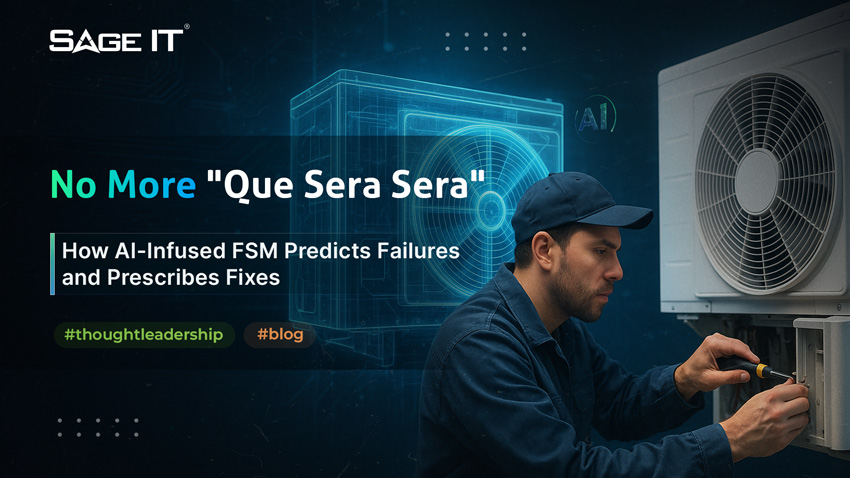
Ah, the classic summer nightmare: your AC sputters, rattles, and then… silence.
We’ve all been there, haven’t we? Frantically calling support, battling automated phone trees, and realizing every technician in a 100-mile radius is booked solid. You wish you had a crystal ball, one that spots a brewing problem and says, “Hey, your HVAC is about to lose its cool. Maybe get that looked at before the mercury hits triple digits.”
Good news: that crystal ball is no longer wishful thinking.
We’re entering a new era in service lifecycle management (SLCM), one in which the days of “Que Sera Sera” are giving way to AI-powered foresight. Failures are now predicted, and fixes prescribed long before you even sense a problem.
From Maytag Men to Mind-Reading Machines: The Evolution of Service
Remember the Maytag Man? If you do, you’re of a certain age. He was the poster child for appliance reliability, often portrayed as bored because things rarely broke.
That era represented the ideal: machines that just worked. But the reality? For decades, SLCM was a reactive game. Something broke, you called, a technician eventually showed up, and life resumed.
Then came scheduled maintenance, a preventive but still imperfect step. You changed your oil every 5,000 miles, inspected your furnace annually. It was a better plan but still generalized, more like throwing darts in the dark.
The early 2000s gave rise to condition-based maintenance (CBM). Sensors began appearing in industrial equipment, vehicles, and home appliances. These early systems offered warnings by detecting excessive vibrations or off-kilter temperatures. However, the data was siloed, and interpreting it was often a guessing game.
The Digital Revolution in SLCM: From Data Drips to Predictive Powerhouses
A Convergence of Breakthroughs
Over the last decade, we’ve seen a remarkable convergence of technological advancements that have redefined the entire SLCM landscape. Here’s what’s driving this seismic shift:
IoT: From Isolation to Interconnection
The Internet of Things (IoT) started with simple connections, such as your phone communicating with your garage door. It quickly matured into the Industrial Internet of Things (IIoT), where machines began communicating with other machines, systems, and humans alike.
Tiny, ubiquitous sensors now serve as the eyes and ears of industrial and consumer assets, relaying data on temperature, vibration, energy usage, and performance in real time. Equipment is no longer a silent workhorse; it is a data-streaming asset that is always broadcasting its status.
Industry 4.0: The Rise of the Smart Factory
With IoT came Industry 4.0, a bold reimagining of manufacturing and service operations. Robotics, automation, and seamless data exchange soon became standard.
Picture a robotic arm on an assembly line detecting a micro-vibration. Instead of pushing through to failure, it flags the anomaly and triggers a preventive protocol. This is the smart factory in action, constantly adapting and self-optimizing.
AI-Infused Predictive Maintenance: The Crystal Ball, Upgraded
The avalanche of sensor data from IoT and Industry 4.0 set the stage for the real game-changer: AI-infused predictive maintenance.
We are no longer simply monitoring machines; we are interpreting them. AI models digest historical patterns, real-time signals, and even environmental variables to predict failures before they happen.
Imagine your HVAC unit. It’s showing a slight uptick in energy consumption, paired with a subtle change in fan speed. Individually, these signals might seem benign. But AI spots the pattern. It identifies a potential capacitor failure, autonomously orders the part, schedules the technician, and notifies you, all before you notice anything is wrong.
Side-by-Side Comparison: Traditional vs AI-Driven Maintenance
| Traditional Maintenance | AI-Infused Predictive Maintenance |
| Reactive – fix after failure | Proactive – prevent failure |
| Scheduled by time/usage | Dynamic, based on real-time data |
| General issue diagnosis | Pinpoint issue & part required |
| Labor-intensive & manual | Automated, intelligent workflows |
Beyond the Breakdown: The Future of SLCM is Proactive, Prescriptive, and Personalized
This isn’t just about avoiding breakdowns. It’s about elevating the entire service experience, and here’s what’s ahead.
Digital Twins: The Asset’s Living Replica
Enter digital twins, which are virtual representations of physical assets continuously updated through real-time sensor data. This isn’t a static 3D model; it’s a living simulation that can test failure scenarios, model maintenance strategies, and predict environmental impact.
Imagine a technician in the field accessing a digital twin via tablet. Without touching the machine, they understand its history, performance, and current condition, which enables faster and more accurate resolutions.
AR/VR: Superpowers for Service Technicians
Augmented Reality (AR) and Virtual Reality (VR) are transforming field service.
Picture this: a technician wearing AR glasses sees step-by-step repair instructions, overlaid in real time onto the faulty equipment. No flipping through manuals. No second guessing. VR complements this by enabling immersive training environments, allowing new technicians to practice repairs in a risk-free setting.
Edge Computing: Real-Time Intelligence at the Source
With thousands of connected machines generating data by the second, cloud dependency can become a bottleneck. Edge computing solves this by enabling processing directly on the device or local network.
This results in lightning-fast decision-making, which is especially critical for systems where milliseconds matter, such as turbine engines or surgical robots.
Mobile Apps and Self-Service: Putting Power in the User’s Hands
Say goodbye to endless service calls.
Modern service platforms are putting diagnostics, alerts, and even basic fixes in the customer’s smartphone. For example, your smart washing machine senses a load imbalance. Instead of halting, it pings your app with a 30-second video tutorial that says, “Here’s how to redistribute the load.”
For serious issues, the app can autonomously diagnose the fault, order the replacement part, and schedule a technician armed with full diagnostic history.
The Real-World Impact: Why This Matters
This transformation isn’t just cool tech; it delivers tangible benefits.
- Up to 50% reduction in unplanned downtime
- 20–30% lower maintenance costs
- Increased customer satisfaction and loyalty
- Greater sustainability through energy optimization and fewer part failures
- Faster first-time fix rates and reduced truck rolls
From Que Sera Sera to Total Control
The shift is clear: we’re no longer reacting to failures. We’re preventing them, learning from them, and increasingly designing them out of existence.
From the Maytag Man’s idle days to today’s AI-powered service environments, the journey has been transformative. And what’s next?
Self-Healing Systems: The Final Frontier?
Imagine a machine that predicts its own failure, diagnoses the fix, procures the part, and applies the solution without human intervention. A self-rejuvenating asset.
Far-fetched? Perhaps. But so was the idea of a tablet computer in the 1960s… until Star Trek showed us one.
So, here’s to the ultimate evolution of SLCM. It is not the end of service, but the birth of autonomous service ecosystems, where foresight replaces firefighting. Where uptime becomes default. And where “Que Sera Sera” becomes “We’ve already fixed it.”