

GxP compliance is not a strategic choice. In life sciences, you cannot manufacture, test, or release a regulated product without it. Every serious company in the field validates its systems as a baseline condition of being allowed to operate. The quality system is validated. The LIMS is validated. The manufacturing execution system is validated.
The question is never whether to validate. It is whether GxP validation reaches the integration layer that moves regulated data between those systems.
Most of the time, it does not. The applications at each end get validated because they are visibly regulated. The integration between them, a LIMS integration feeding the quality system or an MES integration passing batch data, gets built for connectivity and treated as infrastructure. In a GxP environment, that middleware is a regulated computerized system whether or not anyone has treated it as one, and the gap between how it is treated and what it actually is has a way of surfacing at the worst possible moment.
Validation Is Not the Question. Its Reach Is.
Here is the assumption that fails an inspection. The source system is validated. The target system is validated. So the data moving between them must be fine.
An FDA investigator does not share that assumption. When a record moves, the movement itself can change what it means. A mapping can truncate a value. A retry can duplicate a released record. A silent connector failure can drop a batch result that no one notices until a reconciliation step catches it, if a reconciliation step exists.
And data integrity in pharma is precisely where regulators concentrate. Industry analyses of FDA drug GMP warning letters over the past two decades find that data integrity deficiencies appear in roughly 60 to 80 percent of them, as a primary or contributing factor. The failures named are not exotic: shared logins, missing or disabled audit trails, records that cannot be traced, audit trails generated but never reviewed. Every one of those is a data-handling problem, and the integration layer is where data is handled in motion. The consequences are not paperwork. They run to consent decrees, import alerts, and product recalls.
What GxP Validation of an Integration Flow Requires
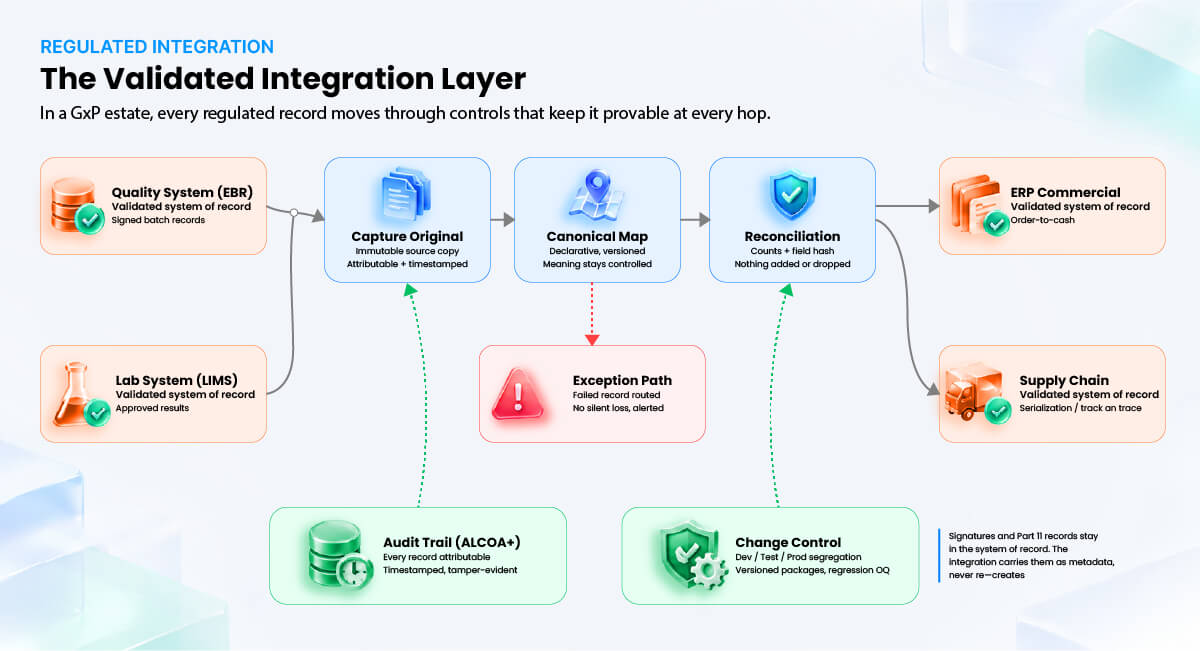
Treating the integration layer as a validated system is not abstract. It means specific controls sit on the path every regulated record travels, so that at any point you can prove what moved, that it moved intact, and who is accountable for it.
The shape is consistent. Records leave a validated system of record already signed or approved. The integration captures the original before it transforms anything, maps it through a controlled, versioned definition rather than ad hoc logic, and reconciles what arrived against what was sent. Failures route to an exception path instead of vanishing. Underneath it all, an audit trail keeps every record attributable, and change control keeps the whole thing stable as it evolves. Notice what the integration layer does not do: it never re-creates a signature. It carries the signed record; it does not become the signer.
GAMP 5 Risk-Based Scoping for Every Interface
GAMP 5, the industry framework for computerized system validation, exists to make that scoping disciplined rather than instinctive. Its principle is that validation effort scales to risk, and risk here means patient safety and data integrity impact, not a narrow reading of what a regulation happens to name.
So the first deliverable in a competent validation effort is not a test script. It is a documented risk and impact assessment that classifies every interface: does this flow create, modify, or only read a regulated record, and what is the consequence to patient safety or data integrity if it fails. A flow carrying a batch record or a patient-linked identity earns full qualification. A flow syncing marketing contacts does not. That single assessment, made early and deliberately, is the largest lever on both timeline and cost, and an auditor can tell whether you scoped to risk or simply rationed effort.
ALCOA+ Data Integrity Has to Be Designed In
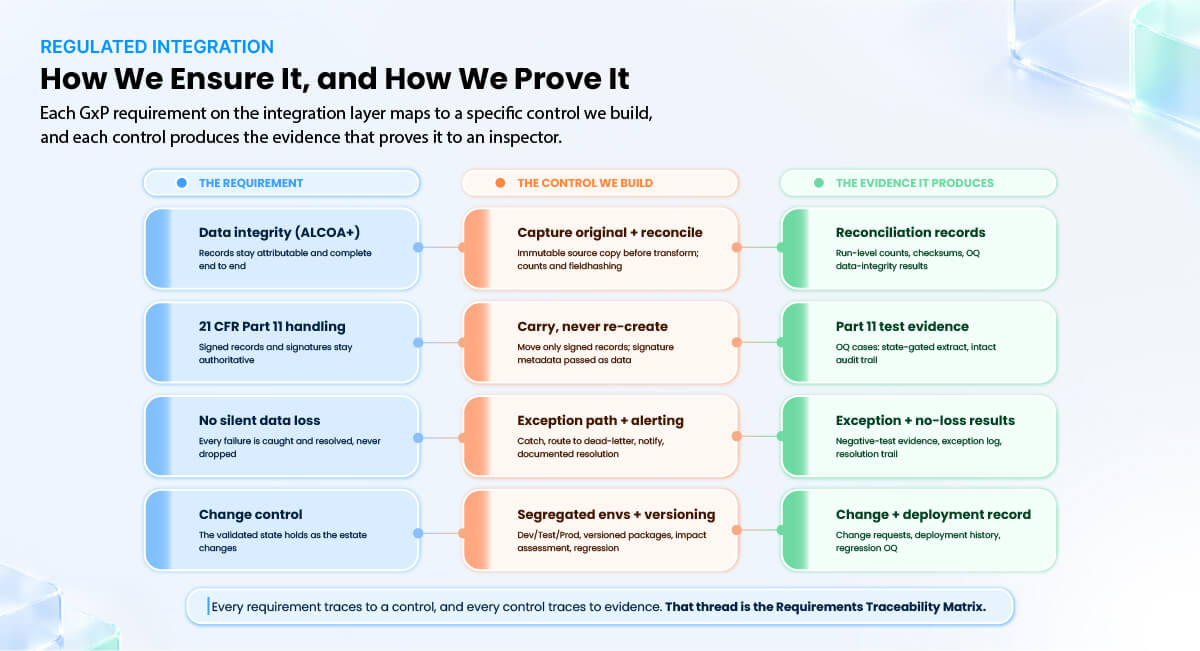
ALCOA+ principles cannot be asserted after the fact. They have to be engineered into the flow. In practice that means preserving source values through every transformation, carrying record counts and reconciliation so you can demonstrate nothing was added or lost, keeping any change in meaning declarative and versioned rather than buried in a script, and routing failures to a controlled exception path instead of letting them disappear.
The test is simple. If a flow cannot prove it moved every record intact, it is not validated. It is hopeful.
21 CFR Part 11: Signatures Stay in the System of Record
One design decision deserves singling out, because getting it wrong is both common and expensive. The integration layer is a courier, not a notary.
Electronic signatures and the 21 CFR Part 11 record originate and remain in the system of record. The integration carries the signed record and its metadata; it does not regenerate a signature or apply a new one. Building an approval or e-signature step inside the flow manufactures a second regulated record outside the quality system, one that now has to be validated and defended on its own terms. The correct pattern is to move only records already in a signed or released state, and to leave the signing where it belongs.
Change Control Is What Keeps It Validated
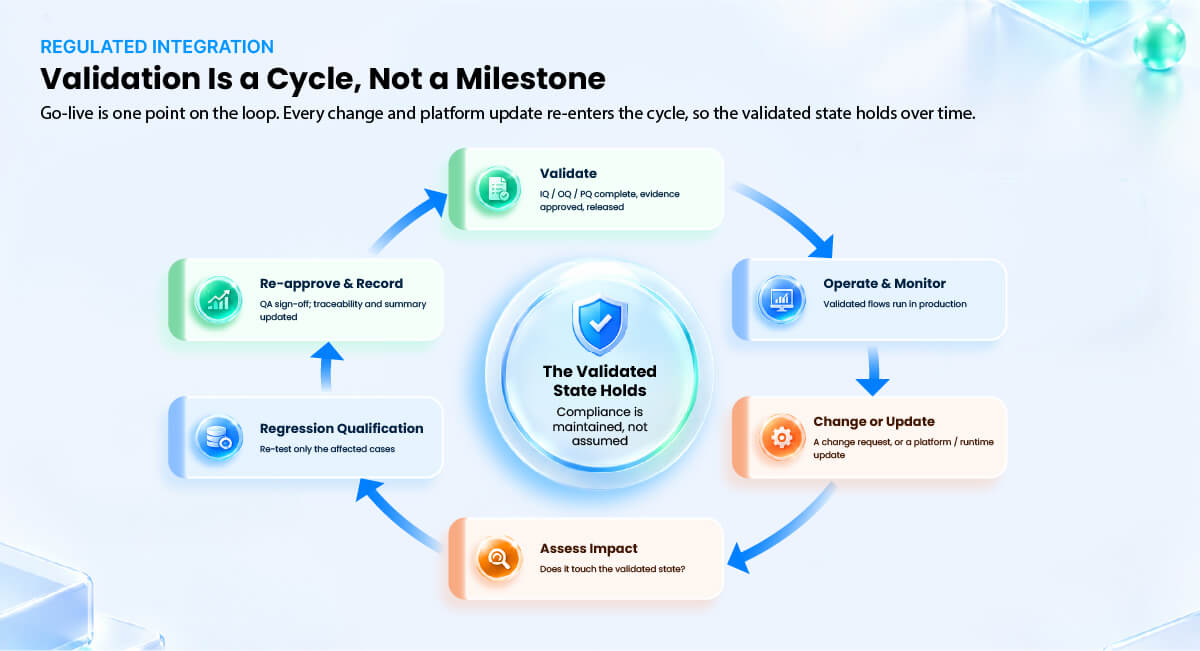
A validated state is not a milestone you pass once. It is a condition you maintain. The moment a flow changes, or the platform beneath it releases an update, that condition is at risk unless change control catches it: a change request, an impact assessment, regression testing, and clean separation between development, test, and production environments with versioned, promotable components.
The programs that stay both compliant and affordable treat this as standing discipline rather than a scramble before each inspection. Continuous, documented control means anomalies surface early and are resolved quietly, instead of erupting into remediation that pulls the organization off its core work.
Why This Intensifies as You Scale
As a regulated business grows, adds products, or expands into new markets, the integration layer stops being a back-office concern and becomes part of the product supply chain. Volumes rise. Traceability has to hold across every hop, provably, at scale. Order-to-cash, labeling, serialization, and safety reporting all begin touching regulated data.
And validation cannot be retrofitted after the fact. It has to be in place before a system goes live in a regulated capacity, which means the architecture decisions made early determine how smoothly that scale-up goes. The integration layer designed as a validated system from the start becomes an accelerant. The one left as plumbing becomes the thing that holds the business back.
Validation Is a Discipline, Not an Afterthought
The pattern across regulated estates is consistent. The integration layer is treated as infrastructure until an audit, a data integrity finding, or a commercial launch forces the question. By then, retrofitting validation onto years of point-to-point connections costs far more than building it in would have.
Designed as a validated system from the start, with risk-based scoping, integrity by design, clean records handling, and change control that survives go-live, the integration layer stops being a source of regulatory exposure. It becomes part of what lets a regulated business scale with confidence, instead of the reason it cannot.
Frequently Asked Questions
Yes, when it creates, modifies, or moves a regulated record. An integration that carries batch results, release status, or patient-linked data is a computerized system in its own right. Validating the source and target systems does not cover what happens to the record in transit.
Yes. GAMP 5 scopes validation to risk, not to whether a system has a user interface. An integration platform that handles regulated data is in scope, and the effort it needs follows from a documented risk and impact assessment of each interface.
Part 11 governs electronic records and signatures, and a record keeps that status while it moves. The integration must carry the signed record and its metadata intact and attributable. It should never regenerate a signature or apply a new one. Signing stays in the system of record.
Start with a risk and impact assessment that classifies each interface by what it does to a regulated record. Then build the controls into the flow: capture the original before transformation, map through versioned definitions, reconcile what arrived against what was sent, route failures to an exception path, and keep an audit trail. Change control keeps the interface validated after go-live.
IQ confirms the integration platform and its runtime are installed and configured as specified, with qualified non-production environments used for testing. OQ tests that each flow maps, reconciles, and handles exceptions as designed, including failure and retry cases. PQ shows the flow performs correctly under production-like conditions and data volumes over a sustained period.
Rightsize Your GxP Validation
Sage IT brings the GxP Validation Accelerator, a prebuilt, GAMP 5-aligned validation plan, a risk-classification framework, and IQ, OQ, and PQ protocol templates, so your team executes a proven method instead of building validation scaffolding from scratch. Run it in-house with our templates, or have our architects deliver it end to end.