

Corporate functions appear ideal for AI: structured work, high volumes, and measurable outcomes. Yet finance, risk, compliance, HR, legal, and procurement are also the least forgiving places to deploy it badly.
In corporate functions, an AI output is only as valuable as the evidence, authority, and accountability behind it.
A variance explanation that cannot be traced, a compliance recommendation that cannot be reconstructed, or an employee decision influenced by an undisclosed model may be fast and accurate. It is still a control failure.
The executive question is not how much work AI can perform. It is how much can be delegated without delegating accountability.
Finance is positioned to lead because it already owns the disciplines enterprise AI requires: materiality, evidence, approval, reconciliation, and control.
Why Corporate Functions Are the Real Stress Test
When AI fails inside finance, compliance, legal, or HR, the consequence may be a misstated record, a regulatory breach, an unfair employee outcome, or an audit finding.
The most consequential failures occur when recommendations cannot be explained, data lineage is unclear, approvals are bypassed, outdated policies are applied, or audit teams cannot reproduce outcomes.
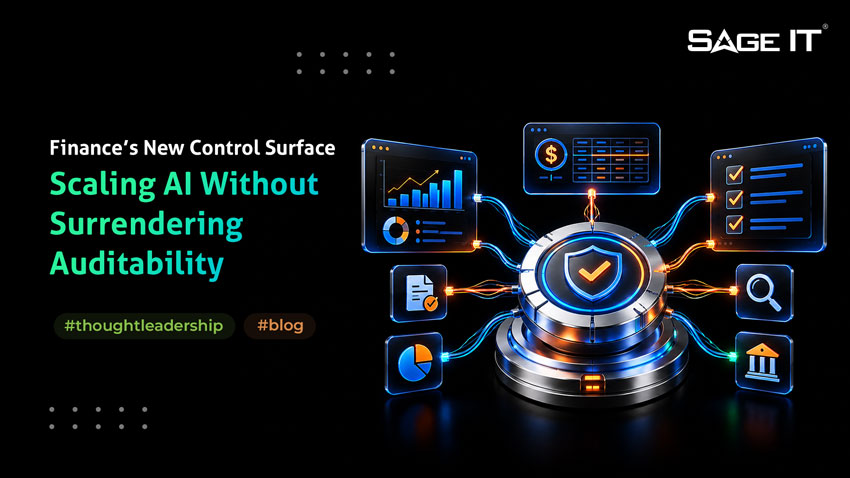
These failures damage what I call the control surface: the policies, processes, permissions, approvals, records, and evidence that enable an organization to operate safely at scale.
Properly designed, AI should make this control environment more responsive, consistent, and intelligent.
The First Control Dividend Is Attention
Corporate functions have built a vast false-positive economy. Thousands of employees review alerts, exceptions, transactions, clauses, and cases that ultimately require no action. Rules-based systems identify possible issues but often generate so much noise that skilled people spend more time clearing low-value alerts than investigating meaningful risk.
In high-volume workflows, one of AI’s earliest defensible benefits is reducing false positives rather than automating final decisions.
The first control dividend from AI is not autonomy. It is attention.
In an anti-money laundering workflow, AI can prioritize alerts, summarize transaction histories, identify patterns, and assemble evidence. The investigator still owns escalation and final disposition.
The machine improves the signal. The human owns the decision.
This is AI as a signal amplifier rather than a decision owner.
Three AI-Specific Control Failures
1. Knowledge Drift
Many apparent hallucinations are answers grounded in obsolete information. An AI system may accurately quote a superseded policy or retired procedure. The answer appears credible because it is supported by a real document, but operationally it is wrong.
An answer can be factually grounded and still be procedurally invalid.
Knowledge governance is therefore part of the control environment. Policies need clear owners, effective dates, version histories, classifications, and retirement processes. Without those disciplines, better models will only produce outdated answers more convincingly.
2. Instruction Hijacking
As AI systems gain access to documents, emails, external content, and enterprise tools, untrusted information can influence their behavior.
Embedded instructions may cause a system to ignore a policy, disclose information, alter prioritization, or attempt an unauthorized action.
The control question is which information, instructions, tools, and actions the system is authorized to use. Those boundaries must be explicit.
3. Evidence Loss
If an AI-influenced decision cannot be reconstructed, it is functionally unauditable.
Explainability in corporate functions is not philosophical. It is evidentiary.
The organization must be able to show what information was used, which policy applied, what the AI recommended, who reviewed it, whether it was overridden, and who approved the final action.
A persuasive answer on a screen is not an audit trail.
Governance Is Moving From Principles to Evidence
The EU AI Act is being applied in phases, while frameworks such as the NIST AI Risk Management Framework, ISO/IEC 42001, COSO guidance, and the Institute of Internal Auditors’ AI Auditing Framework provide more operational direction.
The direction is consistent: AI governance is moving from statements of intent to demonstrable evidence.
These frameworks should not be treated as checklists. Demonstrable control is becoming a competitive advantage, especially in regulated industries.
AI governance is becoming a condition of scale. Organizations that can demonstrate control will move faster into regulated workflows. Those that cannot will face longer approvals, narrower deployment boundaries, restricted partnerships, and declining trust.
The Three Conditions for Controlled AI
Every AI-enabled corporate workflow should preserve three things: signal, evidence, and authority.
Signal: Does AI Improve Human Attention?
AI should reduce noise, identify anomalies, and direct expertise toward cases that deserve judgment.
Signal quality should be measured through false-positive reduction, missed-risk rates, escalation quality, and decision consistency. A system that conceals uncertainty is not strengthening control. It is making risk less visible.
Evidence: Can the Outcome Be Reconstructed?
AI outputs that influence financial, regulatory, contractual, or employee outcomes should be grounded in approved sources. Organizations should retain relevant context, citations, data lineage, outputs, reviews, overrides, approvals, and action history.
Model, prompt, policy, permission, and retrieval-source changes should be treated as control changes. Mature teams test edge cases, monitor drift, review overrides, and verify that underlying knowledge remains current.
Authority: Is the Decision Boundary Explicit?
“Human in the loop” is no longer precise enough. A person may participate without the context, time, or authority required for meaningful oversight.
AI may inform by retrieving, summarizing, comparing, and identifying anomalies.
AI may recommend by drafting an analysis or proposing an action that an authorized person must approve.
AI may act only within predefined limits, restricted permissions, clear thresholds, comprehensive logging, and mandatory escalation.
The key question is not whether a person appears somewhere in the workflow. It is whether authority has been assigned deliberately where risk enters the process.
Accountability Must Be Designed Before Deployment
AI redistributes work, but it does not eliminate responsibility.
A practical approach can build on the Three Lines Model:
Clear ownership also reduces shadow automation, where teams introduce AI into controlled workflows without formal review, evidence requirements, or monitoring.
Measure Value and Control Together
Executives should reject AI performance reports that show productivity without control quality.
A productivity metric without a corresponding control metric creates an incomplete and potentially dangerous picture.
Cycle-time reduction should be reviewed alongside overrides and exceptions. Alert-volume reduction should be paired with false-negative and missed-risk rates. Analyst productivity should be paired with consistency and rework. Faster close cycles should be reviewed with reconciliation and correction rates.
Employee adoption should also be assessed with satisfaction, escalations, complaints, and policy exceptions.
The objective is not to prove that AI is moving work faster. It is to prove that AI is improving outcomes without making risk harder to see.
The Executive Agenda
Before scaling AI in a controlled function, leadership must answer five non-negotiable questions:
1. Trace the Influence
Where is AI influencing a judgment, record, obligation, financial commitment, or employee outcome?
2. Audit the Footprint
What information and evidence must be retained so the result can be independently reconstructed and reviewed?
3. Assign Accountability
Who owns the operational, regulatory, and business outcome when the system produces an incorrect or harmful result?
4. Map the Boundaries
What actions may the system take without explicit human approval, and under what permissions, thresholds, and escalation rules?
5. Govern the Drift
How will changes to models, prompts, data, permissions, policies, and approved knowledge sources be tested, monitored, and governed?
If leadership cannot answer these questions clearly, the organization is not ready to scale the workflow, regardless of how impressive the demonstration appears.
The Race to Intelligent Control
AI in corporate functions is not a race to autonomy. It is a race to intelligent control.
The strongest organizations will use AI to reduce noise, focus human judgment, improve consistency, and produce better evidence when decisions are made.
That is the real control dividend: greater speed without less accountability, greater intelligence without less transparency, and greater automation without ambiguity about who remains responsible.
Organizations that treat controls as obstacles will discover that uncontrolled speed creates its own cost through rework, incidents, audit findings, regulatory scrutiny, and loss of trust.
Those that design auditability into the workflow can move faster because they can trust what they have built.
Finance’s new control surface is already taking shape. The question is whether it will be fragile by accident or resilient by design.