

The first wave of generative AI rewarded people who could prompt well. The agentic wave will reward people who can delegate, supervise, and intervene well.
An AI assistant can generate a response. An AI agent can interpret a goal, divide it into steps, access enterprise systems, coordinate activities, and execute work. Once machines begin to act rather than simply respond, the management question changes.
It is no longer only, “What can AI do?”
It becomes, “What should we allow AI to do, under whose supervision, and with what accountability?”
The transition to agentic AI is therefore not merely a technology upgrade. It is a delegation test.
Organizations may have access to the same models, platforms, and agents. What they will not possess equally is the judgment and discipline required to use them responsibly at scale.
Paul R. Daugherty and H. James Wilson describe the capabilities required for effective human and AI collaboration as “fusion skills.” In the agentic workplace, these skills are moving from individual advantages to organizational necessities.
Why the agentic workplace changes the skills equation?
Earlier generations of enterprise technology automated predefined tasks. Agentic AI changes that relationship. These systems can interpret objectives, decompose them into tasks, retrieve information, interact with applications, initiate actions, and adapt from feedback.
Employees are becoming more than technology users. They are collaborators, supervisors, and stewards of machine actors.
Technical literacy, functional expertise, and process knowledge remain essential, but they are no longer sufficient. People must also know how to question machine reasoning, decide where human judgment should override an AI recommendation, define delegation boundaries, and redesign work around the strengths of humans and machines.
An organization cannot safely deploy agents with more authority than its workforce is prepared to supervise.
Fusion skills are the missing layer between technology and outcomes
Fusion skills are sometimes treated as soft skills. That understates their importance.
They are the missing layer between AI capability and business outcomes. They influence decision quality, workflow reliability, productivity, customer impact, risk exposure, and the level of autonomy an organization can safely grant its systems.
These are practical behaviors that can be observed, developed, and measured inside real workflows.
The challenge is that machine capability is advancing faster than organizational capability. Used well, AI extends human judgment. Used poorly, it scales errors and weak decisions.
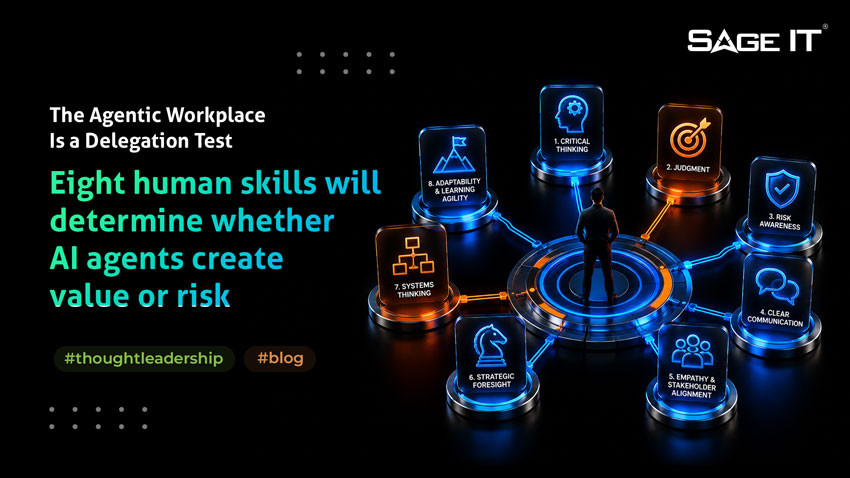
Eight fusion skills will determine which outcome prevails.
1. Intelligent interrogation
Valuable employees will not accept AI output at face value. They will frame precise objectives, provide context, probe assumptions, request alternatives, identify missing evidence, and surface uncertainty. Agentic systems can sound persuasive even when their reasoning is incomplete. Without intelligent interrogation, organizations risk scaling plausible answers rather than reliable decisions.
2. Judgment integration
AI recognizes patterns and optimizes against defined objectives. Humans contribute context, ethics, empathy, institutional understanding, and accountability. Judgment integration means identifying where human authority must enter a workflow, such as before a consequential action, after an exception, above a financial threshold, or when legal, safety, reputational, or customer risk becomes material. Human oversight should not approve every routine action, but it must ensure autonomy never outruns accountability.
3. Reciprocal apprenticing
Humans can learn from AI-generated analysis, while AI systems improve through human corrections, overrides, feedback, and outcomes. But this creates organizational value only when the learning is captured. Repeated corrections, escalation reasons, and failure patterns should improve prompts, knowledge sources, workflows, controls, and training. Reciprocal apprenticing turns individual experience into institutional learning.
4. Bot-based empowerment
Bot-based empowerment means delegating work without surrendering responsibility. Employees should know what an agent may access, recommend, prepare, execute, or escalate. Delegation without boundaries or visibility becomes abdication. The agent extends capacity, but the human supervisor must still understand what was delegated, where uncertainty emerged, and who owns the result.
5. Holistic melding
Holistic melding is not about inserting AI into an existing process. It is about redesigning the workflow so human and machine contributions operate as one system. AI may monitor signals, identify patterns, and coordinate execution while people set objectives, handle exceptions, weigh trade-offs, and remain accountable. The goal is not to separate human and machine tasks, but to combine their strengths around a better operating model.
6. Rehumanizing time
Time saved is not automatically value created. If leaders do not decide where released capacity should go, efficiency gains are often absorbed by more meetings, messages, and low-value activity. Rehumanizing time means reinvesting that capacity in customer relationships, creative problem-solving, mentoring, strategic thinking, ethical reflection, and innovation. AI should not only make work faster. It should enable more meaningful work.
7. Responsible normalizing
AI use often exists at two extremes: hidden shadow AI or excessive restriction. Responsible normalizing creates a productive middle ground in which employees use approved systems openly, follow shared standards, protect data, verify consequential outputs, disclose meaningful AI involvement, and escalate uncertainty. Responsible use becomes dependable when it is visible, routine, and supported by a culture that permits honest reporting.
8. Relentless reimagining
The final skill is refusing to treat today’s workflow as permanent. Leaders and employees must continually ask which handoffs, approvals, and delays are no longer necessary, which decisions could move earlier, and what new products or services AI makes possible. Organizations that redesign work once and stop will quickly create a new generation of legacy processes.
Failure can occur in both directions
Weak fusion skills create both overreliance and underutilization.
Some employees will delegate consequential work without sufficient review. Others will restrict capable systems to low-value tasks because they lack the confidence, judgment, or permission to use them effectively.
The result is inconsistent quality, fragmented adoption, rising risk, and disappointing returns. Strong fusion skills allow organizations to use AI ambitiously without using it recklessly.
Turning fusion skills into an operating strategy
Fusion skills will not emerge from a one-time training program. They must be embedded into role design, hiring, leadership development, performance evaluation, and promotion.
Job descriptions should state how AI contributes to the role, which decisions may be delegated, where human judgment remains essential, and what accountability stays with the employee. Organizations should reward people not for using AI frequently, but for improving the performance and reliability of the combined human and AI system.
Five leadership moves can accelerate that shift.
1. Define the boundaries of delegation
Make clear what an AI system may recommend, prepare, execute with approval, execute independently, or never perform. Decision rights, escalation triggers, and accountability must be explicit.
2. Redesign complete workflows
Do not insert agents into broken processes. Reconsider handoffs, approvals, information flows, exception handling, performance measures, and customer impact from end to end.
3. Train through consequential work
Develop fusion skills through real service cases, forecasts, contract reviews, policy decisions, operational exceptions, and compliance scenarios. Employees need practice supervising machine actors inside meaningful workflows, not generic prompt training.
4. Measure human and AI performance together
Do not measure success by usage. Measure decision quality, cycle time, rework, escalation quality, consistency, risk events, customer outcomes, and business performance. The unit of measurement should be the human and AI system together.
5. Model the behavior at the top
Executives should visibly question AI-generated analysis, test assumptions, evaluate uncertainty, override recommendations when context demands it, and remain accountable for consequential decisions. Employees take their cues from what leaders reward.
The executive takeaway
The next phase of AI will not be defined only by machines that produce better answers. It will be defined by machines that take increasingly consequential actions.
That makes human capability more important, not less.
Organizations will need people who can challenge machine reasoning, define autonomy, intervene with judgment, redesign workflows, and turn released capacity into value. These skills are the control system for the agentic enterprise.
Technology leaders will continue to evaluate models, platforms, architectures, and agents. But the most consequential question may be a human one:
Is our workforce prepared to supervise what our technology is becoming capable of doing?
Organizations that answer that question early will be better positioned to turn AI agents into a durable advantage. Those that do not may discover that deploying intelligence is easier than governing its actions.
In the agentic workplace, machines will expand what can be done.
Human skills will determine what should be done, what must not be done, and who remains accountable for the result.