

Over the last few years, I have had countless conversations about AI with customers, technology leaders and delivery teams. Most of them circle back to the same four questions: Which model should we use? How quickly can we implement it? How do we make our data available to it? How do we keep it secure?
These are the right questions. But lately, I keep coming back to a different one.
If every enterprise can access the same increasingly capable AI models, what will actually set one organization apart from another?
Models are improving at an extraordinary pace. Access is getting easier and costs are falling. The same models are available to thousands of companies through every major cloud platform. The model alone is unlikely to stay a differentiator for long.
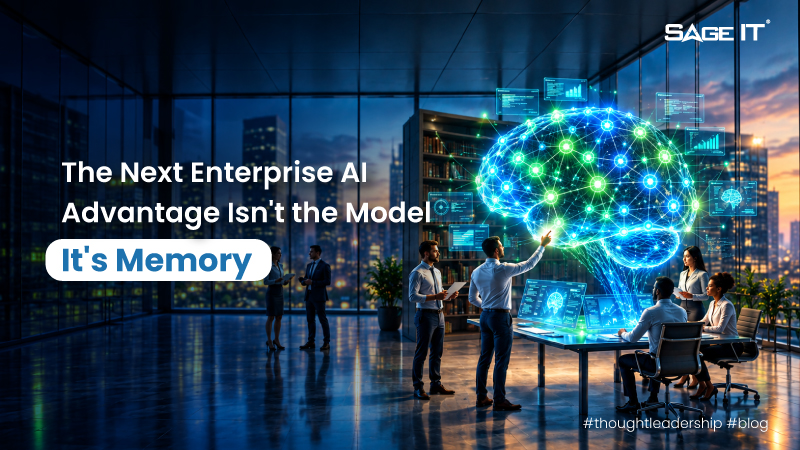
What a company knows, and how effectively it puts that knowledge to work, will matter far more. I call this enterprise memory: not another document store or knowledge repository, but an organization’s ability to remember what it has learned, understand the context behind it, and bring it back at the moment someone needs it.
Enterprises have a strange problem: they forget
I have seen this happen many times in technology organizations.
A team spends months solving a difficult problem for a customer. They work out the right architecture, learn what doesn’t work, overcome a few surprises and get the solution into production. A year or two later, another team faces a similar problem and starts investigating from scratch.
The knowledge hasn’t disappeared. It is sitting in a project folder, a Jira ticket, an architecture document or a long email thread. But finding it is hard, and understanding why the team made its decisions is harder still.
Pre-sales tells the same story. A team spends weeks on an RFP: researching the customer’s environment, shaping the architecture, identifying risks and building a strong commercial proposal. The opportunity closes. Months later, another team receives a strikingly similar RFP and starts again from a blank page.
Then there is the knowledge that never gets written down. The architect who knows why a decision was made moves on. The delivery manager who remembers which approach failed changes roles. The engineer who knows the customer’s environment best leaves the company.
The documents remain. The context often doesn’t. That gap is exactly what makes enterprise memory worth solving.
AI knows a lot. It doesn’t know your business.
What fascinates me about today’s AI models is how much general knowledge they already carry. Ask about a technology, an industry, an architecture pattern or a business problem, and the answer is often impressive.
But knowing something in general is different from knowing how your organization has experienced it. A model can explain how to approach a complex data migration. Can it tell you:
The model’s answer may be technically excellent. It just may not be your organization’s answer. As AI becomes ubiquitous, that distinction will matter more and more.
A tale of two consultants
Imagine two consultants joining a customer engagement. Both are technically strong. One joined your company last week; the other has been with you for ten years.
The newcomer may even know the technology better. But the veteran knows the customer. They know what has already been tried and what worked. They remember the project that went wrong three years ago, why a particular integration was designed the way it was, which stakeholders need to be in the room, and the unwritten rules nobody documents.
Would we call them equivalent? Probably not. The difference isn’t intelligence. It is experience and context.
I see enterprise AI the same way. The model provides intelligence. Enterprise memory provides experience. Bring the two together, and AI starts working the way your organization actually works.
What enterprise memory really means
Enterprise memory is not a product. It is a capability, built from three pieces working together.
1. Capture what we learn, not just what we do
Most enterprises are excellent at capturing transactions: incidents, project plans, proposals, tickets, documents. They are far less consistent at capturing what they learned from them. Why did we make that decision? What did we assume? What happened next? What would we do differently?
Those answers are often the most valuable knowledge an organization has. Retrospectives, architecture reviews, incident postmortems and solution reviews are natural places to capture them. The key is not to add another form to fill in. Knowledge capture has to become part of how work gets done.
2. Connect the dots
A document on its own rarely tells the whole story. An architecture document for an integration is useful. That same document linked to the customer, the business problem, the technologies, the team, the incidents that followed and the lessons learned is far more useful.
This is where data integration, semantic search, metadata, knowledge graphs and knowledge engineering come in. The goal isn’t a bigger document library. It is a web of relationships between pieces of knowledge.
3. Surface it at the moment of need
This is where AI turns memory into an advantage. Picture a sales team preparing an RFP: instead of digging through years of proposals, they see relevant past solutions, architectures, case studies and lessons learned. Or picture an engineer facing a production issue who simply asks, “Have we seen this before?” The system finds a similar incident, identifies the likely root cause, shows how it was resolved and points to the right runbook.
The value isn’t more information. It is shrinking the distance between knowledge and action.
Where enterprise memory pays off first
Pre-sales. Why should every proposal start from a blank page? Most organizations have already solved many of the problems in today’s RFPs. The aim isn’t to copy old proposals but to learn from past thinking: which architectures were used, what worked, which customer examples apply and who has the right experience. AI can bring all of that together far faster than any manual search.
Delivery. Delivery teams accumulate enormous practical knowledge, much of it scattered across project artifacts and people’s heads. A delivery manager starting a new program could ask, “What problems did we face on similar programs?” and get an answer grounded in the organization’s own experience, not generic AI knowledge. That shortens the learning curve and helps teams avoid repeating mistakes.
Operations. Tickets, root-cause analyses, monitoring data and runbooks hold years of hard-won operational experience. Connecting them moves a team from “Let’s investigate” to “We’ve seen this before.” That difference is significant.
Leadership. This is the application I find most compelling. Imagine asking, “The last time we tried something similar, what happened?” and getting more than a summary: why we made the decision, what we assumed, what worked, what failed, what the customer said, what it cost and what we would do differently today. At that point, it stops looking like enterprise search and starts looking like organizational memory.
The catch
Enterprise memory sounds attractive. Building it is not easy.
Enterprise data is fragmented across many systems. Different teams describe the same things in different ways. Some information is outdated, and much of it is tacit. Security and confidentiality are critical, especially for organizations working across multiple customers and regulated environments.
And there is a very human question: why would people contribute what they know?
That is why I don’t believe enterprise memory can be bought off the shelf as an AI tool. It needs strong data foundations, integration, governance and knowledge engineering. Above all, it needs people and processes that treat knowledge as an organizational asset. AI may be the interface, but the real work happens underneath.
Don’t build an enterprise brain overnight
Start small. Pick one area where the value is obvious: RFPs, a strategic customer, production support or architecture knowledge. Build the memory around that single problem. Connect the relevant sources, put the right security and governance around them, and give people an AI interface.
Then measure honestly:
If the answer is yes, expand. Over time, every new project, proposal, incident and decision adds to the organization’s memory. The enterprise doesn’t just accumulate more data. It accumulates more usable experience.
From AI access to AI context
I believe this is where enterprise AI is heading. The first question was, “How do we get access to AI?” Then it became, “How do we put AI into our workflows?” The next question will be, “How do we make AI understand our organization?”
Access to the model is no longer a differentiator. Your competitors can use the same model, buy the same cloud services and deploy a similar AI assistant. What they cannot buy overnight is your accumulated experience: your customer history, delivery lessons, architectural decisions, proposals, operational knowledge, successes and failures.
That is your institutional memory. Capture it, connect it, govern it and make it available to both people and AI, and it becomes one of the most powerful competitive assets you have.
The real AI question
So for technology leaders, the question isn’t only “Which AI model should we use?” It is also:
This is where data, integration, AI and governance come together. At Sage IT, this is the work we do with our customers: building the data, integration and governance foundations that let AI draw on what an enterprise already knows. Enterprise memory is not about putting more documents into a system. It is about turning organizational experience into something that can be found, understood, trusted and reused.
The organizations that get this right may find their biggest AI advantage isn’t a model nobody else has. It is something much harder to replicate: what they already know, and how well they make it work for everyone.
The next AI advantage isn’t the model. It’s how well your enterprise remembers.