
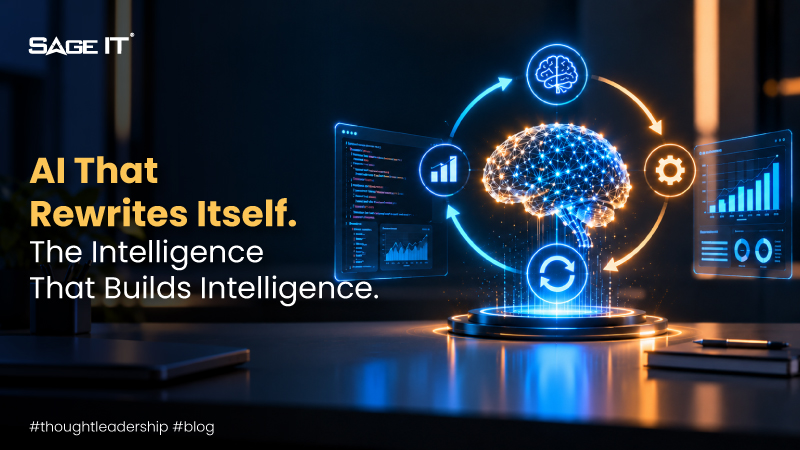
The Intelligence That Builds Intelligence
What happens when AI begins improving the very systems that make it intelligent? The answer could redefine the future of engineering, enterprise innovation, and technology leadership.
For decades, the relationship between humans and technology followed a familiar pattern: we designed the systems, machines executed them, and we returned to make them better.
That equation is beginning to change.
We have witnessed AI evolve from generating content to writing software, orchestrating workflows, and solving increasingly complex problems. But a more consequential frontier is emerging one where AI is not merely performing tasks, but participating in the improvement of its own engineering capabilities.
We are moving from intelligence that executes to intelligence that helps engineer its own evolution.
And the implications extend far beyond software development.
From AI-Assisted Engineering to Self-Improving Intelligence
Three research breakthroughs illustrate how this transition is taking shape.
The Darwin Gödel Machine: AI That Modifies Its Own Code
Research associated with Sakana AI demonstrated an agent capable of modifying its own implementation, testing the results, and retaining successful improvements. In reported experiments, its performance on SWE-bench increased from 20% to 50%.
This represents more than automated code generation. It demonstrates how an AI-driven system can participate in improving the mechanisms through which it solves engineering problems.
Google DeepMind’s AlphaEvolve: AI That Discovers Better Algorithms
AlphaEvolve combines language models with automated evaluation to discover and optimize algorithms. Its applications include computing infrastructure, mathematical problems, and operational optimization.
The significance is profound: AI can now contribute to improving some of the algorithms and infrastructure on which modern computing and AI itself depends.
TTT-Discover: AI That Learns While Solving
Traditional pretrained models generally rely on capabilities acquired before deployment. TTT-Discover explores a different paradigm: problem-specific learning during inference, allowing a system to improve its solutions through continued experimentation.
These developments do not establish unrestricted recursive self-improvement. They represent distinct, experimentally demonstrated advances.
But collectively, they point toward a powerful possibility:
The process of improving intelligence is itself becoming increasingly automatable.
The Real Disruption Is Not Faster Coding. It Is Faster Innovation.
Most enterprise AI strategies remain centered on productivity: accelerating software development, automating repetitive tasks, and reducing operational costs.
These improvements matter. But they may represent only the first wave.
Imagine an AI-native engineering environment capable of continuously analyzing performance, identifying bottlenecks, generating alternative solutions, testing improvements, and recommending validated architectural changes.
One enterprise uses AI to help engineers build faster.
Another uses AI to help its engineering systems become progressively better.
The difference is significant.
The first improves execution efficiency. The second begins improving the organization’s capacity to innovate.
The competitive advantage may increasingly shift from how much technology an enterprise can build to how quickly it can discover, validate, and adopt better technology.
The GCC Opportunity: From Engineering Delivery to Intelligence Creation
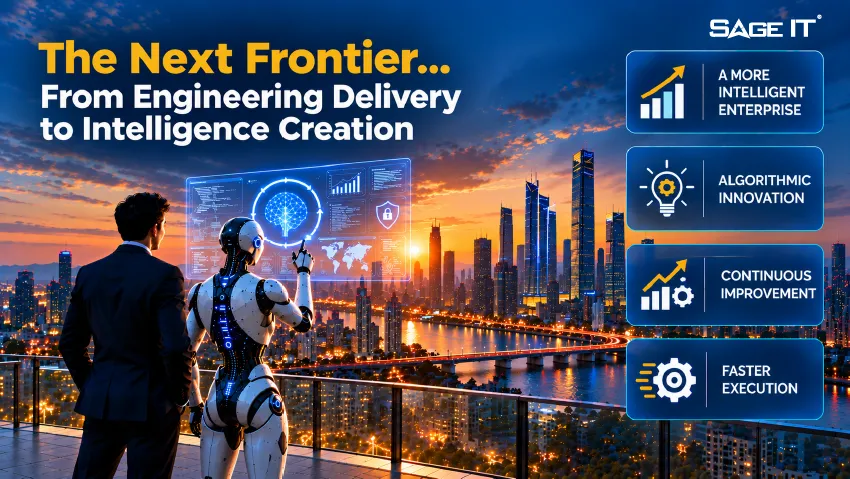
For Global Capability Centers (GCCs), this frontier presents an important strategic opportunity.
GCCs have already evolved from cost-efficient delivery centers into strategic hubs for product engineering, cybersecurity, data, and innovation.
Self-improving AI systems could accelerate that transformation.
Consider a GCC responsible for a global financial platform. An AI-native engineering environment could analyze approved operational telemetry, identify recurring performance issues, generate optimization strategies, evaluate them against controlled workloads, and present validated improvements for engineering approval.
Over time, successful experiments could become part of the organization’s reusable engineering knowledge.
This is an emerging architectural direction rather than an established, universally available capability.
Nevertheless, the opportunity is compelling.
The next generation of GCCs could become centers of continuous intelligence creation—not merely centers of engineering execution.
For technology leaders, the strategic question begins to change:
How much engineering capacity can we deliver?
Becomes:
How much new engineering capability can we continuously create?
The Critical Question: Who Controls Intelligence That Can Change Itself?
As AI systems become capable of modifying their own tools, workflows, and execution strategies, an equally important challenge emerges: trust.
Who determines what an AI system is authorized to modify?
How do we independently verify that a proposed improvement is genuinely better?
How do we prevent performance optimization from introducing new vulnerabilities, weakening controls, or compromising reliability?
The answer cannot rely solely on the intelligence of the system making the change.
It requires a disciplined engineering foundation: controlled experimentation, measurable outcomes, independent evaluation, enforceable authorization, auditability, and safe rollback.
An AI system may be permitted to discover an improvement without being authorized to deploy it.
It may optimize an algorithm without receiving permission to modify its security boundaries.
Self-improvement without verifiable control is not sustainable innovation.
This is where enterprise architecture, cybersecurity, and AI engineering converge and where technology leadership becomes decisive.
The Next Competitive Advantage: Organizations That Continuously Improve
For CTOs, CIOs, Chief AI Officers, and GCC leaders, the opportunity is not to replace human engineering judgment with autonomous systems.
It is to create environments where human expertise and machine-driven experimentation reinforce each other.
Where AI explores possibilities at a scale difficult for humans to achieve alone.
Where engineers establish objectives, validate discoveries, and enforce architectural boundaries.
Where every successful improvement contributes to an expanding foundation of organizational capability.
The future of enterprise AI may not be defined simply by the intelligence of the systems organizations deploy.
It may be defined by how effectively those organizations can continuously improve the intelligence they create and use.
We spent decades building machines that execute our instructions.
We are now entering an era where machines can help discover better instructions, better algorithms, and better ways of engineering themselves.
The next AI revolution may not be built by humans alone. It may be built by intelligence that keeps learning how to build better intelligence.
And that leaves every technology leader with a defining question:
Are we building intelligent systems or are we building organizations capable of continuously creating better intelligence?
Research References
About the Author