Are we approaching a turning point?
I have been thinking quite a bit about where the IT services industry is heading.
For decades, we have built our businesses around people, technology skills, delivery capabilities and the ability to execute projects efficiently. We have grown by adding customers, expanding teams, building delivery centres and developing expertise across technology platforms.
It has worked remarkably well. Many of the largest technology services companies in the world were built on this model.
But I sometimes wonder whether we are reaching a point where doing more of the same will no longer be enough.
AI is changing the way software is developed, applications are maintained, data is processed and business operations are managed. More importantly, it is changing what customers expect from us.
Customers are no longer interested only in how quickly we can develop an application or how many resources we can deploy. They want to know how we can help them run their businesses better:
These are the conversations we need to be having. And they lead to a bigger question: could the combination of domain expertise, enterprise data and AI create a much larger opportunity than traditional IT services?
I genuinely believe it could. In fact, this combination could change the economics of our industry and set technology services companies on an entirely different growth trajectory.
Understanding the business now matters more than knowing the technology
Access to technology is no longer a significant barrier. Most companies can use the same cloud platforms, development tools, AI models and frameworks.
The differentiator is increasingly what we know about the customer’s business and how well we can apply technology to solve its problems.
Take insurance. There are plenty of technology professionals who can build a claims processing application. But how many truly understand why claims get delayed, where leakage happens, how underwriting decisions affect profitability, what drives customer dissatisfaction or how fraud patterns emerge?
There is a big difference between knowing how to build an application and understanding how the business actually works. The same applies to manufacturing, healthcare, banking and retail.
In manufacturing, building a predictive maintenance solution is not particularly difficult from a technology perspective. Understanding how equipment downtime affects production schedules, customer commitments and profitability is where the real value lies.
In healthcare, developing an application is one thing. Understanding the patient journey, clinical workflows and the challenges faced by healthcare professionals is quite another.
Having spent close to 18 years in an established IT services organization, I have seen how domain knowledge shapes the quality of technology delivery. My experience across enterprise applications, ERP, business intelligence and analytics, and insurance delivery taught me something important: understanding the technology is only one part of the equation. Understanding the customer’s business, its operating environment and the challenges its people face is what makes the difference.
Over time, I realized that the strongest delivery teams were not necessarily those with the best technical skills alone. They were the teams that understood why they were building something, how it would be used and what difference it would make to the business.
That understanding becomes even more important in an AI-driven world.
IT services companies need to invest more in developing people who understand the business, not just the technology. We need to get closer to customer operations, understand their challenges and take part in conversations that go beyond IT requirements.
The more we understand a business, the better positioned we are to identify opportunities that may not even be part of the original request. That, to me, is the beginning of a strategic partnership.
We have plenty of data. But are we really using it?
Over the years, enterprises have invested heavily in data platforms, analytics, data warehouses and business intelligence. Yet many organizations still struggle to get meaningful value from their data.
Companies have accumulated enormous amounts of information across applications, departments and business functions, but much of it remains fragmented. Some sits in legacy systems, some in documents and emails, and some in operational platforms that do not communicate effectively with each other.
Having data and being able to use it intelligently are two very different things.
The next opportunity in data engineering is not simply about building more pipelines or creating more dashboards. It is about connecting information, understanding its business context and making it useful.
Consider the insurance example again. An organization may have years of claims history, customer information, policy details and operational data. But unless these pieces come together, it is difficult to see why certain claims take longer, where inefficiencies exist or which patterns might indicate fraud.
When we combine domain knowledge with properly connected enterprise data, we start asking much better questions. And that is where AI becomes interesting.
AI is much bigger than developer productivity
Much of the current conversation around AI in IT services focuses on productivity. How much faster can we write code? How many test cases can we automate? How much effort can we save in application maintenance?
These are important questions, and we should absolutely pursue those opportunities. But they are only one side of the story.
The bigger opportunity is to use AI to change how businesses operate.
Imagine an insurance claims process where AI reads incoming documents, validates information, identifies inconsistencies, flags potential fraud, recommends the next course of action and routes exceptions to the right people. This is no longer about automating a few manual steps. It is about rethinking the entire process.
The same possibilities exist across industries:
What makes these solutions valuable is not AI alone. It is the combination of business understanding, enterprise data and the ability to apply AI in the right context.
Without domain knowledge, AI may solve the wrong problem. Without reliable data, even the best models will struggle. And without proper engineering, a promising demonstration may never become a dependable enterprise solution.
There is a tendency to believe that AI will take care of much of the complexity involved in building technology solutions. I don’t quite see it that way. AI can accelerate development, testing, documentation and much more. But enterprise solutions still need sound architecture, integration, security, governance, performance engineering and operational discipline.
A successful proof of concept is one thing. Running a business-critical application reliably in a customer’s production environment is another. This is where engineering expertise becomes even more important.
Our software development lifecycle itself needs to change. AI should become part of how we understand requirements, design solutions, write code, test applications, deploy software and manage operations. We cannot simply hand developers AI tools and expect transformation to follow. We need to rethink the entire engineering process.
The economics of IT services are changing
This is perhaps the question that interests me most.
Traditionally, our growth has been closely tied to the number of people we deploy, the size of our projects and the scale of our delivery operations. To grow, we generally needed more people, more projects and more delivery capacity.
My perspective here is also shaped by my entrepreneurial journey. After several years in the corporate world, I took the entrepreneurial route and experienced what it takes to build a technology services business from the ground up.
When you are building a company, every customer, every engagement and every delivery decision has a direct business implication. You become closely involved in customer relationships, solutioning, sales, people, operations and delivery.
One thing became particularly evident: how closely traditional services growth is tied to people and delivery capacity. You win an engagement, build a team and deliver the work. To grow further, you repeat the process. It made me appreciate the importance of building capabilities that can be reused rather than treating every engagement as an entirely new exercise.
This is where AI creates an opportunity we should not underestimate.
If a team can deliver in a few weeks what previously took several months, or if an intelligent system can perform activities that once required considerable manual effort, we need to rethink how we price, deliver and measure our services.
Using AI to deliver the same services at a lower cost may improve productivity, but it will not create a sustainable competitive advantage. If everyone has access to similar AI tools, productivity gains will eventually become the industry norm.
The bigger opportunity is to build capabilities that customers cannot easily replicate or source from just any technology provider.
Imagine developing a domain-specific solution for claims processing, manufacturing operations or cybersecurity. Once we have invested in understanding the business problem, connecting the relevant data and building the AI capabilities, we can reuse and extend that solution across customers facing similar challenges.
We are no longer starting from scratch every time. Our engineering investment becomes reusable. Our intellectual property grows. Our understanding of the domain deepens with every implementation. And the value we deliver is no longer directly proportional to the number of people involved.
That is an important shift in the economics of IT services.
It does not mean every services company needs to become a product company. But we do need to start thinking more like product companies in how we develop reusable solutions and intellectual property. There is a middle ground between traditional services and pure product businesses, and that is where some very interesting opportunities will emerge.
Four capabilities that will shape the future
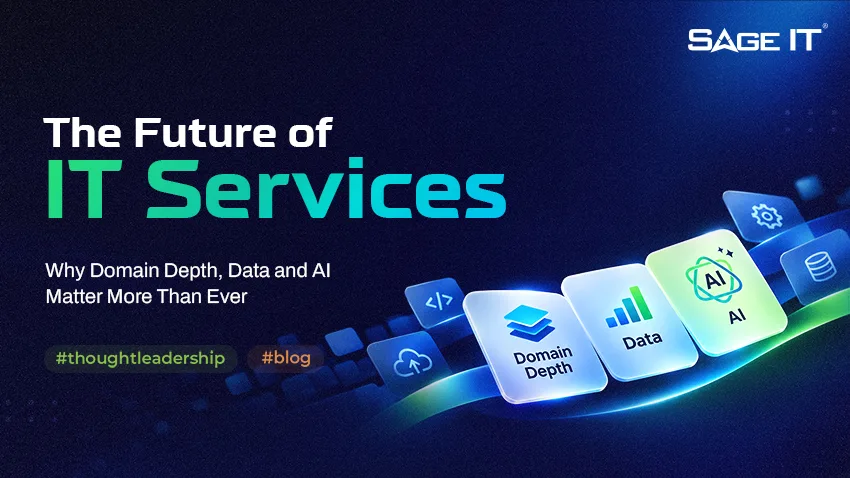
If I were to simplify my thinking, I would bring it down to four areas:
- 1
Domain Depth: Business Context. Understanding the industries we serve, the processes our customers run and the business problems they are trying to solve.
- 2
Data: Enterprise Intelligence. Helping customers connect their information and make it accessible, trustworthy and useful.
- 3AI: Intelligent Execution. Using AI to improve decisions, automate processes and create capabilities that were previously difficult or uneconomical to build.
- 4
Engineering: Scalable Delivery. Bringing the discipline to make everything work reliably in real enterprise environments.
None of these works in isolation. Domain knowledge helps us identify the right problem. Data gives us the information needed to understand it. AI helps us act on that information. Engineering makes the solution work at scale.
This is the combination that can create a different kind of IT services business.
Where does Sage IT fit into this journey?
At Sage IT, I see a real opportunity to bring these capabilities together.
One thing I feel strongly about is that AI should not be treated as a separate practice or a standalone service offering. It should become a horizontal capability across everything we do. Think about our existing technology services:
The opportunity is to weave AI into the fabric of our engineering and delivery processes rather than treating it as another technology to sell.
This also means investing in our people. We need engineers who understand business problems, data professionals who understand the context behind the data, and domain specialists who are comfortable working with AI. We need teams that work across traditional technology boundaries rather than in isolated practices.
Having experienced both large-scale enterprise delivery and the realities of building a services business, I have come to appreciate that good ideas are only the starting point. My corporate experience reinforced the importance of delivery discipline, governance, repeatability and execution at scale. My entrepreneurial experience taught me the value of agility, ownership, quick decision-making and staying close to customers.
The next generation of IT services companies will need both: the engineering discipline of a large enterprise and the entrepreneurial mindset of an agile organization.
At Sage IT, this is an important part of our journey towards becoming AI-native. We need to keep evolving our engineering practices, encourage experimentation and build reusable capabilities that translate into tangible customer value.
Most importantly, we need to measure success differently. It cannot always be about utilization, headcount and project completion. We should increasingly ask what business value we have created for the customer, what reusable capabilities we have built and how much more effective our delivery has become.
This is a journey. It will require experimentation, continuous learning and a willingness to challenge some of the ways we have traditionally operated.
A thought to leave you with
I have seen the IT services industry evolve through several transitions: enterprise applications, ERP, outsourcing, cloud, digital transformation and now AI. Every transition has created opportunities for companies willing to rethink their business models. AI may well be the most significant yet.
Having seen this industry from the corporate side, as an entrepreneur and now in a technology leadership role at Sage IT, one thing has remained constant: technology keeps changing, but the fundamentals of creating customer value do not. What is changing is the opportunity to create that value differently.
I don’t think the winners will necessarily be the companies with the largest AI teams or the most sophisticated models. The real winners will be those who understand their customers’ businesses, know how to unlock the value of enterprise data and have the engineering capabilities to turn AI into tangible results.
We need to move beyond asking how efficiently we can deliver technology services, and start asking how much more value we can create for our customers.
Domain Depth gives us relevance. Data gives us context. AI gives us scale.
When we bring these together with strong engineering, we have an opportunity to build something far more valuable than the traditional IT services business.
That is where our industry is heading. And it is an exciting time to be part of the journey.