
For decades, enterprise scale was largely about adding more: more people, more infrastructure, more applications, and more automation. Global delivery changed the economics of talent. Cloud changed the economics of infrastructure. Platforms changed how we scaled software.
AI is now changing something potentially much bigger: the economics of how an enterprise produces an outcome.
And that raises a question I keep coming back to: What if the next enterprise doesn’t simply use AI to do more work? What if the enterprise itself becomes capable of continuously changing how it delivers the outcome?
That is what I mean by the Self-Evolving Enterprise.
We are already moving beyond copilots and individual agents, and increasingly beyond automating isolated workflows. The next challenge is not simply “How many agents can we deploy?”
It is: How intelligently can the enterprise organize itself around the outcomes that matter?
Outcomes At Scale
By Outcomes at Scale, I don’t mean “more output,” and I don’t mean taking the same process and simply running it 10X faster.
I mean making a valuable business result repeatable, adaptive, measurable, governed and economically sustainable, across customers, functions, geographies and changing business conditions, without requiring people, cost and complexity to grow at the same rate.
Consider a simple example. A company wants to reduce customer onboarding from 10 days to 1 day, without increasing fraud, compliance risk or headcount.
Today, we might launch a transformation program: map the process, assign a team, select applications, automate tasks, add AI and then measure the improvement.
But AI gives us the possibility of thinking differently.
Instead of permanently designing everything around a fixed workflow, the enterprise can increasingly determine the best combination of Humans + Agents + Models + Data + Applications + Compute + Controls required to produce the desired business result.
And when conditions change, the combination changes.
That is the important part.
The Model Is Not A Pipeline
I initially thought about this as:
Self-Scale → Self-Assemble → Self-Loop → Self-Evolve → Outcome
But that misses the point.
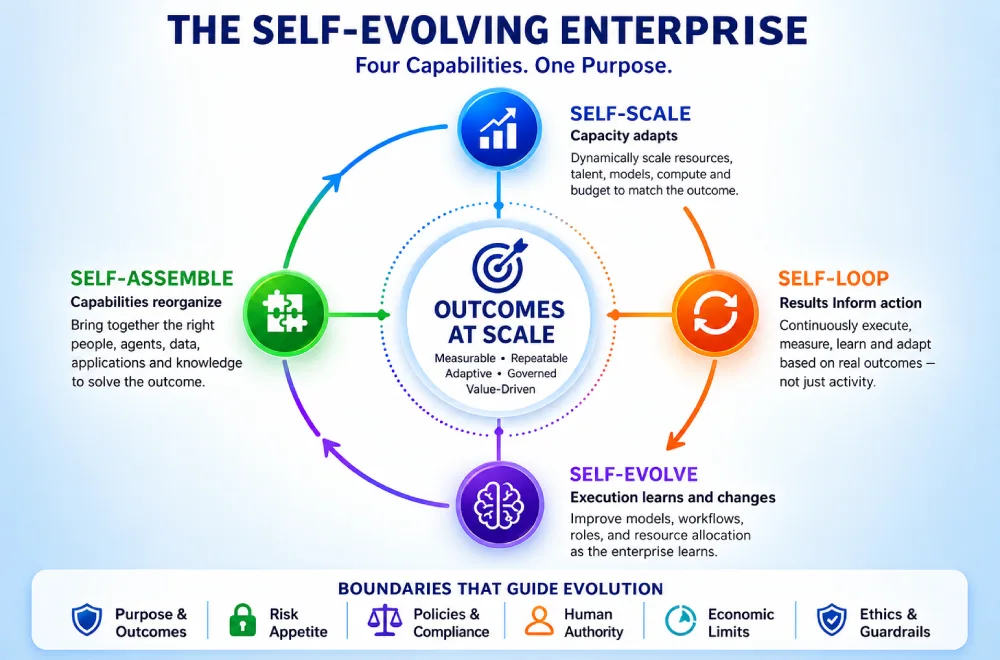
These should not be sequential stages through which an outcome travels. They are four simultaneous properties of an adaptive enterprise, continuously operating around the business outcomes that matter.
1 Self-Scale: Capacity Adapts
This isn’t simply infrastructure auto-scaling. Imagine the enterprise being able to dynamically adjust whatever capacity an outcome requires: compute, models, agents, human expertise, data access, budgets and even appropriate decision authority.
The question changes from “How much capacity do we have?” to “What capacity does this outcome require right now?”
Capacity begins to follow the outcome.
2 Self-Assemble: Capabilities Reorganize
Today, enterprise capability is largely organized inside functional boundaries. Finance has its systems, Sales has its systems, Operations has its people, and Technology has its platforms.
But business outcomes rarely respect those boundaries.
AI creates the possibility of making enterprise capabilities increasingly composable. For an important business outcome, the enterprise can bring together the right People + Agents + Knowledge + Systems + Data + Controls, even when those capabilities live in different parts of the organization.
The interesting question is no longer simply “Who owns this process?”
It becomes: “What combination of capabilities can deliver this outcome best?”
3 Self-Loop: Results Continuously Inform Action
This is where we need to move beyond conventional automation.
Automation traditionally asks whether the process completed. An outcome-oriented enterprise asks whether the business result actually improved.
Customer onboarding may have completed successfully, but did onboarding time fall? Did abandonment decrease? Did fraud increase? Did cost improve? Did customer experience improve? Did we create a new compliance problem?
That creates a continuous relationship between execution and outcome.
EXECUTION
Plans and decisions
put into action.
RESULT
Outcomes and outputs
are generated.
MEASURE
Performance is measured
against desired outcomes.
LEARN + RECONFIGURE
Insights drive learning
and the system adapts
and reconfigures.
CONTINUOUS
FEEDBACK LOOP
The system never stops
improving.
EXECUTION → RESULT → MEASURE → LEARN + RECONFIGURE
The workflow completing is no longer the finish line.
The outcome becomes the feedback signal.
That distinction is fundamental.
4 Self-Evolve: The Way Work Gets Done Can Change
This is where the idea becomes much more interesting.
Imagine the enterprise discovers that a smaller model produces equivalent quality at one-third the cost, a different combination of agents performs better, a workflow step contributes nothing measurable, human judgment materially improves a particular class of high-risk decisions, a different data source improves accuracy, or a particular agent creates unacceptable risk.
What happens today? We see the insight in a dashboard, discuss it, redesign the process, change the system, test it and eventually deploy again.
A Self-Evolving Enterprise increasingly closes the distance between learning and adaptation.
Within clearly defined boundaries, it can change how the outcome is produced: change the model, change the agent, change the sequence, change resource allocation, increase human involvement, remove unnecessary steps or reassemble capabilities, and then measure again.
The enterprise doesn’t just learn about its performance.
Its execution model learns from performance.
Self-Evolving Does Not Mean Self-Governing
This distinction is critical.
I am not suggesting that AI should autonomously decide what a company values. Quite the opposite. As execution becomes more adaptive, governance becomes more important.
Leadership and humans continue to define the purpose, desired outcomes, risk appetite, economic limits, policies, authority, ethics and non-negotiable controls.
Inside those boundaries, AI can increasingly optimize how work gets done. Outside those boundaries, the answer is simple: stop, escalate and bring in human authority.
This is not unlimited autonomy.
It is bounded autonomy.
And I believe bounded autonomy will become one of the foundations that makes a Self-Evolving Enterprise possible.
The AI Scorecard Must Change Too
For the last few years, we have celebrated the number of AI use cases, copilots deployed, employees enabled, agents created, workflows automated, tokens consumed and hours saved.
Those metrics aren’t useless. But they don’t necessarily tell us whether AI changed the business.
A Self-Evolving Enterprise needs a different scorecard:
What outcome changed? By how much? At what cost? At what risk? For how long? Can we reproduce it elsewhere? Can the system improve it again?
That is a fundamentally different measurement philosophy.
It moves us from measuring AI activity to measuring enterprise outcomes.
And that is what I mean by Outcomes at Scale.
The Leadership Question Is Changing
For years, workforce planning asked, “How many people do we need?” Cloud changed the infrastructure question. Automation made us ask, “How much work can we automate?” And Agentic AI is increasingly making us ask, “How much work can agents execute?”
But I believe the more consequential question is becoming:
“What outcome are we accountable for, and what is the best combination of human and machine intelligence required to continuously deliver it?”
That is a very different way to think about the enterprise.
It is not AI replacing people. It is not agents everywhere. And it is certainly not automation for automation’s sake.
It is an enterprise in which capacity adapts, capabilities assemble, results drive learning and execution evolves, continuously around the outcomes that matter.
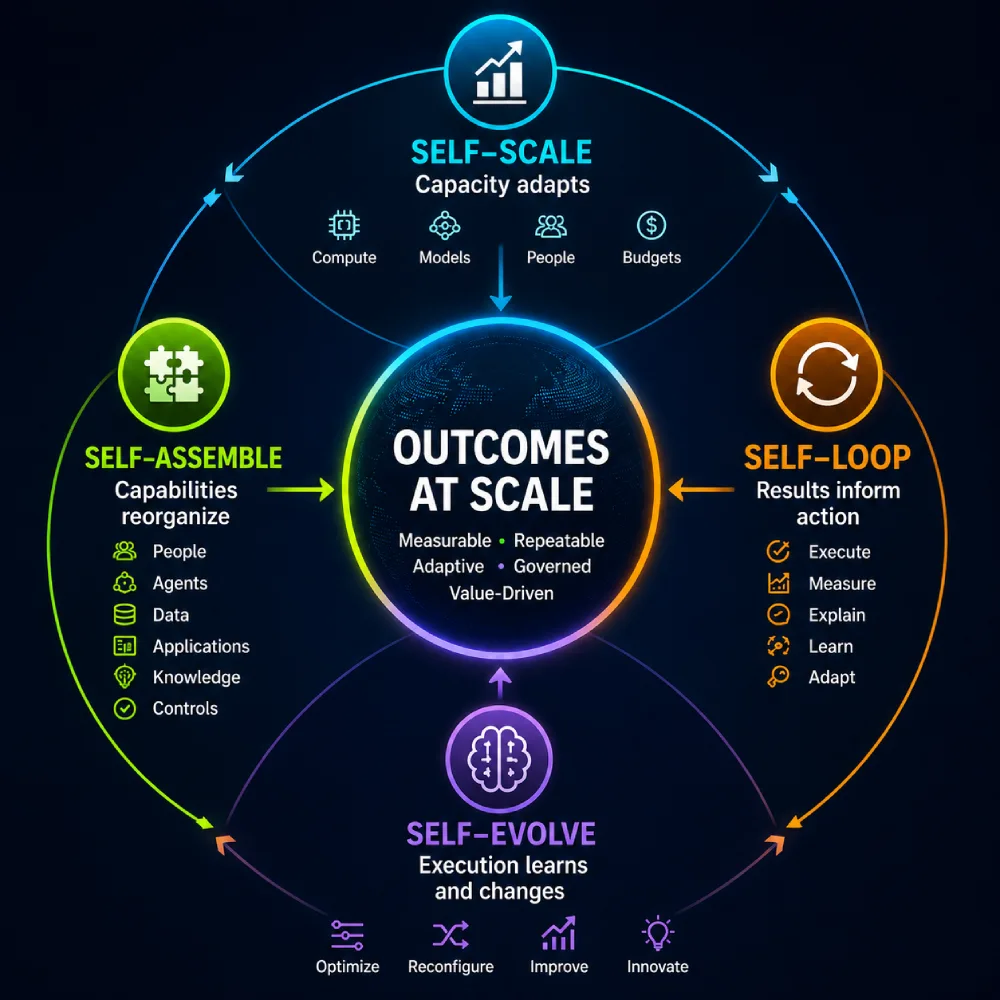
The Self-Evolving Enterprise
SELF-SCALE
Capacity adapts
SELF-ASSEMBLE
Capabilities reorganize
SELF-LOOP
Results inform action
SELF-EVOLVE
Execution learns and changes
Outcomes At Scale
Perhaps that is the real evolution of the AI-native enterprise.
Not simply an enterprise that uses intelligence, but one that can continuously reconfigure how human intelligence, machine intelligence and enterprise capabilities come together to create measurable value.
And maybe the biggest shift is surprisingly simple:
Don’t just ask how AI can scale the work. Ask how the enterprise can continuously evolve to scale the outcome.
“The Self-Evolving Enterprise doesn’t scale work. It delivers outcomes at scale.”
– Dr. NN, 2026