

A Sage IT read on Boomi’s 2026 platform expansion, launched in Chicago in May and restaged for EMEA at Boomi World Tour London last week: what’s buyable today, and what it means for your business.
Last week the 2026 Boomi story reached London. Boomi first unveiled this expansion at Boomi World 2026, its flagship in Chicago in May, in front of 1,700-plus customers and partners. Boomi World Tour London, 23 to 24 June, restaged the same release for 700 EMEA integration and data leaders, in the region where residency questions bite hardest. Nothing new launched in London. But two months on from Chicago the roadmap has firmed up and a real slice of it has shipped, which makes now the right moment for the read that matters: what you can put into production, what to pilot, and what to leave on the roadmap.
This is the direction we’ve pointed clients toward for two years. The value in enterprise AI was never the model. It was governed access to the systems the model acts on, and the runtime that access executes in. Boomi just made that its product line.
On the Chicago mainstage, Steve Lucas and Ed Macosky reframed the company. Two years ago Boomi was an integration and automation company. Last year, AI-driven automation. This year it calls itself the data activation company, built on one claim: agents are only as good as the data they can reach, and almost no enterprise data is reachable. Boomi’s own figures put throughput at more than twice Visa’s transaction rate across 30,000-plus customers, with only about 7% of enterprise data in motion. Treat the Visa comparison as a keynote flourish; the point underneath it holds. Most enterprise data never moves, and agents can’t act on data that doesn’t move.
So, is Boomi still an iPaaS? Yes, comfortably. It’s a Leader in the Gartner Magic Quadrant for iPaaS for the twelfth consecutive time. Boomi isn’t walking away from that. The integration platform is the floor. What’s new is the layer built on top of it.
The five pillars
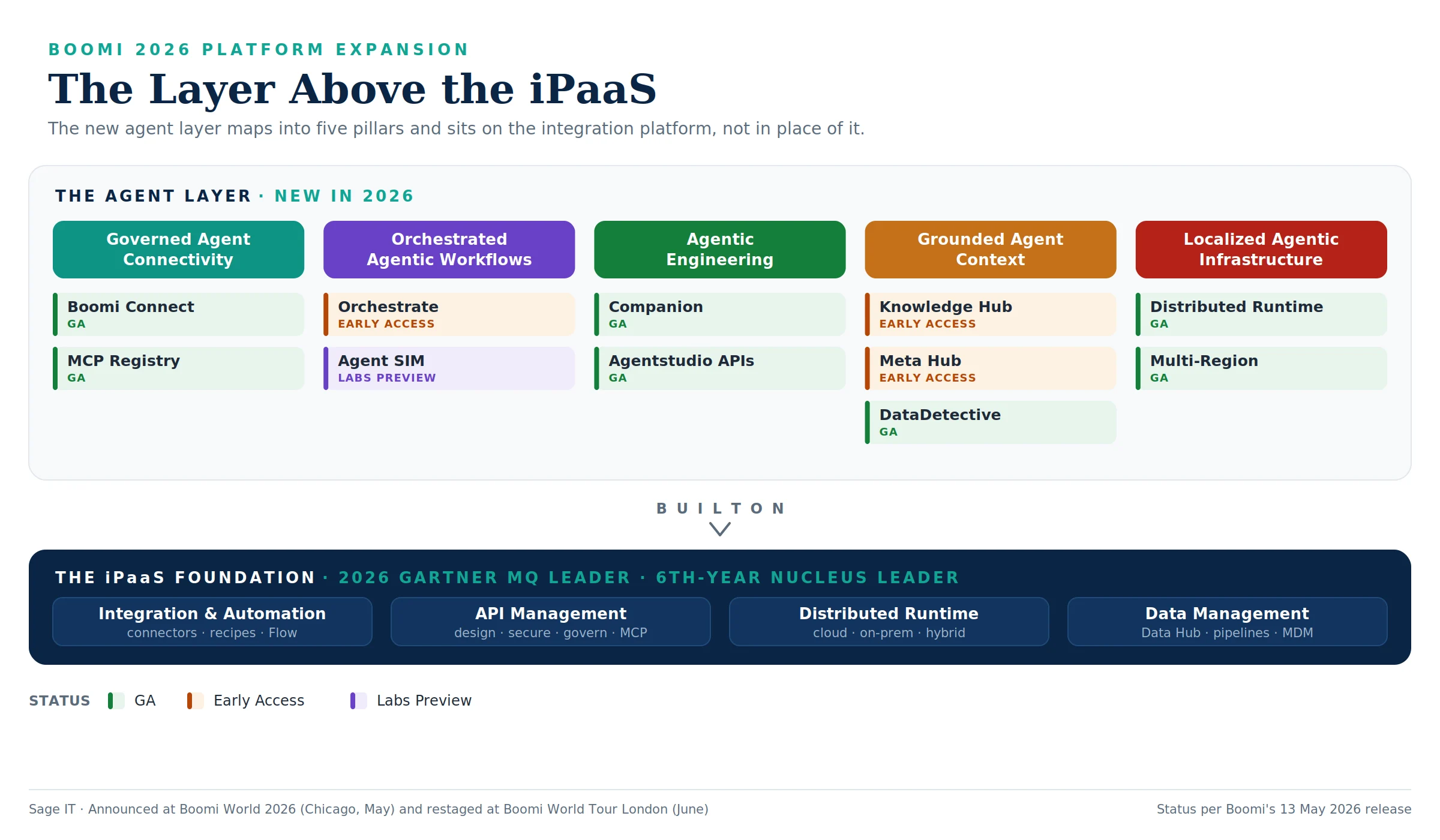
Boomi grouped the announcements into five areas: governed agent connectivity, orchestrated agentic workflows, agentic engineering, grounded agent context, and localized agent infrastructure. That’s not decoration. It maps to where agentic projects actually fail: connectivity, orchestration, build velocity, context, and where the thing runs. Anyone who has shipped an agent into production has bled on at least three.
Connect is the headline, and it’s GA
Macosky called Boomi Connect the most important thing announced, and the substance backs it. Connect is a managed MCP service that bridges the major AI front ends, Claude, Gemini, ChatGPT Enterprise, and Microsoft Copilot, to more than 1,000 enterprise tools. Underneath, Connect handles authentication (OAuth 2.0, API keys, delegated on-behalf-of, SAML/SSO, mTLS), enforces per-user permissions, applies rate limiting and cost controls, and logs every tool call. Governance, observability, and metering on one control plane. It’s GA now, licensed by annual tool-call volume, with a Base Tier starting at 25,000 calls a month across three sources, enough to prove something real before you commit budget.
One caution before you oversell it. MCP is an open standard, so the gateway layer is a race, not a moat, and Boomi’s letter of intent to acquire Lunar.dev is what fills out its announced AI Gateway: the routing, rate-limiting, and prompt-observability layer. Treat that piece as maturing, not finished. Connect’s real edge today isn’t the protocol. It’s the connector catalog, the governance-and-metering wrapper, and a bidirectional link to the official MCP registry that no competitor offers yet.
How it compares to the field
Every iPaaS vendor is running this play. MuleSoft has its agent story through Salesforce, Workato and SnapLogic are both pitching agentic control planes, Microsoft is bundling agents into Copilot Studio and Fabric. Screenshot Boomi’s five pillars next to theirs and the checklists look similar.
The difference sits underneath the checklist. First, 30,000-plus customers already running production integrations, so the agent layer plugs into connectivity that exists rather than a greenfield build. Second, that bidirectional official-registry integration. Third, and most strategic, Boomi is taking the runtime all the way to on-premises through the Red Hat collaboration, a layer iPaaS vendors historically refused to own. If you already run Boomi, switching cost favors Boomi. If you don’t, this is a platform decision, not a feature comparison.
Orchestrate and Agent SIM: promising, not buyable
Boomi Orchestrate is a single canvas where you describe a business problem in plain language and it composes a blueprint of the workflows, APIs, data models, and agents to solve it, tuned to your environment. It’s the most exciting thing announced and the least ready: early access, no GA date. Agent SIM, which validates agent behavior before production, is a Labs preview with no SLA, useful as a learning tool, not a QA gate. Right ideas, early maturity. Don’t mistake the stage demo for a price list.
Companion: the one that changes the delivery math
Boomi Companion is a set of open-source agent skills, built on the open Agent Skills standard, that install into Claude Code, OpenAI Codex, Copilot, and Claude Cowork. In Claude Code you add it with /plugin marketplace add OfficialBoomi/boomi-companion, point it at a Boomi API token, and it designs, builds, tests, deploys, and diagnoses integrations against your real platform in natural language, across 35-plus AI tools. It configures real Boomi components and runs its own test-and-diagnose loop, so what you review is a working integration, not a half-built one. Be precise on lock-in: the skill format is open, the platform underneath is not. And it’s GA but open-source, provided as-is with no SLA, so treat it as an accelerator, not the sole path to production.
The business-model implication is worth stating plainly. Companion compresses build hours, and for a services firm that bills hours, that’s the point, not the threat. The value in agentic integration was never typing connectors. It’s designing governed orchestration, proving agents behave under real conditions, and standing behind them in production. That’s where we’re pointing the Sage IT practice: up the value chain, from build-hours to architecture, governance, and agent assurance.
Grounded context: where reliability comes from
Three products. Knowledge Hub is a no-code managed RAG service that unifies structured and unstructured knowledge into one retrieval layer, with observability into what an agent pulled; early access. Meta Hub is the semantic layer, the glossary and lineage that tells an agent what your terms mean, so “revenue” means the same thing to finance and to the agent; also early access. DataDetective, which is GA, scans, classifies, and scrubs sensitive data before it reaches a model.
Meta Hub gives agents definitions; Knowledge Hub gives them content. Definitions without content is empty reasoning; content without definitions is inconsistent reasoning. Agents need both, and Boomi now sells both.
Localized infrastructure: agents where the data lives
The pillar an EMEA room should care about most. The Distributed Agent Runtime, now GA, lets you deploy agents and host LLMs and small language models on premises, in a private cloud, or hybrid, with reasoning behind the firewall. Scope it carefully: that GA runs through the Red Hat collaboration (OpenShift, a Kubernetes-native runtime, Boomi’s model router) and Couchbase (persistent agent memory), so a customer without that stack doesn’t get the story exactly as staged. Agentstudio Multi-Region Instances, also GA, pin runtime execution to clouds in the US, UK, Japan, and Australia while metadata stays in your platform region, North America or Europe. For a UK or EU enterprise that keeps execution and data in-region, turning “AI is blocked by compliance” into something you can deploy.
The proof points, read straight
Boomi was named a Pioneer in the inaugural June 2026 Gartner Emerging Market Quadrant for No-Code Agent Builders. Read it for what it is: an emerging-market quadrant exists because the category isn’t established yet, so leading it signals momentum, not maturity. The credential with weight is the one that answers this article’s title, a twelve-time iPaaS Magic Quadrant Leader, backed by a sixth-year Nucleus lead. The more useful number is adoption: Boomi says customers have pushed more than 90,000 enterprise agents into production. Its customer awards (HNL Lab Medicine, IMAX, and J.D. Power globally; Abudawood Group in EMEA for SAP data) are adoption signals, though light on independently verifiable outcomes.
What this means for your business
Strip it to decisions. Reaching enterprise systems through ad hoc code today? Connect plus the MCP Registry is the governed, auditable alternative you can deploy now. Residency or sovereignty constraints, which for UK and EU buyers is most of you? Multi-Region and the Distributed Agent Runtime move you from “compliance blocks AI” to “AI runs where the rules require.” Integration backlog the bottleneck? Companion changes the math this quarter. Pilots that never reach production? The whole release aims at that gap.
The buying signal, simply: Connect, MCP Registry, Agentstudio APIs, DataDetective, Companion, Distributed Agent Runtime, and Multi-Region are GA today; Orchestrate, Knowledge Hub, and Meta Hub need early-access sign-up; Agent SIM is Labs-only. Verified against Boomi’s product pages and release notes as of June 2026.
Our position is straightforward. We’re aligned with where Boomi is taking the platform because it matches where enterprise AI has to go: governed, grounded, and running where the data lives. The value we add sits in the gap between a launch keynote and a production system: which capabilities are GA and safe to commit, which are early access worth piloting, and how to sequence them into a roadmap that ships instead of a POC that stalls.
Boomi didn’t announce a feature this year. It announced a layer. The test from here is the only one that matters: execution. Enterprises don’t need more demos. They need software that survives real data, real permissions, and a real audit, and a partner who will tell them which parts are ready today.