

More output is not more performance. The first wave of generative AI gave most enterprises both, but only one of them compounds.
Generative AI has solved a problem most enterprises never had: producing more content. More emails. More summaries. More decks. More analysis. More code. More documentation. Teams are moving faster. But speed alone does not create better business performance.
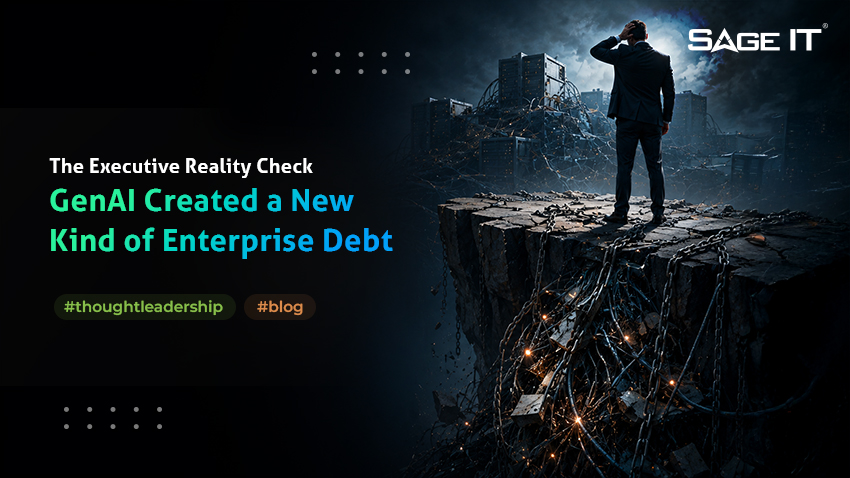
In many organizations, the first wave of GenAI has quietly created a new liability, often called output inflation. Polished volume goes up, but better decisions, stronger customer outcomes, and more reliable work do not automatically follow. Like any debt, it accrues silently and comes due later as review burden, rework, and eroding trust in what the machine produced.
That is the executive reality check. The pilot era of GenAI is over. The systems era is here, and leadership teams now have to decide whether GenAI scales through operating discipline or organizational noise.
In two years of pilots, copilots, and demos, GenAI proved it can create genuine productivity gains. Those same efforts also exposed the harder reality: hallucinations, data-leakage risk, inconsistent answers, unclear ownership, and uncertainty about where human judgment must stay in control.
So the question is no longer whether GenAI improves productivity. It does. The question is whether those gains can be made repeatable, reliable, governed, and safe enough to compound across the enterprise.
As Daugherty and Wilson argued in Human + Machine, advantage is created in the “missing middle,” where people and machines together produce outcomes neither could achieve alone. That is why GenAI should no longer be managed as a software tool. It is an operating capability, with accountability, reliability targets, governance, and service levels.
From the pilot era to the systems era
Tools live at the edge of the organization: individual productivity, local experimentation, discretionary use. Operating capabilities live in the core: repeatable workflows, measurable outcomes, controlled risk, predictable performance.
GenAI forces the shift for three reasons: it is a general-purpose interface for work; it introduces probabilistic behavior into processes most organizations treat as deterministic; and it is increasingly able to act, not just advise.
The question is not whether agentic AI arrives, but whether it scales through design or through chaos.
| Pilot Era | Systems Era |
|---|---|
| Experiments | Operating capabilities |
| Individual prompts | Governed context |
| Local productivity wins | Enterprise workflow redesign |
| Model selection | Reliability strategy |
| Optional governance | Embedded controls |
| Output volume | Business outcomes |
The pilot era proved the potential. The systems era decides whether that potential becomes business value or becomes enterprise noise.
What leaders must stop doing
Stop measuring progress by the number of use cases launched. A long list of pilots is not transformation. Measure outcomes improved: cycle time, rework, cost-to-serve, quality, compliance performance, and decision speed.
Stop treating model selection as the strategy. The model matters; it is not the operating model. Context, governance, integration, workflow redesign, adoption, and measurement matter as much or more.
Stop confusing more output with better performance. Without quality standards, review discipline, and clear decision rights, AI-generated output becomes productivity theater. The enterprise does not need more polished noise; it needs better decisions, faster execution, and more reliable work.
Containing output inflation is operational, not aspirational. The practical guardrails are concrete: quality rubrics for AI-assisted work, review loops that reward concise decision support over sheer volume, a citations-required rule for high-impact outputs, and training that rewards judgment rather than verbosity.
Two executive frameworks that cannot stay ambiguous
1. The AI Action Boundary Model
Define where AI can support work, where humans must approve it, and where autonomy is allowed only under strict controls.
| Boundary | What AI can do | What Human role | Risk posture |
|---|---|---|---|
| Advise | Suggest options, insights, recommendations | Decide | Low–medium |
| Draft | Create content or proposed responses | Review and approve | Medium |
| Execute with approval | Trigger an action after confirmation | Authorize | Medium–high |
| Execute autonomously | Act within defined constraints | Monitor and intervene | High |
Map this to workflow risk. Summarizing an internal meeting is low risk. Recommending pricing, approving eligibility, answering a regulated customer inquiry, or initiating a payment is not.
For higher-risk workflows, define circuit breakers, including conditions under which the AI must stop, escalate, or require explicit human approval. The goal is not to slow the organization down; it is to keep a productivity initiative from becoming an incident-response program.
2. The GenAI Reliability Checklist
Most executive discussion over-indexes on which model or vendor to pick. Mature enterprises focus on reliability strategy instead.
| Reliability dimension | Executive question |
|---|---|
| Accuracy | What error rate is acceptable for this workflow? |
| Grounding | Which sources must the AI use? |
| Citations | When must the AI show evidence? |
| Safe refusal | When should it decline, say it does not know, or escalate? |
| Latency and uptime | How fast and how available must the system be? |
| Monitoring | How will failures be detected in production? |
| Regression | How will updates be tested before release? |
| Escalation | Who owns edge cases and incidents? |
You do not deploy a model. You deploy a system with service levels.
Three operating shifts underneath the frameworks
From answers to evidence. Retrieval-augmented generation grounds outputs in approved sources, but RAG itself is no longer the differentiator. What matters now is how well the system is operated. For low-risk ideation, a weak answer is tolerable. For customer communication, compliance guidance, pricing, or legal commitments, citations are a control, not a formatting preference.
From prompts to governed context. Prompting helps an individual; context engineering helps an enterprise. It is the discipline of designing repeatable pipelines for which sources can be used, how permissions are enforced, when the AI must cite or refuse, and which actions require human approval. At scale, many “model failures” are really permissioning failures.
From isolated agents to interoperable systems. Copilots, custom GPTs, automations, and early agents are already spreading across teams, and the standards picture is consolidating fast. The Linux Foundation’s formation of the Agentic AI Foundation in late 2025, backed by major cloud, AI, and enterprise technology providers and supported by the growing adoption of standards such as MCP and AGENTS.md, signals a broader shift: agentic AI is moving from single-vendor experimentation toward open, enterprise-grade infrastructure.
Enterprise architecture must prepare for agentic systems now; this is a current operating-model requirement, not a future one.
Building it like a capability
Four moves turn this into an operating capability.
First, establish three-line accountability. Business owners own outcomes and residual risk, risk, compliance, and security set guardrails, and audit validates controls.
Second, build a shared platform layer so every function starts from a higher baseline of approved models, retrieval, identity controls, evaluation, and monitoring.
Third, use a tiered deployment model matched to risk.
Fourth, treat evaluation as a release gate. For medium- and high-risk workflows, pre-production evaluation and production monitoring are non-negotiable.
What to do in the next 90 days
Leaders do not need to transform the whole enterprise at once. They need the right starting points and operating discipline that scales.
1. Pick. Pick two or three high-value workflows that are high-volume, language-heavy, and measurable, such as customer-inquiry triage, policy Q&A, proposal drafting, ticket summarization, and contract-review support.
2. Classify. Define the action boundary and risk tier for each.
3. Ground. Ground high-impact outputs in approved enterprise knowledge. Here, citations are not optional; they are part of trust.
4. Measure. Build evaluation sets from real examples, edge cases, and known failure modes; track cycle time, rework, first-pass quality, quality score using a human rubric, adoption, and escalation frequency.
5. Standardize. Publish a standard way of working with AI: approved and prohibited uses, risk tiers, citation expectations, data-access rules, and escalation paths.
The bottom line for CXOs
GenAI is not another tool rollout. It is a new operating capability that is already shaping how work is designed, how decisions are supported, and how customers are served.
The next phase of advantage will not come from isolated pilots. It will come from building AI into the operating fabric of the enterprise, with clear ownership, trusted context, measurable reliability, and human judgment designed into the workflow.
Treat GenAI the way you treat cybersecurity, data, and cloud: horizontal, strategic, and continuously improved as models, workflows, and risks evolve.
The goal is not to remove human judgment from the enterprise. It is to place human judgment where it creates the most value, around risk, context, accountability, and the decisions that matter.
For enterprises, the opportunity is not simply to adopt GenAI faster. It is to build the operating discipline that lets AI scale with trust, evidence, and measurable business value.
That is where Sage IT helps enterprises move from experimentation to execution: turning GenAI pilots into reliable operating capabilities by combining integration, grounding, and governance so AI scales with evidence, controls, and measurable business value.
Additional references: Linux Foundation announcement on the formation of the Agentic AI Foundation; Anthropic, Model Context Protocol; OpenAI / AGENTS.md; Microsoft Azure guidance on groundedness; industry coverage on agentic interoperability.