

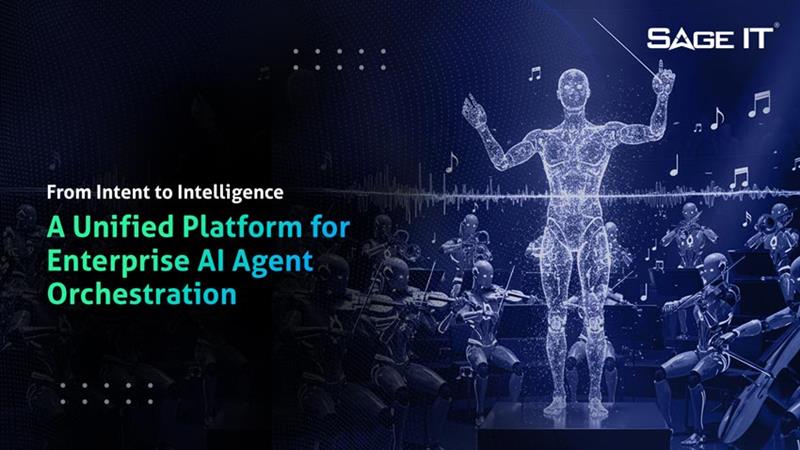
Most organizations are one platform away from scale.
Frontier model capability is no longer the constraint. The six structural gaps below are what keep AI initiatives trapped in controlled experiments.
01 — Fragmentation
LangChain, CrewAI, and custom logic coexist with no shared runtime, observability, or governance. Every team picks its own stack. Nothing talks to anything.
02 — High Barrier to Entry
Building a production agent requires framework expertise, prompt engineering, container knowledge, and DevOps chops. Most teams have at most two of the four.
03 — Operationalization Gap
Moving from prototype to production is its own specialist discipline. Without a dedicated AI platform team, agents sit in limbo indefinitely.
04 — Coordination Vacuum
There’s no standard for agent-to-agent discovery or message routing. Multi-agent systems get wired together with hard-coded endpoints that break the moment anything changes.
05 — Safety as Afterthought
Global output filters can’t differentiate between a support agent that must protect PII and a research agent that needs full access. Bolted-on safety is either too blunt or full of gaps.
06 — Observability Blindspot
Without per-call cost attribution and behavioral trend monitoring, you can’t manage what you can’t see. LLM costs creep up in silence until it’s too late to optimize.
29 pages of architecture that actually ships.
Page 01 — The Enterprise AI Agent Problem
Why the shift from assistants to agents changes everything — and the six structural gaps blocking production deployment
Page 03 — From Intent to Agent: Natural Language Creation
The 5-stage pipeline that takes a plain-English description and returns a deployment-ready agent specification
Page 05–06 — Multi-Agent Solutions & A2A Communication
Visual composition, workflow orchestration, and the capability-based registry that lets agents discover each other at runtime
Page 07–08 — Guardrails, Knowledge & Enterprise Connectivity
Safety-native per-agent policy profiles, RAG pipelines, native tools, and MCP server integration
Page 09–12 — Observability, Deployment & Enterprise Readiness
Lang fuse tracing, one-click Kubernetes deployment, multi-provider LLM management, and four-layer audit trails
Page 13–14 — Use Cases & Platform Differentiation
Six production patterns, from customer support automation to DevOps intelligence vs. the build-your-own alternative
“The gap is not one of model capability — it is one of platform.”
“AI agents are the new microservices. Like microservices, they cannot be managed at scale through individual attention — they require a control plane.”
Read this if AI deployment is your problem to solve.
Enterprise Architects
Get the full technical stack — from Kubernetes deployment to Redis state management — before your next design review.
CTOs & VPs of Engineering
Understand exactly what a production AI agent platform requires before committing headcount to build one from scratch.
Product & Operations Leaders
Six use cases with concrete workflow patterns show you which business problems agents can solve today — not in theory.
Compliance & Security Teams
See how per-agent guardrail profiles and four-layer audit trails address the governance requirements that block AI deployments.