

There’s a moment in Apollo 13 when Jim Lovell tells the story of a night flight off a carrier. His radar jams, then his instrument lights short out, and suddenly he’s sitting in a black cockpit over a black ocean with no idea where home is. He’s seconds from ditching. And then he looks down and sees it: a long green glow in the water, phosphorescent algae churned up by his own carrier’s wake, painting a glowing runway across the dark straight back to the deck. “It was leading me home,” he says. The thing that saved him wasn’t the instrument panel. It was a faint signal he almost didn’t look for.
I think about that scene a lot, because a good chunk of my career has been spent staring into black cockpits. It started in an overheated classroom in Bangalore, where my Operations Research professor wrote two letters on the board, NP, and then the word that’s trailed me for twenty years: hard. The Traveling Salesman Problem. Some problems, he warned us, balloon so fast that no computer on Earth can brute-force its way to the answer. You lean on a heuristic, trust your gut, and settle for “good enough.”
I never fully made peace with it. And the first time I read about quantum computing (years ago, through a logistics lens, of all things) it landed exactly like Lovell’s green glow. A different kind of signal in the dark. I chased that idea across a whole blog once already. This is me still chasing it, except the glow is brighter now, and this time I can actually see the ships deck.
Last time, I strapped the whole idea to a DeLorean and hit 88. A gloriously fun ride into the future, but I blew through a few red lights. This time around, I’ve got a far more practical idea: blending Archestra, the orchestration engine we’ve already built at Sage IT, with real advances in quantum computing, the kind that have quietly stopped feeling like science fiction. The future I’m about to describe doesn’t need a flux capacitor. All it needs is silicon fabrication technology that already exists in abundance: the same lines we’ve used for decades, just now learning to print qubits too.
The spark came on a trip to Sydney. I was touring a lab when the lead engineer explained, very matter-of-factly, that we’re closing in on the point where you can manufacture quantum bits at scale, not with exotic, hand-built contraptions, but on the same wafer technology that already prints ordinary chips. Manufacturability. That was the word that stuck. Because the moment something becomes manufacturable, it stops being a physics dream and starts being an engineering timeline. Hold that thought: first, let me tell you what’s actually broken.
The thing that actually slows projects down (spoiler: it isn’t the code)
Ask anyone who’s shipped something large what really eats the timeline, and almost nobody says “the code.” They say the coordination. Who’s blocked on whom. Which piece can’t start until three others land. How the entire plan quietly rearranges itself the instant one dependency slips.
And we’re not amateurs about this anymore: we have serious mechanisms for it. Modern planning platforms do critical-path analysis, resource-leveling, automated scheduling; the Jiras and Smartsheets of the world recompute a sprint the moment you drag a card. We left whiteboards and gut-feel behind a long time ago. But strip away the dashboards and every one of those tools is doing the same thing underneath: approximating. They make an educated guess at an answer that is, mathematically, too large to actually compute. Even our best dashboards don’t solve the scheduling problem: they approximate it, and status meetings exist to measure how far off the approximation was.
Here’s where my Sydney brain kicked in. We already live in this space: Archestra, our agentic orchestration platform for the AI-assisted software development lifecycle. So I’m in that lab, watching quantum bits inch toward manufacturability, and two wires cross in my head: what I’m looking at here is the missing half of the agent-driven delivery we’re already chasing. What if these two things, the agentic orchestration we have today and the quantum hardware arriving tomorrow, grew up together?
(Yes, this is the part that might read like a soft plug for our platform. It isn’t meant to be, and if it comes across that way, I’ll live with it, because the real subject is bigger than any one product: how projects themselves are going to run once quantum is in the mix.)
Enter the swarm
We’re moving from software that humans write and AI assists, to software built by swarms of agents: agents that spin up other agents, split the work, negotiate among themselves, and run in parallel at a scale no human team can match. When that becomes normal (and it will, sooner than most people think), the bottleneck moves. It stops being “how fast can people build” and becomes “how well can we conduct thousands of agents toward one goal.”
That’s the future we’ve been building toward.
Meet the conductor of the near future: Archestra on Quantum
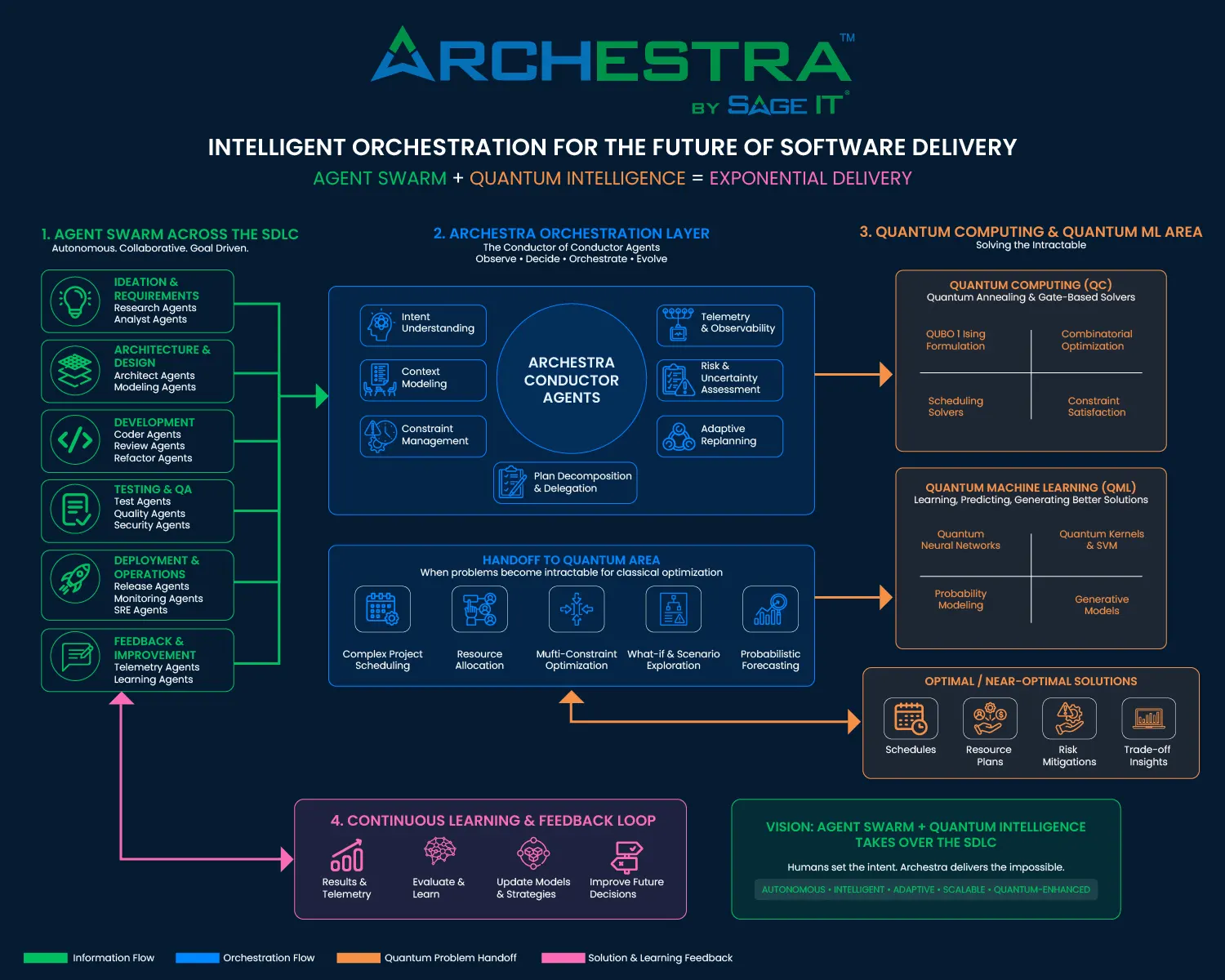
A quick, honest framing. Orchestration, as most of us have known it, was built for humans: coordinating people, teams, and handoffs. Archestra is a different animal: an orchestration scaffold for the full agentic stack. It stands up agents, tools, and workflows and nimbly conducts them across data, models (LLMs and classical ML), and infrastructure. It observes, decides, orchestrates, and evolves: reading intent, modeling context, managing constraints, decomposing the plan, and delegating it across the swarm. The figure with the baton, except it never loses the score and never sleeps.
So why drag quantum into it at all? Because agentic swarms are the near future, and the near future breaks the math. The moment you have thousands of agents contending for shared resources under shifting priorities, your scheduling problem detonates into something no classical machine can truly optimize. Quantum used to be the thing we filed under “someday, once we can control all the parameters.” What I saw in Sydney rearranged that timeline in my head: someday started looking a lot like soon. And an orchestration layer built for the agentic era is exactly the thing that’s ready to absorb it.
Here’s the move that matters. When Archestra hits a decision that’s genuinely intractable (the scheduling knot, the resource fight, the ten-thousand-constraint optimization), it doesn’t stall the whole orchestra. It hands that one problem to a machine built for it, takes the answer back, and keeps conducting.
Why quantum, and why I’m not hand-waving this time
Let me be careful, because this is where quantum gets oversold. It is not going to replace your servers, and it is not going to write your code. But that scheduling monster, the Resource-Constrained Project Scheduling Problem (RCPSP) and grown-up cousin of my old classroom nemesis the TSP, is NP-hard. It’s precisely the family of combinatorial optimization problems quantum was born to attack. Reframe a schedule as an optimization landscape, a QUBO, a Quadratic Unconstrained Binary Optimization problem, then hand it to a quantum annealer or a gate-based solver, and let it explore a space far too vast for any classical computer to walk.
Make it concrete. Picture a real enterprise release six months out. A dozen agent swarms are working at once: coding agents, test agents, security agents, infrastructure agents, with thousands of interdependent tasks between them, all competing for the same finite pool of build runners, staging environments, data sets, and the handful of human approvals that still gate a ship. Every time a requirement shifts or a security scan lights up, the optimal ordering of everything downstream changes. Today we don’t solve that tangle; we can’t. We pick a decent-looking path and course-correct when it snaps. A quantum solver can hold the entire tangle at once (every task, every constraint, every dependency) and hand back an arrangement we could never have reasoned our way to. A different category of answer to a problem we’ve only ever been approximating, because until now we simply didn’t have the horsepower.
This part is real, and the wafer is why
Sydney was the eye-opener, not the whole story. In that lab, I finally saw the thread that ties this together: CMOS manufacturing, the same process that’s printed chips for fifty years, is now bending toward the manufacturability of quantum. That’s the part that gives me hope, because manufacturable means real.
And once you start pulling that thread, it’s everywhere. In July 2026, Diraq and imec ran a working eight-qubit silicon spin array fabricated on a standard 300mm CMOS foundry process: the same industrial line that feeds the trillion-dollar chip market. And these are “hot” qubits: where the big superconducting machines from Google and IBM must sit near 15 millikelvin (colder than deep space, in a refrigerator that costs more than a house), silicon spin qubits now run above 1 Kelvin, more than sixty times warmer. Sounds trivial. It’s the difference between a lab showpiece and something that could one day live in an ordinary data-center rack.
Silicon Spin Qubits vs Superconducting Qubits: Cryogenic & Spatial Scaling Breakthroughs
Operating Temperature (Kelvin)
Qubit Physical Footprint / Pitch
And this is no single lab’s lucky break. Intel has been printing spin qubits on 300mm wafers at its Oregon fab (the same lithography that makes its CPUs) at better than 95% yield across ten-thousand-plus quantum-dot arrays per wafer, and its quantum hardware lead flatly says a full-scale quantum computer “could be produced in a present-day chip factory.” They’ve already shipped a 12-qubit research chip to universities. In 2026 Intel’s 18A node picked up its first quantum process design kit, with Hitachi and Japan’s AIST chasing a thousand qubits by 2030. IBM spent that same summer acquiring HRL Laboratories and routing it through its own wafer foundry in Albany, New York. And you can safely bet the same race is running in China, in South Korea, anywhere with a serious foundry and national ambition.
Notice the common thread. Not a new exotic material. Not a room-sized one-off. The same CMOS method we’ve spent fifty years and untold billions perfecting. Which is also why this is a window and not a spectator sport: the organizations that start thinking in agentic-plus-quantum terms now are the ones who’ll be ready when the hardware fully lands. We’d rather be early than polite about it.
The part where the humans come back in
Now a confession, because I made one last time and I meant it. We didn’t dream up the Archestra-plus-quantum idea alone, and I’m not writing this blog alone either. AI tools helped. Colleagues helped. But the memory of that Bangalore classroom, the stubborn hunch that scheduling is the real boogeyman, the decision to point all of it at how we actually deliver software, even that opening riff about Lovell and the green glow: that part is ours. The human part. Me, you, us.
That’s the shape of the future we’re building toward. Humans set the intent. The swarm does the work. Archestra conducts. And when the math turns impossible, a chip grown on a silicon wafer solves the thing we’ve been guessing at for decades. Project management stops being a room full of people bravely eyeballing a plan, and becomes something closer to physics: intent in, optimal plan out.
Here’s what I keep coming back to. The most powerful technology in that entire chain isn’t the swarm, and it isn’t the qubit. It’s the human imagination that reached for both. Last time I let that imagination sprint all the way to AGI: phantasmagorical, fantastical, a little unhinged. But strip away the sci-fi and what’s left is still the most extraordinary thing we’ve got: the ability to picture something impossible and then, stubbornly, build our way to it. That’s the whole story of us. It’s how we got off the ground, how we got to the Moon, how we’re already arguing about Mars over coffee. Every one of those began with someone staring into a black cockpit, refusing to ditch, waiting for the glow.
Quantum computing wrapped around agentic orchestration is just the latest glow on the water. That’s how this blog came to be: one more attempt to point at the carrier deck before we can quite see it. I hope you enjoyed the ride.
So buckle up, fellow travelers. We’re not done: this is only Part 2.
And if I remember my Back to the Future right, the good stuff always happens in the sequels