

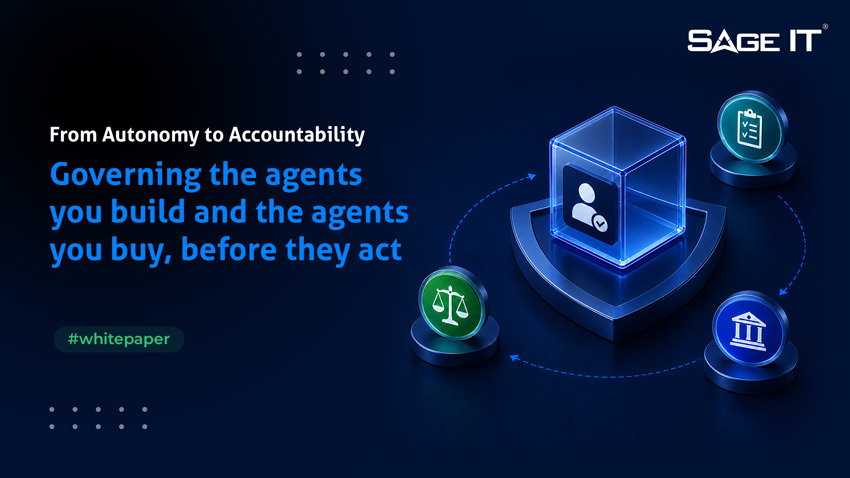
Only one in five organizations has mature governance for autonomous agents. This paper shows what production-grade agent governance looks like, and how a global tax-compliance software firm reached it.
Why this matters
An AI agent that queries a CRM, posts to a ledger, or opens a ticket is a privileged actor inside your business. Most security teams cannot answer five basic questions about it: which agent acted, on whose authority, what it touched, whether that stayed in bounds, and whether they could prove any of it.
That gap is not shrinking. Agent adoption is climbing toward three in four organizations within two years, while mature governance sits at roughly one in five. A third of executives aren’t confident they could stop a rogue agent if one started causing harm.
This whitepaper covers:
One control plane for the agents you build and the agents you buy.
Frontier model capability isn’t what’s holding enterprises back from scaling agents anymore. Governance is. When every agent has an identity, holds only the access its task requires, and leaves an audit trail an auditor will accept, the security review that blocks most agents from production becomes a repeatable approval.
The agents don’t need to become more capable. They need to become accountable.