

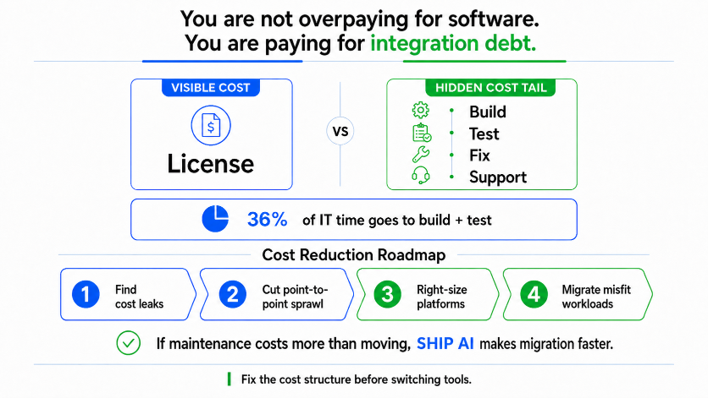
Most enterprises overpay for integration not because of the platform they chose, but because of the architecture they never fixed. To reduce those costs, fix the architecture first, the maintenance tail and point-to-point sprawl, then migrate the platforms that are genuinely misfit, because a justified migration is usually the single largest one-time cost reduction available. The platform license is the visible line item and the easy one to negotiate, but it is rarely where the full cost lives.
MuleSoft’s 2025 Connectivity Benchmark reports that organizations spend an average of $4.7 million building custom integrations, run roughly 1,000 applications, and have integrated more than half of them in only about 2% of cases. Its 2026 benchmark adds that IT teams spend 36% of their time building and testing integrations. Those figures point to the real issue: integration cost compounds through build effort, testing effort, rework, and long-term maintenance.
At Sage IT, our position is simple. Do not reduce integration cost by chasing the cheapest tool; reduce it by answering four questions:
- Where does the integration spend actually go?
- Which integrations create the most maintenance load?
- Which platforms are over-scoped, under-used, or strategically misfit?
- Which migrations are worth doing, and how do we reduce their cost and risk?
Of those four, migration is where the largest one-time savings sit. When right-sizing shows that a legacy or over-scoped platform should move, Sage IT’s SHIP AI becomes the lever: a generative-AI migration accelerator that moves TIBCO and MuleSoft estates onto AWS, Azure Integration Services, SAP BTP, or Boomi at materially lower migration cost and faster delivery, by extracting legacy integration logic and generating target-platform workflows automatically. License negotiation buys visible savings and architecture cleanup buys durable savings, but an accelerated migration off the wrong platform is what unlocks the step-change, which is why most of this guide moves from diagnosis to migration.
Quotable takeaway: Integration cost is dominated by maintenance and point-to-point sprawl, not the platform license.
How this guide was created
This guide was prepared by Sage IT’s integration and AI solutions practice using primary industry benchmarks, iPaaS cost research, Model Context Protocol adoption signals, and Sage IT’s implementation experience with SHIP AI, CogniDev, integration modernization, and platform migration programs. Cost figures, vendor pricing, benchmark data, and migration metrics should be validated against each client’s contracts, architecture, integration inventory, and target operating model before any platform or migration decision.
Where enterprise integration cost actually comes from
Why are integration costs higher than they look?
Enterprise integration costs look lower than they are because most budgets track the platform subscription and miss the maintenance tail. MuleSoft’s 2026 benchmark also found that 26% of IT projects were not delivered on time in the last 12 months, a reminder that integration cost is not only a platform expense. It shows up as delayed delivery, rework, missed business timelines, and lost team capacity.
A Forrester Total Economic Impact study of the Boomi platform described the pre-state clearly: point-to-point connections and legacy middleware created integration sprawl that slowed business processes. The license is the visible line item, but the real cost is distributed across integration design, initial build, testing, failed jobs, rework after API changes, manual monitoring, specialist support, regression testing, delayed business projects, and migration debt. That is why a platform can look expensive while the architecture underneath it is the bigger problem.
What drives enterprise integration costs?
Enterprise integration costs are driven by three layers.
| Cost layer | What it includes | Why it matters |
| Platform license | iPaaS, middleware, API management, cloud integration services | Visible, negotiable, and easy to benchmark |
| Initial build | Design, development, mapping, testing, deployment | Often underestimated during project planning |
| Ongoing maintenance | Fixes, API changes, monitoring, rework, regression testing, support | Usually the largest long-term cost driver |
The mistake is treating the first layer as the whole problem. A cheaper platform can still become expensive if every integration is custom-built, poorly documented, and difficult to maintain.
Quotable takeaway: The license is visible. The maintenance tail is where integration cost compounds.
What is the total cost of ownership of an integration?
The total cost of ownership of an integration is the platform license plus the initial build cost plus every year of maintenance over the integration’s life, and that final component matters most over time. Build cost happens once; maintenance repeats every year. Every brittle connection creates a future support obligation, every undocumented mapping creates a future dependency, and every point-to-point integration becomes fragile when one system changes its API, schema, endpoint, security model, or business rule. The defensible way to size the maintenance share is effort: MuleSoft’s 2026 Connectivity Benchmark reports IT teams spend 36% of their time building and testing integrations. That is why the better metric is not just platform spend, but cost per live integration.
What should an integration cost audit measure?
A useful cost audit should separate spend into four categories.
| Audit area | What to measure |
| License cost | Annual subscription, platform tiers, usage-based charges |
| Build cost | Design, development, testing, deployment, consulting |
| Maintenance cost | Support hours, failure resolution, API changes, regression testing |
| Business impact | Delayed projects, failed transactions, operational risk, lost team capacity |
The output should be a ranked list of the most expensive and most fragile integrations, that is the list that matters, not the vendor invoice alone.
Why does cutting the platform license rarely solve the problem?
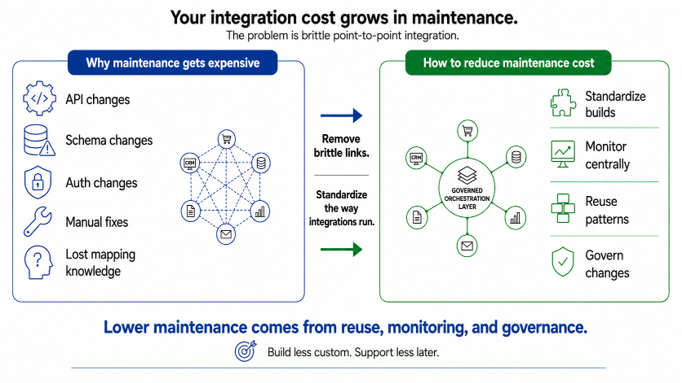
Cutting the platform license rarely solves the problem because the integration pattern usually remains unchanged. If the architecture is still point-to-point, every platform becomes expensive; if every new system requires a custom build, every platform becomes slow; and if logic is trapped in undocumented mappings, every platform becomes risky. MuleSoft’s 2026 benchmark shows the load sits in the architecture, not the license: IT teams spend 36% of their time on integration work and 26% of projects ran late in the last 12 months. A vendor switch can reduce the subscription line and still increase total cost if it resets build, training, testing, migration, and governance effort. That is why we recommend a different sequence: audit first, right-size second, and migrate only where the platform is genuinely misfit.
Quotable takeaway: Switching platforms to save money is usually not the cheapest path. The cheaper move is to right-size and collapse point-to-point sprawl, then migrate only what is genuinely misfit.
How to actually reduce integration cost
What are the five levers that actually reduce integration cost?
There are five levers that reduce integration cost, and only one of them is the license.
| Lever | What it does | Why it reduces cost |
| Audit total cost of ownership | Separates license, build, and maintenance | Shows where the money actually goes |
| Right-size the platform mix | Matches workloads to the cheapest adequate platform | Avoids paying for unused capability |
| Collapse point-to-point sprawl | Consolidates brittle custom connections | Reduces rework and support load |
| Standardize on agentic, self-healing integration | Uses governed, reusable connection patterns | Reduces rebuilds after system changes |
| Govern for reuse | Makes each new system configurable, not custom-built | Prevents cost from returning |
This is the practical framework. A license negotiation may help, but architecture improvement is what creates durable savings.
How do you reduce integration maintenance costs?
Reduce integration maintenance costs by removing brittle point-to-point connections and standardizing how integrations are built, monitored, reused, and governed. A point-to-point connection may be fast to build, but it becomes expensive when the source API changes, the target schema changes, authentication requirements change, business rules change, the original developer leaves, no one understands the mapping logic, or failures require manual investigation.
A Forrester Total Economic Impact study reported that the Boomi platform reduced integration development time by 65% in an earlier engagement. Some maintenance-reduction claims in the market are stronger, including vendor claims of 80% reductions in integration maintenance effort, but those should be treated as claims to verify rather than independent benchmarks. The right posture is to use vendor claims carefully and measure your own before-and-after team hours.
Quotable takeaway: Maintenance reduction should be measured in support hours, failure rates, and cost per integration, not only in vendor headline percentages.
Platform cost, fit, and ROI
Platform cost compared: Boomi, MuleSoft, and Workato
Boomi, MuleSoft, and Workato sit at different cost and fit profiles, and choosing the wrong fit is one of the fastest ways to overpay.
Independent pricing analysis commonly places MuleSoft Anypoint around $300,000+ per year at scale, with certified consultants around $150 to $250 per hour and 6 to 12 month implementations. Boomi Professional starts near $550 per month, with quote-based enterprise tiers, and Workato uses recipe-based pricing that is often lower at entry. These are indicative ranges, not fixed list prices, because all three vendors negotiate.
| Platform | Indicative cost positioning | Best-fit cost profile |
| Boomi | From around $550/month; enterprise quote-based | Broad mid-market and enterprise iPaaS, packaged connectors |
| MuleSoft Anypoint | Around $300,000+/year at scale; consultants $150–$250/hour | API-led architecture, complex enterprise API management |
| Workato | Recipe-based pricing; often lower at entry | SaaS workflow automation and business automation |
The practical implication is not “MuleSoft is bad” or “Boomi is always cheaper.” It is this: if an organization is running broad mid-market integration on an expensive API-led estate it does not fully use, it may be paying for capability that does not match the workload. That is a right-sizing opportunity.
Boomi vs MuleSoft: which costs less?
For most mid-market integration estates, Boomi is the lower-cost option and MuleSoft is the more expensive, API-led platform. Independent pricing analysis places MuleSoft Anypoint around $300,000+ per year at scale with 6 to 12 month implementations, while Boomi Professional starts near $550 per month. The gap is not only sticker price: MuleSoft is priced for complex, full-lifecycle API management, so an organization running broad mid-market integration on MuleSoft often pays for capability it does not use. Boomi is the cheaper fit for that workload, but if the wider estate is consolidating on AWS, Azure, or SAP BTP, the lowest total cost is usually landing integration in that cloud rather than on either iPaaS.
Is iPaaS worth the cost?
iPaaS and cloud-native integration are worth the cost when they replace custom-coded, point-to-point integration and reduce the maintenance that comes with it. They are not automatically worth it if they simply wrap the same sprawl. Independent Forrester Total Economic Impact studies have found strong returns when managed integration replaces custom work, for example, the Forrester TEI of the Boomi platform reported 347% ROI, and the Forrester TEI of Microsoft Azure Integration Services reported 295% ROI with $8.57M net present value over three years. These are separate, vendor-commissioned composite studies with different scopes, baselines, and time periods, so read them as directional evidence that managed and cloud integration pay back, not as a head-to-head ranking of one platform against another.
The pattern is consistent: managed and cloud-native integration reduce cost when they consolidate custom work and reduce support effort. They do not reduce cost when the underlying architecture remains fragmented.
Why agentic, self-healing integration is the next cost lever
Agentic integration is becoming relevant because it changes how systems and AI-enabled workflows connect. The point is not simply “AI for integration.” The point is a standardized, governed layer where agents and systems can connect without recreating custom point-to-point work every time.
What is agentic integration?
Agentic integration is an architecture where AI agents execute workflows across systems through standardized, governed interfaces rather than hand-coded point-to-point connectors. The Model Context Protocol, launched by Anthropic in November 2024 and backed by OpenAI, Google, Microsoft, and AWS, is emerging as one standard for this layer. It reduces integration complexity from N × M custom connectors to N + M standardized connections. Before standardization, every agent-system combination required custom work; with a standardized protocol, systems expose capabilities once and agents connect through a governed interface.
Quotable takeaway: MCP changes the integration problem from many custom connections to fewer standardized interfaces.
How does MCP reduce integration cost?
MCP reduces integration cost by replacing bespoke, per-tool connectors with a single standardized interface pattern. That can reduce custom connector builds, rework after system changes, vendor lock-in, agent-specific integration complexity, and duplicate integration logic.
Anthropic’s ecosystem update cites more than 10,000 active public MCP servers, and a 2026 enterprise survey reported 41% of software organizations running MCP servers in limited or broad production. That does not mean every enterprise should rush into MCP, it means the integration pattern is moving from pilot conversation to production architecture. The cost opportunity is real, but it still needs governance.
Does agentic integration actually reduce cost, or is it hype?
Agentic integration reduces cost in direction, but the headline percentages should be treated carefully. The credible signal is not that every vendor claims a large cost reduction; it is that brittle integration is one of the biggest reasons enterprise AI stalls. MIT’s Project NANDA found that only 5% of custom enterprise AI tools reach production, with failures attributed largely to brittle enterprise integration rather than model quality, and McKinsey has similarly reported that a large share of companies use generative AI while many still see no material earnings impact. Our view: agentic integration can reduce cost when it standardizes access, reduces rebuilds, and makes workflows more adaptive, and it creates risk when it is deployed without controls.
How do you keep agentic integration safe to deploy?
Two controls make agentic integration enterprise-ready.
| Control | What it does |
| Auto-discovery | Lets agents discover available systems and capabilities through a governed layer |
| Human-in-the-loop monitor | Keeps auditable records of agent decisions and holds high-impact actions for review |
This is the difference between a pilot and a production-grade architecture. For regulated buyers, autonomous connectivity is not enough: the agent must be governed, it must be auditable, and it must know when not to act.
Quotable takeaway: Production-grade agentic integration combines autonomous discovery with governed, auditable execution.
When to switch tools, and when to migrate
When is switching tools the wrong move?
Switching tools is the wrong move when the only reason is a lower sticker price. A platform switch can introduce migration cost, retraining cost, rebuild cost, testing cost, operational risk, temporary productivity loss, and new governance work. If the existing platform is stable, well-used, and strategically aligned, fixing the architecture is often cheaper than switching platforms.
Should you switch off MuleSoft to cut costs?
Not automatically. Switching off MuleSoft purely to cut cost is usually not the cheapest path, because migration itself can exceed a year of license savings. The stronger first move is to right-size by asking whether the organization is using MuleSoft’s API-led capabilities, whether workloads are complex enough to justify the platform, what the cost per integration is, which integrations are fragile, which workloads could move to AWS, Azure, SAP BTP, or Boomi, and which workloads should stay. Switching makes sense when the platform is genuinely misfit, not when the invoice is simply uncomfortable.
When is migration worth it?
Migration is worth it when an organization is locked into a legacy or over-scoped platform whose license, maintenance, specialist dependency, and operational drag exceed the value it returns. Common examples include:
| Situation | Why migration may be worth evaluating |
| Legacy TIBCO estate | Rising support dependency and modernization pressure |
| Under-used MuleSoft estate | Paying for API-led capability the business does not fully use |
| Cloud-first enterprise | Integration may belong closer to AWS or Azure-native services |
| SAP-centric enterprise | SAP BTP may better align with ERP direction |
| Broad mid-market integration | Boomi may be a better fit for multi-system iPaaS needs |
This is where migration becomes a right-sizing decision, not a procurement reaction.
Where does SHIP AI fit into integration cost reduction?
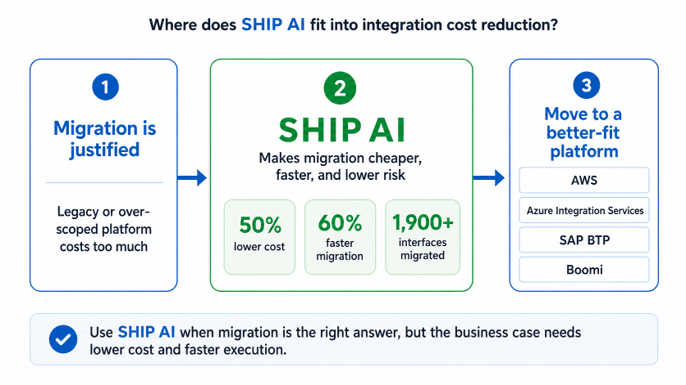
SHIP AI fits when the cost audit shows that migration is the right move, but migration cost and risk are blocking the business case. Many organizations know they have outgrown a legacy or over-scoped platform, yet they stay because migration looks slow, expensive, risky, and dependent on scarce specialists. SHIP AI addresses that barrier directly.
SHIP AI is Sage IT’s generative-AI migration accelerator for moving legacy integration estates off TIBCO and MuleSoft onto AWS, Azure Integration Services, SAP BTP, or Boomi. It reduces migration cost by 50% and migration time by 60% by extracting and interpreting legacy integration logic and generating target-platform workflows automatically. SHIP AI has helped migrate more than 1,900 interfaces across engagements and runs on a secure, localized Docker deployment.
See your projected cost and timeline reduction in minutes.
That positioning should stay precise. SHIP AI is not the answer to every integration cost problem; it is the answer when the architecture says migration is justified and the business case needs a lower-cost, faster path.
Confirm the right target platform and scope the move before you commit.
Quotable takeaway: SHIP AI does not replace the cost audit. It makes the justified migration cheaper, faster, and less dependent on scarce legacy expertise.
When the target is AWS, Azure, or SAP BTP
Most 2026 migrations off TIBCO or MuleSoft do not land on another iPaaS. They land on a platform the enterprise has already chosen, AWS, Azure Integration Services, or SAP BTP, and SHIP AI runs those migrations in production today, not only the move to Boomi. The same 50% lower migration cost and 60% faster delivery apply, because the savings come from automating the analysis-and-rebuild work rather than from any single destination. The sections below cover which targets SHIP AI supports, how the migration works, and how to choose the right target for your estate.
Can SHIP AI migrate to AWS, Azure, SAP BTP, and Boomi?
Yes. SHIP AI supports migrations from TIBCO and MuleSoft to AWS, Azure Integration Services, SAP BTP, and Boomi. It is built for any-to-any migration, any legacy source onto any modern target, and already supports production TIBCO-to-AWS and TIBCO-to-Azure migration patterns, with SAP BTP and Boomi supported as targets.
Right-sizing in 2026 rarely means moving to another iPaaS by default. For many enterprises leaving TIBCO or MuleSoft, the destination is a stack already in the estate: AWS, Azure Integration Services, SAP BTP, or Boomi. The 50% cost reduction and 60% time reduction apply across targets because the savings come from automating the analysis-and-rebuild work, not from any single destination platform. That matters when cloud and ERP decisions have already fixed the target: the question is no longer only “which iPaaS?” but how to move off the legacy platform cheaply, safely, and with less dependency on scarce specialists. The migration tool should not force the target architecture, the target should follow the enterprise strategy.
| Target platform | When it may fit |
| AWS | The enterprise is standardizing integration near AWS-native services, data, monitoring, and governance |
| Azure Integration Services | The estate is Microsoft-centric and already uses Azure identity, monitoring, and cloud operations |
| SAP BTP | The organization is SAP-led and wants integration close to the ERP and SAP ecosystem |
| Boomi | The business needs broad multi-system iPaaS connectivity across SaaS and enterprise applications |
Quotable takeaway: The right migration target is not the cheapest platform. It is the platform that best fits the operating model.
How does SHIP AI migrate a TIBCO or MuleSoft estate?
SHIP AI turns a manual, specialist-dependent rebuild into a largely automated migration workflow. A traditional migration often requires teams to discover legacy interfaces, reverse-engineer integration logic, interpret mappings and dependencies, rebuild workflows in the target platform, validate output, test behavior, and document the new architecture. SHIP AI automates key parts of that process.
| Migration activity | Traditional approach | SHIP AI-assisted approach |
| Interface discovery | Manual inventory and review | Automated extraction |
| Logic interpretation | Specialist-led reverse engineering | AI-assisted interpretation |
| Mapping conversion | Manual rebuild | Target-platform generation |
| Workflow creation | Rebuild from scratch | Generated workflows and artifacts |
| Validation | Manual comparison and testing | Assisted validation |
| Documentation | Often delayed or incomplete | Auto-generated technical artifacts |
The value is not only speed; it is reducing dependency on institutional knowledge trapped in legacy integration platforms.
How do you choose between AWS, Azure, SAP BTP, and Boomi as the target?
Let the existing enterprise architecture decide, not the migration tool.
| Enterprise direction | Recommended target logic |
| AWS-first cloud strategy | Land integration closer to AWS-native services and governance |
| Microsoft-first cloud strategy | Use Azure Integration Services where identity, monitoring, and operations already live |
| SAP-centered enterprise | Keep integration close to SAP BTP and core ERP processes |
| Broad SaaS and enterprise app landscape | Use Boomi where packaged connectors and iPaaS breadth matter most |
Because SHIP AI supports multiple targets, the migration target can follow the architecture decision. That is the point of right-sizing.
What if migration also involves legacy application code?
Integration is often only half of the legacy estate. The platform migration moves the interfaces, but the COBOL, Java, .NET, or mainframe applications behind those integrations may also need modernization. This is where Sage IT pairs SHIP AI with CogniDev.
CogniDev is Sage IT’s multi-agent AI accelerator for application modernization. It helps transform legacy code onto AWS, Azure, or Google Cloud with zero downtime, uses a platform-agnostic any-to-any model, supports bring-your-own-LLM flexibility, and can auto-generate architecture documents, dependency maps, and tests. CogniDev reports up to 70% cost savings and 75% less migration time versus traditional modernization approaches. In short, SHIP AI modernizes the integration layer and CogniDev modernizes the applications around it, the two halves of a legacy modernization move. This should remain a supporting point: the main story is still integration cost reduction.
Audit your cost and prove the ROI
Start with a cost audit, not a tool swap
A cost audit separates the visible license from the build and maintenance spend that actually drives total cost. That audit should produce a practical decision map.
| Classification | What it means | Recommended action |
| Keep | Stable, valuable, right platform | Continue and monitor |
| Optimize | Useful but expensive to maintain | Standardize, document, improve monitoring |
| Consolidate | Duplicative or point-to-point | Collapse onto orchestration layer |
| Migrate | Legacy, misfit, or strategically misaligned | Evaluate accelerated migration |
| Retire | No longer needed or redundant | Remove safely |
The audit is also the artifact that lets IT explain the business case to finance, not with vague transformation language, but with cost per integration, maintenance effort, and migration readiness.
What is the ROI of integration cost reduction?
The ROI of integration cost reduction comes from three sources: lower platform spend after right-sizing, lower maintenance after collapsing point-to-point sprawl, and recovered team capacity. SHIP AI’s reported 50% lower migration cost and 60% faster delivery reduce the one-time investment that usually blocks right-sizing. That matters because migration economics often decide whether right-sizing happens at all: if migration is too expensive, organizations stay on platforms they have outgrown; if migration cost and timeline come down, the business case changes.
Platform and decision reference
Indicative iPaaS cost positioning
| Platform | Indicative entry / scale cost | Best-fit cost profile |
| Boomi | From around $550/month; enterprise quote-based | Broad mid-market and enterprise iPaaS, packaged connectors |
| MuleSoft Anypoint | Around $300,000+/year at scale; consultants $150–$250/hour | API-led architecture; most expensive of the three |
| Workato | Recipe-based; often lower at entry | SaaS workflow and business automation |
Situation-to-action map
| Situation | Recommended action | Sage IT fit |
| Single-system lookups and queries | Native connector or managed iPaaS | Managed iPaaS services |
| Over-paying on an under-used MuleSoft estate | Right-size to cloud or leaner iPaaS | SHIP AI migration to AWS, Azure, SAP BTP, or Boomi |
| Locked into legacy or over-scoped platform | Migrate, accelerated | SHIP AI |
| On TIBCO or MuleSoft, target is AWS | Migrate to AWS, accelerated | SHIP AI migration to AWS |
| On TIBCO or MuleSoft, target is Azure | Migrate to Azure, accelerated | SHIP AI migration to Azure |
| SAP-centric estate | Evaluate SAP BTP target | SHIP AI migration to SAP BTP |
| Broad SaaS integration estate | Evaluate Boomi fit | SHIP AI migration to Boomi where justified |
| Cross-system workflows such as O2C and P2P | Add agentic orchestration layer | Boomi orchestration and integration architecture services |
| Greenfield integration build | Build retrieval-native and reuse-ready from the start | SHIP AI ACCELERATE, where applicable |
| Point-to-point sprawl, high maintenance | Collapse onto orchestration layer | Integration architecture services |
| Legacy app code also needs modernization | Modernize integration and application layers | SHIP AI plus CogniDev |
The most common mistakes in cutting integration costs
What is the most common mistake in cutting integration costs?
The most common mistake is treating the platform license as the problem and switching vendors to chase a lower sticker price. That approach can fail because it resets build and retraining cost while leaving the point-to-point architecture intact. The better move is to identify what is actually expensive, license, build, maintenance, rework, failure recovery, specialist dependency, and project delay, and only then decide whether to optimize, consolidate, right-size, or migrate.
Why should you avoid headline cost-reduction percentages?
Avoid headline cost-reduction percentages when the methodology is unclear. Figures such as a 60% to 68% total-cost-of-ownership reduction, or fixed annual maintenance percentages, often trace to vendor blogs or agency estimates rather than primary studies. That does not make all vendor numbers useless; it means they should be labeled properly. Lead instead with primary benchmark data where available, named studies with disclosed methodology, internal before-and-after metrics, cost-per-integration baselines, team-hour reductions, failure-rate changes, and migration-readiness assessments. That is what keeps the business case credible with a CFO.
Quotable takeaway: Stating uncertainty where it exists is part of a credible integration cost case.
Which integration cost reduction path should you choose?
| Your situation | Recommended path |
| You need to lower spend but do not know where cost is coming from | Start with a total cost of ownership audit |
| Platform is expensive but stable and well-used | Optimize, govern reuse, and renegotiate |
| Platform is under-used or over-scoped | Right-size the estate |
| MuleSoft estate is not using full API-led capability | Evaluate a cloud or leaner iPaaS target |
| TIBCO estate is difficult to maintain | Evaluate modernization and migration |
| Enterprise is standardizing on AWS or Azure | Consider moving integration closer to the cloud platform |
| Enterprise is SAP-centric | Evaluate SAP BTP as the target |
| Business needs broad iPaaS connectivity | Evaluate Boomi fit |
| Migration is justified but too costly or slow | Use SHIP AI to reduce migration cost and timeline |
| Legacy application code is also part of the estate | Pair SHIP AI with CogniDev |
The practical rule is simple: high maintenance on a stable platform calls for optimizing the architecture; a high run-rate on a misfit platform calls for right-sizing; and a justified migration with a high migration barrier is where SHIP AI earns its place.
FAQ
Next step
Map where your integration spend actually goes before changing any platform. Sage IT’s integration cost assessment separates license from build and maintenance, ranks the most expensive and most fragile integrations, and identifies where right-sizing, consolidation, or accelerated migration will recover the most value. The goal is not to migrate everything; it is to identify which workloads should stay, which should be optimized, and which should move to AWS, Azure Integration Services, SAP BTP, or Boomi through a lower-risk migration path.
Get a target recommendation and a scoped, lower-risk migration plan.
Conclusion: What should your integration cost strategy solve?
Reducing integration cost is an architecture decision, not a license negotiation. Audit total cost of ownership, right-size the platform mix, collapse point-to-point sprawl, standardize integration patterns, and govern for reuse, then act on the biggest lever, which for most enterprises is migrating the legacy or over-scoped platforms that are genuinely misfit. The audit and maintenance work is the on-ramp; the migration is where the step-change in cost lives. The better question is not “can we get a cheaper integration license?” but “which platforms should we move, where should they go, and how do we cut the cost and risk of getting there?” That is where SHIP AI fits, not as the first move, but as the accelerator that makes the justified migration faster, cheaper, and less dependent on scarce specialists.
Quotable takeaway: Fix the architecture first, then migrate the platforms that are genuinely misfit, that is where the step-change in integration cost comes out.