
sage-most-loved-work-place

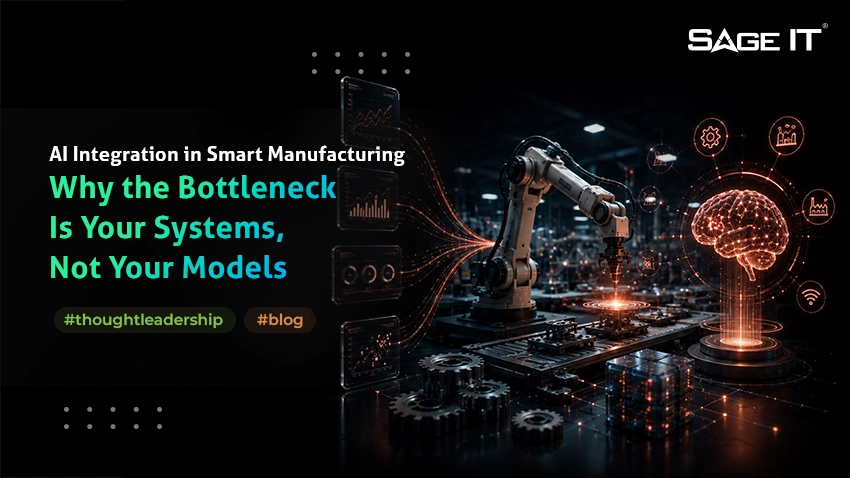
AI Integration in Smart Manufacturing: Why the Bottleneck Is Your Systems, Not Your Models

To integrate AI in smart manufacturing, connect factory-floor (OT) data to business (IT) systems through a governed integration layer, then let AI act across those systems rather than inside one.

Madhu Anthati
Madhu Anthati
Vice President-Integration Solutions
Connect on LinkedIn
AI-Integration-rc-blog

The hard part is not the model. McKinsey’s 2025 State of AI survey found 88% of organizations use AI but only about one-third have scaled it past pilots, and just 39% report any earnings impact. In manufacturing, the reason pilots stall is that predictive-maintenance, computer-vision, and generative-AI tools run in silos, disconnected from the MES, ERP, and supply-chain systems where the business outcome lives. The highest-leverage move is to standardize OT/IT integration on ISA-95, OPC UA, and a unified namespace, then add a governed orchestration layer so agents execute cross-system workflows with auditability.

Most smart manufacturing AI programs buy another model when the constraint is integration. The model demos well in a pilot, then cannot reach the data or trigger the actions that would make it pay.

How this guide was created

This guide was prepared by Sage IT’s integration and AI practice, drawing first on our own governed business-system delivery for manufacturers – Order-to-Cash and Procure-to-Pay across NetSuite, Boomi, Shopify, and Procore. That work sits above the ERP. On the factory floor, we design to the ISA-95 and OPC UA standards below and integrate with existing OT systems rather than replace them. We combined that delivery experience with primary research from McKinsey’s 2025 State of AI survey, Deloitte’s 2025 Smart Manufacturing and Operations Survey of 600 US manufacturing executives, Gartner’s 2025 forecasts on task-specific AI agents, the World Economic Forum Global Lighthouse Network, and the ANSI/ISA-95 2025 standard. Adoption figures, ROI ranges, and vendor claims should be validated against your own plant data, contracts, and system architecture before any platform or deployment decision.

Why most manufacturing AI stalls after the pilot

Manufacturing AI stalls after the pilot because the model is connected to a demo, not to the systems that run the plant. The technology that decides success is integration, not the algorithm.

Why do most smart manufacturing AI projects stay stuck in pilots?

Most smart manufacturing AI projects stay stuck because a working model in a sandbox cannot reach production data or trigger real actions across systems. McKinsey’s 2025 State of AI survey reports that 88% of organizations now use AI, yet only about one-third have scaled it to capture enterprise-wide value, leaving roughly two-thirds in experimentation. Only 39% of respondents say AI has affected earnings at all, and most of those report less than a 5% impact on EBIT. In a factory, a computer-vision defect model or a generative-AI maintenance assistant proves accuracy on a single line, then has no governed path to write results into the MES, update the ERP, or open a work order. The pilot succeeds and the workflow does not, because the deployment stopped at the model and never crossed into the systems of record.

What is the real bottleneck in smart manufacturing AI, the model or the integration?

The real bottleneck is integration between operational technology and business systems, not model quality. Deloitte’s 2025 Smart Manufacturing and Operations Survey of 600 US manufacturing executives found 29% using AI or machine learning at a facility or network level and 24% deploying generative AI, with far more still piloting than scaling. The gap between piloting and scaling is where integration lives. Modern models are commodity capability; the differentiator is whether the model can read the right plant and business data and act on it under governance. Gartner projects that 40% of enterprise applications will embed task-specific AI agents by the end of 2026, up from less than 5% in 2025, which means the pressure now shifts from building models to wiring them safely into MES, ERP, SCADA, and supply-chain systems.

What does AI integration in smart manufacturing actually mean?

AI integration in smart manufacturing means connecting AI models to both the operational technology on the factory floor and the information technology that runs the business, so the AI can sense, decide, and act across systems. Operational technology includes PLCs, SCADA, historians, and IoT sensors. Information technology includes the MES, the ERP such as Oracle NetSuite or SAP, the CMMS, and supply-chain platforms. Integration is what turns an isolated prediction into an executed outcome: a vibration anomaly detected on a machine becomes a scheduled work order in the CMMS, a parts reservation in the ERP, and a revised production plan in the MES. Without that cross-system path, the AI produces insight that a human still has to carry between seven systems by hand.

/* ========================================================= SCOPE ========================================================= */ #ai-governed-integration { width: 100%; background: #ffffff; padding: 42px 25px 45px; box-sizing: border-box; } #ai-governed-integration *, #ai-governed-integration *::before, #ai-governed-integration *::after { box-sizing: border-box; } #ai-governed-integration .agi-container { width: 100%; max-width: 1800px; margin: 0 auto; display: grid; grid-template-columns: minmax(0, 1fr) 2px minmax(0, 1fr); gap: 58px; } /* ========================================================= COMMON PANEL ========================================================= */ #ai-governed-integration .agi-panel { min-width: 0; } #ai-governed-integration .agi-panel-heading { margin-bottom: 34px; } #ai-governed-integration .agi-panel-heading h2 { margin: 0 0 5px; font-family: "Roboto", Arial, sans-serif; font-size: 30px; line-height: 1.15; font-weight: 700; color: #062f68; text-align: center; } #ai-governed-integration .agi-panel-heading p { margin: 0; font-family: "Poppins", Arial, sans-serif; font-size: 18px; line-height: 1.35; font-weight: 400; color: #252b37; text-align: center !important; } /* ========================================================= DIVIDER ========================================================= */ #ai-governed-integration .agi-divider { width: 2px; min-height: 650px; background-image: linear-gradient( to bottom, #99cdf7 45%, rgba(255, 255, 255, 0) 0% ); background-position: right; background-size: 2px 9px; background-repeat: repeat-y; } /* ========================================================= LEFT SIDE ========================================================= */ #ai-governed-integration .agi-left-diagram { position: relative; min-height: 530px; } /* AI model */ #ai-governed-integration .agi-ai-model { width: 52%; min-height: 104px; margin: 0 auto; border-radius: 14px; display: flex; flex-direction: column; align-items: center; justify-content: center; text-align: center; background: linear-gradient( 110deg, #626c7b 0%, #566170 100% ); color: #ffffff; position: relative; z-index: 2; } #ai-governed-integration .agi-ai-model strong { display: block; font-family: "Roboto", Arial, sans-serif; font-size: 24px; line-height: 1.2; font-weight: 700; } #ai-governed-integration .agi-ai-model span { margin-top: 5px; font-family: "Poppins", Arial, sans-serif; font-size: 18px; line-height: 1.35; } /* Red path */ #ai-governed-integration .agi-red-path { position: relative; width: 40px; height: 132px; margin: 0 auto; } #ai-governed-integration .agi-red-dashed-line { position: absolute; top: 0; left: 50%; height: 96px; border-left: 4px dashed #d53b28; transform: translateX(-50%); } #ai-governed-integration .agi-red-arrow { position: absolute; left: 50%; bottom: 5px; width: 0; height: 0; border-left: 17px solid transparent; border-right: 17px solid transparent; border-top: 32px solid #d53b28; transform: translateX(-50%); } /* Warning */ #ai-governed-integration .agi-warning { position: absolute; top: 122px; right: 2%; min-width: 175px; padding: 7px 5px; border: 1.5px solid #dd4636; border-radius: 13px; background: #fff5f2; text-align: center; font-family: "Roboto", Arial, sans-serif; font-size: 16px; line-height: 1.3; font-weight: 700; color: #c53526; transform: translateX(40px); } /* Siloed systems */ #ai-governed-integration .agi-silo-systems { display: grid; grid-template-columns: repeat(4, 1fr); gap: 20px; margin-top: 5px; } #ai-governed-integration .agi-silo-box { min-height: 100px; display: flex; align-items: center; justify-content: center; padding: 15px; background: linear-gradient( 135deg, #f1f3f5 0%, #e6e9ec 100% ); border: 1px solid #dce0e5; border-radius: 12px; text-align: center; font-family: "Roboto", Arial, sans-serif; font-size: 18px; line-height: 1.25; font-weight: 700; color: #0c2d54; } /* Bottom note */ #ai-governed-integration .agi-left-note { margin-top: 50px; text-align: center; font-family: "Poppins", Arial, sans-serif; font-size: 20px; line-height: 1.5; font-style: italic; font-weight: 400; color: #222a39; } /* ========================================================= RIGHT SIDE ========================================================= */ #ai-governed-integration .agi-right-diagram { position: relative; width: 100%; min-height: 520px; display: grid; grid-template-columns: 27% 28% 25%; justify-content: space-between; padding-top: 45px; } /* OT / IT labels */ #ai-governed-integration .agi-side-label { position: absolute; top: 0; font-family: "Roboto", Arial, sans-serif; font-size: 21px; line-height: 1; font-weight: 700; color: #0764ad; } #ai-governed-integration .agi-ot-label { left: 12%; } #ai-governed-integration .agi-it-label { right: 11%; } /* Common light system boxes */ #ai-governed-integration .agi-system-box { min-height: 65px; display: flex; align-items: center; justify-content: center; padding: 10px 14px; border: 1px solid #c7def5; border-radius: 10px; background: linear-gradient( 110deg, #edf5fe 0%, #e2eefb 100% ); text-align: center; font-family: "Roboto", Arial, sans-serif; font-size:16px; line-height: 1.2; font-weight: 700; color: #07529b; position: relative; z-index: 3; } /* OT systems */ #ai-governed-integration .agi-ot-systems { grid-column: 1; display: flex; flex-direction: column; gap: 20px; } /* Center integration */ #ai-governed-integration .agi-governed-box { grid-column: 2; min-height: 280px; display: flex; align-items: center; justify-content: center; padding: 25px; border-radius: 16px; background: linear-gradient( 135deg, #185db4 0%, #0752a7 100% ); text-align: center; color: #ffffff; position: relative; z-index: 3; } #ai-governed-integration .agi-governed-box span { font-family: "Roboto", Arial, sans-serif; font-size: 18px; line-height: 1.35; font-weight: 700; } /* IT systems */ #ai-governed-integration .agi-it-systems { grid-column: 3; display: flex; flex-direction: column; gap: 12px; } #ai-governed-integration .agi-it-systems .agi-system-box { min-height: 57px; } /* ========================================================= CONNECTORS ========================================================= */ #ai-governed-integration .agi-connectors { position: absolute; top: 45px; left: 0; width: 100%; height:300px; pointer-events: none; z-index: 1; } #ai-governed-integration .agi-svg-line { fill: none; stroke: #0969bd; stroke-width: 4; } /* ========================================================= AI AGENT ========================================================= */ #ai-governed-integration .agi-agent-up-arrow { position: relative; left: 152px; bottom: 122px; height: 211px; transform: translateX(-50%); z-index: 2; pointer-events: none; right: 0; margin: auto; } /* Vertical blue line */ #ai-governed-integration .agi-agent-up-arrow span { position: absolute; left: 50%; bottom: 0; width: 4px; height: 58px; background: #0969bd; transform: translateX(-50%); } /* Upward arrow head */ #ai-governed-integration .agi-agent-up-arrow span::before { content: ""; position: absolute; top: -20px; left: 50%; width: 0; height: 0; border-left: 18px solid transparent; border-right: 18px solid transparent; border-bottom: 28px solid #0969bd; transform: translateX(-50%); } #ai-governed-integration .agi-agent-box { position: absolute; bottom: 0; left: 50%; width: 51%; min-height: 100px; padding: 15px 25px; display: flex; flex-direction: column; align-items: center; justify-content: center; border-radius: 13px; background: linear-gradient( 90deg, #74b4f4 0%, #7db9f5 100% ); text-align: center; transform: translateX(-50%); z-index: 3; } #ai-governed-integration .agi-agent-box strong { font-family: "Roboto", Arial, sans-serif; font-size: 18px; line-height: 1.2; font-weight: 700; color: #062d67; } #ai-governed-integration .agi-agent-box span { margin-top: 3px; font-family: "Poppins", Arial, sans-serif; font-size: 17px; line-height: 1.35; color: #123e73; } /* ========================================================= LARGE TABLET ========================================================= */ @media only screen and (max-width: 1250px) { #ai-governed-integration .agi-container { gap: 35px; } #ai-governed-integration .agi-panel-heading h2 { font-size: 24px; } #ai-governed-integration .agi-panel-heading p { font-size: 18px; } #ai-governed-integration .agi-ai-model { width: 58%; } #ai-governed-integration .agi-ai-model strong { font-size: 18px; } #ai-governed-integration .agi-ai-model span { font-size: 16px; } #ai-governed-integration .agi-warning { min-width: 180px; font-size: 17px; } #ai-governed-integration .agi-silo-box { font-size: 17px; } #ai-governed-integration .agi-system-box { font-size: 16px; } #ai-governed-integration .agi-governed-box span { font-size: 22px; } } /* ========================================================= TABLET / MOBILE ========================================================= */ @media only screen and (max-width: 900px) { #ai-governed-integration { padding: 35px 20px; } #ai-governed-integration .agi-container { display: block; } #ai-governed-integration .agi-divider { width: 100%; min-height: 0; height: 2px; margin: 50px 0; background-image: linear-gradient( to right, #99cdf7 45%, transparent 0% ); background-size: 9px 2px; background-repeat: repeat-x; } #ai-governed-integration .agi-panel-heading { text-align: center; } #ai-governed-integration .agi-left-diagram { max-width: 700px; margin: 0 auto; } #ai-governed-integration .agi-right-diagram { max-width: 760px; margin: 0 auto; } } /* ========================================================= MOBILE ========================================================= */ @media only screen and (max-width: 650px) { #ai-governed-integration .agi-agent-up-arrow { position: relative; order: 6; left: auto; bottom: auto; width: 40px; height: 58px; margin: -12px auto 0; transform: none; } #ai-governed-integration .agi-agent-up-arrow span { height: 38px; } #ai-governed-integration .agi-agent-up-arrow span::before { top: -16px; border-left-width: 13px; border-right-width: 13px; border-bottom-width: 21px; } #ai-governed-integration .agi-agent-box { order: 7; } #ai-governed-integration { padding: 30px 15px; } #ai-governed-integration .agi-panel-heading { margin-bottom: 25px; } #ai-governed-integration .agi-panel-heading h2 { font-size: 24px; } #ai-governed-integration .agi-panel-heading p { font-size: 16px; } /* LEFT */ #ai-governed-integration .agi-left-diagram { min-height: auto; } #ai-governed-integration .agi-ai-model { width: 85%; min-height: 90px; } #ai-governed-integration .agi-ai-model strong { font-size: 18px; } #ai-governed-integration .agi-ai-model span { font-size: 15px; } #ai-governed-integration .agi-warning { position: static; width: fit-content; min-width: 0; margin: 0 auto 25px; padding: 10px 18px; font-size: 15px; transform: none; } #ai-governed-integration .agi-red-path { height: 90px; } #ai-governed-integration .agi-red-dashed-line { height: 58px; } #ai-governed-integration .agi-red-arrow { border-left-width: 13px; border-right-width: 13px; border-top-width: 24px; } #ai-governed-integration .agi-silo-systems { grid-template-columns: repeat(2, 1fr); gap: 12px; } #ai-governed-integration .agi-silo-box { min-height: 78px; font-size: 16px; } #ai-governed-integration .agi-left-note { margin-top: 30px; font-size: 16px; } /* RIGHT */ #ai-governed-integration .agi-right-diagram { min-height: auto; display: flex; flex-direction: column; padding-top: 0; } #ai-governed-integration .agi-side-label { position: static; margin-bottom: 10px; font-size: 18px; text-align: center; } #ai-governed-integration .agi-ot-label { order: 1; } #ai-governed-integration .agi-ot-systems { order: 2; display: grid; grid-template-columns: repeat(3, 1fr); gap: 8px; margin-bottom: 30px; } #ai-governed-integration .agi-governed-box { order: 3; width: 75%; min-height: 180px; margin: 0 auto 30px; } #ai-governed-integration .agi-governed-box span { font-size: 22px; } #ai-governed-integration .agi-it-label { order: 4; } #ai-governed-integration .agi-it-systems { order: 5; display: grid; grid-template-columns: repeat(2, 1fr); gap: 8px; margin-bottom: 30px; } #ai-governed-integration .agi-system-box, #ai-governed-integration .agi-it-systems .agi-system-box { min-height: 65px; font-size: 14px; } #ai-governed-integration .agi-agent-box { position: static; order: 6; width: 82%; min-height: 90px; margin: 0 auto; transform: none; } #ai-governed-integration .agi-agent-box strong { font-size: 18px; } #ai-governed-integration .agi-agent-box span { font-size: 14px; } /* Hide desktop connector SVG on mobile. Mobile flow remains clear through vertical positioning. */ #ai-governed-integration .agi-connectors { display: none; } } /* ========================================================= SMALL MOBILE ========================================================= */ @media only screen and (max-width: 420px) { #ai-governed-integration .agi-panel-heading h2 { font-size: 24px; } #ai-governed-integration .agi-panel-heading p { font-size: 15px; } #ai-governed-integration .agi-ai-model { width: 92%; } #ai-governed-integration .agi-silo-systems { grid-template-columns: 1fr 1fr; } #ai-governed-integration .agi-ot-systems { grid-template-columns: 1fr; } #ai-governed-integration .agi-governed-box { width: 90%; } #ai-governed-integration .agi-it-systems { grid-template-columns: 1fr 1fr; } #ai-governed-integration .agi-agent-box { width: 92%; } }

Siloed AI

value stuck in the pilot

AI model predictive / vision / genAI
no governed
path to act
MES
ERP
CMMS
Supply chain
Insight a human still carries
between systems by hand

Governed integration

value delivered across OT and IT

OT
IT
PLC / SCADA
Historian
IoT sensors
Governed
integration
+ agent layer
MES
ERP
CMMS
Supply chain
AI agent one audit trail per outcome

The two layers you are actually integrating: OT and IT

Smart manufacturing AI integration spans two layers that historically did not talk to each other: operational technology on the plant floor and information technology in the business. Bridging them is the core engineering problem.

How do you connect factory-floor OT data to business IT systems?

Connect factory-floor data to business systems by normalizing machine signals into a shared data layer, then exposing that layer to both AI and enterprise applications. Protocol gateways translate diverse inputs, OPC UA from modern equipment, Modbus TCP from legacy PLCs, and MQTT from edge devices, into consistent streams. A unified namespace then organizes that data by the ISA-95 hierarchy of Enterprise, Site, Area, Line, and Cell, so every system reads the same real-time picture. This matters for AI because an agent cannot reason across a plant if the same machine is identified three different ways in three systems. Resolving asset identity in a shared layer is the precondition for any cross-system AI action, which is why data architecture, not model selection, is the first step.

What standards make OT and IT integration work?

The standards that make OT and IT integration work are ISA-95, OPC UA, MQTT, and B2MML, organized through a unified namespace. The ANSI/ISA-95 standard, updated in its 2025 edition, defines the common models and terminology for exchanging information between control systems and enterprise systems such as the ERP. OPC UA provides real-time, secure OT/IT communication, B2MML provides the XML data model for ERP-to-MES exchange, and MQTT with a message broker such as Apache Kafka moves high-volume sensor data. Standardizing on these removes the custom, point-to-point connections that break whenever a machine or an API changes. For AI specifically, standardized data is what lets a model trained on one line generalize across a site without a new integration project per machine.

Where AI integration pays off first

AI integration in smart manufacturing pays off first in bounded, data-rich workflows with a clear financial signal. Start where the value is measurable and the risk is contained, not with an open-ended mandate to run the plant.

Which smart manufacturing AI use cases deliver ROI first?

The use cases that deliver ROI first are predictive maintenance, quality inspection with computer vision, and cross-system exception handling in the supply chain. Predictive maintenance has the clearest financial signal because downtime is expensive and measurable. Computer-vision quality inspection reduces scrap and rework on a single line with low integration risk. Cross-system exception handling, such as reconciling an order against inventory and a supplier commitment, is higher value but requires the OT/IT integration described above. The World Economic Forum Global Lighthouse Network, which tracks more than 220 advanced manufacturing sites, reports that 94% of successful transformations combine multiple technology domains, pairing AI with IoT, cloud, and digital twins rather than deploying AI alone.

How much can AI predictive maintenance reduce downtime and cost?

AI-driven predictive maintenance can reduce equipment downtime by up to roughly 50% and cut maintenance costs by 10% to 40% at maturity, according to widely cited McKinsey analysis, though realized results vary by asset and data quality. Deloitte has estimated that unplanned downtime costs industrial manufacturers on the order of $50 billion a year, which is why maintenance is the common entry point. Treat the headline percentages as directional rather than guaranteed: they come from analyses across mixed industries, and outcomes depend on sensor coverage, historian data quality, and whether the prediction actually triggers a governed work order in the CMMS. The durable ROI comes from closing that loop from prediction to executed maintenance action, not from the model accuracy alone.

Table 1. Where AI integration pays off first, by systems touched and integration risk.

Use case Systems touched Integration risk First-value signal
Predictive maintenance IoT sensors, historian, CMMS, ERP Medium Downtime hours avoided
Computer-vision quality Line camera, MES Low Scrap and rework rate
Supply-chain exception handling ERP, MES, supplier systems High Order fill rate, days sales outstanding
Generative-AI operator assist Historian, MES, knowledge base Low Time to resolve on floor

From point solutions to agentic, cross-system execution

The next stage of smart manufacturing AI is agentic execution across systems, not another isolated model. This is where integration stops being plumbing and becomes the product.

What is agentic AI integration in manufacturing?

Agentic AI integration in manufacturing is an architecture where AI agents execute business workflows across the MES, ERP, and supply-chain systems through a governed layer, rather than through hand-coded point-to-point connections. Gartner forecasts that 40% of enterprise applications will embed task-specific AI agents by the end of 2026, and that 50% of cross-functional supply-chain solutions will use intelligent agents by 2030. Gartner also predicts that more than 40% of agentic AI projects will be canceled by the end of 2027 – citing escalating costs, unclear business value, and inadequate risk controls. In manufacturing, those failures trace back to one root: agents deployed onto an unresolved data foundation, without governance. That is the failure mode this architecture is built to avoid. The value is not that an agent answers a question about one system. It is that an agent can take a business intent, such as “fulfill this order” or “resolve this maintenance exception,” and carry it across every system involved. Deloitte’s analysis of agentic supply chains is explicit that AI agents depend on a data foundation supporting consistent interpretation and governed action, which restates the same point: the agent is only as good as the integration beneath it.

Why do cross-system manufacturing workflows need governance, not just connection?

Cross-system manufacturing workflows need governance because an agent that can act across the ERP, MES, and payment systems can also cause cross-system damage. Connection alone lets an agent read and write; governance decides what it is allowed to do, which actions require human approval, and how every step is logged. A production example: an agent that detects a three-way match failure on a vendor invoice should validate against the purchase order and receipt, propose a resolution, and route it for approval, not post to the general ledger on its own. The governance layer enforces least-privilege roles across systems, so an agent with read access in the MES does not gain write access in the ERP. One audit trail per business outcome, rather than seven separate system logs, is what makes the workflow defensible to a plant controller and an auditor.

Where does agentic orchestration fit in a manufacturing stack?

Agentic orchestration fits on the business-system side of a manufacturing stack, above the ERP, commerce, CRM, and payment platforms, while OT integration standards handle the factory floor. Sage IT’s NS-AIF, an Autonomous Cross-System Action Fabric for NetSuite-centered environments, is one example of this layer: it takes a business intent such as “create customer and set up payment” and executes it across NetSuite, Shopify, HubSpot, and Stripe with governance and a single audit trail. That scope is deliberate. NS-AIF orchestrates business outcomes across enterprise systems, not machine control on the shop floor, so it complements rather than replaces the ISA-95 and OPC UA layer that connects PLCs, SCADA, and historians. For a manufacturer, the practical pattern is three layers: OT/IT data standardized on ISA-95 and OPC UA at the floor, an iPaaS such as Boomi integrating the business systems above it, and a governed agentic layer above the ERP for cross-system workflows like Order-to-Cash and Procure-to-Pay. Sage IT is strongest in the top two layers; the OT layer is standards-driven, where we integrate with your existing floor systems.

/* ================================================== AGENTIC MANUFACTURING ROLLOUT SECTION ================================================== */ #agentic-rollout { width: 100%; background: #ffffff; padding: 25px 20px 30px; box-sizing: border-box; } #agentic-rollout *, #agentic-rollout *::before, #agentic-rollout *::after { box-sizing: border-box; } #agentic-rollout .ar-container { width: 100%; max-width: 1440px; margin: 0 auto; } /* ================================================== HEADING ================================================== */ #agentic-rollout .ar-heading { text-align: center; margin-bottom: 52px; } #agentic-rollout .ar-heading h2 { margin: 0 0 12px; padding: 0; font-family: "Roboto", Arial, sans-serif; font-size: 30px; line-height: 1.18; font-weight: 700; color: #082f5d; } #agentic-rollout .ar-heading p { margin: 0; font-family: "Poppins", Arial, sans-serif; font-size: 18px; line-height: 1.5; font-weight: 400; color: #303030; } /* ================================================== MAIN CONTENT ================================================== */ #agentic-rollout .ar-content { display: grid; grid-template-columns: 150px minmax(0, 1fr); gap: 30px; width: 100%; max-width: 1335px; margin: 0 auto; } /* ================================================== RISK SCALE ================================================== */ #agentic-rollout .ar-risk-scale { position: relative; min-height: 910px; width: 100%; } #agentic-rollout .ar-risk-top, #agentic-rollout .ar-risk-bottom { position: absolute; left: 0; font-family: "Roboto", Arial, sans-serif; font-size: 17px; line-height: 1.25; font-weight: 700; color: #063365; white-space: nowrap; } #agentic-rollout .ar-risk-top { top: -24px; } #agentic-rollout .ar-risk-bottom { bottom: -12px; } #agentic-rollout .ar-risk-line { position: absolute; top: 10px; bottom: 20px; left: 62px; width: 2px; background: #328ce1; } #agentic-rollout .ar-dot { position: absolute; left: 50%; width: 13px; height: 13px; background: #3195eb; border-radius: 50%; transform: translateX(-50%); } #agentic-rollout .ar-dot-top { top: -5px; } #agentic-rollout .ar-dot-bottom { bottom: -5px; } /* ================================================== STEPS WRAPPER ================================================== */ #agentic-rollout .ar-steps { width: 100%; } /* ================================================== STEP CARD ================================================== */ #agentic-rollout .ar-step { position: relative; display: flex; align-items: center; min-height: 145px; width: 100%; padding: 27px 42px 27px 125px; border-radius: 16px; background: linear-gradient( 100deg, #0867bf 0%, #075cb1 52%, #07539f 100% ); overflow: hidden; } /* Small bright blue vertical edge */ #agentic-rollout .ar-accent { position: absolute; top: 0; bottom: 0; left: 0; width: 16px; background: linear-gradient( 180deg, #22a1f2 0%, #2399e8 100% ); } /* ================================================== NUMBER CIRCLE ================================================== */ #agentic-rollout .ar-number { position: absolute; left: 42px; top: 50%; width: 50px; height: 50px; display: flex; align-items: center; justify-content: center; border-radius: 50%; background: rgba(75, 164, 238, 0.58); transform: translateY(-50%); } #agentic-rollout .ar-number span { font-family: "Roboto", Arial, sans-serif; font-size: 30px; line-height: 1; font-weight: 700; color: #ffffff; } /* ================================================== STEP TYPOGRAPHY ================================================== */ #agentic-rollout .ar-step-content { width: 100%; } #agentic-rollout .ar-step h3 { margin: 0 0 8px; padding: 0; font-family: "Roboto", Arial, sans-serif; font-size: 22px; line-height: 1.2; font-weight: 700; color: #ffffff; } #agentic-rollout .ar-step p { margin: 0; padding: 0; font-family: "Poppins", Arial, sans-serif; font-size: 16px; line-height: 1.5; font-weight: 400; color: #ffffff; } /* ================================================== ARROWS ================================================== */ #agentic-rollout .ar-arrow { width: 0; height: 0; margin: 17px auto; border-left: 16px solid transparent; border-right: 16px solid transparent; border-top: 20px solid #0860aa; } /* ================================================== FINAL / EXPANSION CARD ================================================== */ #agentic-rollout .ar-step-final { background: linear-gradient( 100deg, #a9d8fb 0%, #a2d4f8 50%, #9ed0f5 100% ); } #agentic-rollout .ar-step-final .ar-accent { background: #0867b4; } #agentic-rollout .ar-step-final .ar-number { background: rgba(70, 161, 231, 0.38); } #agentic-rollout .ar-step-final .ar-step-content h3 { color: #082f5d; } #agentic-rollout .ar-step-final .ar-step-content p { color: #082747; } /* ================================================== TABLET ================================================== */ @media only screen and (max-width: 1100px) { #agentic-rollout { padding: 30px 24px; } #agentic-rollout .ar-heading { margin-bottom: 45px; } #agentic-rollout .ar-heading h2 { font-size: 28px; } #agentic-rollout .ar-heading p { font-size: 18px; } #agentic-rollout .ar-content { grid-template-columns: 125px minmax(0, 1fr); gap: 24px; } #agentic-rollout .ar-risk-top, #agentic-rollout .ar-risk-bottom { font-size: 14px; } #agentic-rollout .ar-risk-line { left: 51px; } #agentic-rollout .ar-step { min-height: 130px; padding: 24px 30px 24px 130px; } #agentic-rollout .ar-number { left: 34px; width: 67px; height: 67px; } #agentic-rollout .ar-number span { font-size: 25px; } #agentic-rollout .ar-step h3 { font-size: 18px; } #agentic-rollout .ar-step p { font-size: 16px; } #agentic-rollout .ar-risk-scale { min-height: 830px; } } /* ================================================== MOBILE ================================================== */ @media only screen and (max-width: 767px) { #agentic-rollout { padding: 30px 16px; } #agentic-rollout .ar-heading { margin-bottom: 30px; } #agentic-rollout .ar-heading h2 { font-size: 28px; line-height: 1.25; margin-bottom: 10px; } #agentic-rollout .ar-heading p { max-width: 500px; margin: 0 auto; font-size: 15px; line-height: 1.55; } /* Convert risk indicator to horizontal mobile version */ #agentic-rollout .ar-content { display: block; } #agentic-rollout .ar-risk-scale { position: relative; display: flex; align-items: center; justify-content: space-between; min-height: 0; height: 54px; margin-bottom: 20px; } #agentic-rollout .ar-risk-top, #agentic-rollout .ar-risk-bottom { position: static; width: auto; font-size: 11px; line-height: 1.2; } #agentic-rollout .ar-risk-top { text-align: left; } #agentic-rollout .ar-risk-bottom { text-align: right; } #agentic-rollout .ar-risk-line { position: absolute; top: 50%; bottom: auto; left: 82px; right: 118px; width: auto; height: 2px; transform: translateY(-50%); } #agentic-rollout .ar-dot { top: 50%; width: 10px; height: 10px; transform: translate(-50%, -50%); } #agentic-rollout .ar-dot-top { left: 0; } #agentic-rollout .ar-dot-bottom { left: 100%; } /* Cards */ #agentic-rollout .ar-step { display: block; min-height: 0; padding: 25px 20px 24px 86px; border-radius: 12px; } #agentic-rollout .ar-accent { width: 9px; } #agentic-rollout .ar-number { left: 22px; width: 49px; height: 49px; } #agentic-rollout .ar-number span { font-size: 25px; } #agentic-rollout .ar-step h3 { margin-bottom: 7px; font-size: 18px; line-height: 1.25; } #agentic-rollout .ar-step p { font-size: 14px; line-height: 1.55; } #agentic-rollout .ar-arrow { margin: 11px auto; border-left-width: 11px; border-right-width: 11px; border-top-width: 14px; } } /* ================================================== SMALL MOBILE ================================================== */ @media only screen and (max-width: 480px) { #agentic-rollout { padding-left: 12px; padding-right: 12px; } #agentic-rollout .ar-heading h2 { font-size: 25px; } #agentic-rollout .ar-heading p { font-size: 14px; } #agentic-rollout .ar-risk-scale { height: 48px; } #agentic-rollout .ar-risk-top, #agentic-rollout .ar-risk-bottom { font-size: 10px; } #agentic-rollout .ar-risk-line { left: 70px; right: 103px; } #agentic-rollout .ar-step { padding: 22px 17px 22px 75px; } #agentic-rollout .ar-number { left: 19px; width: 43px; height: 43px; } #agentic-rollout .ar-number span { font-size: 22px; } #agentic-rollout .ar-step h3 { font-size: 19px; } #agentic-rollout .ar-step p { font-size: 13.5px; } }

Safe rollout path for agentic manufacturing workflows

Autonomy increases only as trust is earned — each gate must hold before the next

LOWEST RISK
CONTROLLED SCALE
1

Read-only validation

Agent observes; writes nothing. Prove accuracy against live data.

2

Propose-only workflow

Agent drafts actions for review; no changes are committed.

3

Human-approved writes

Agent executes only after a person approves each consequential step.

4

Controlled production pilot

Bounded autonomy on one workflow, under full audit and rollback.

5

Workflow expansion

Extend to adjacent cross-system workflows once each gate holds.

When you do not need cross-system agentic integration

Agentic cross-system integration is not the right answer for every smart manufacturing AI use case. Recommending it everywhere would be dishonest and expensive.

When is a single point solution the right answer?

A single point solution is the right answer when the workflow lives inside one system and has a bounded, well-understood scope. A computer-vision model that flags surface defects on one line and writes a pass or fail to the MES does not need an orchestration fabric; it needs a reliable connection to that one system. A historian anomaly dashboard that a technician reads does not need governed write access anywhere. Reach for cross-system agentic integration only when the business outcome genuinely spans systems, for example order fulfillment across commerce, ERP, and logistics, or maintenance that must touch the CMMS, ERP, and procurement. Matching the architecture to the workflow scope avoids overengineering a problem that a focused tool already solves.

How to govern AI agents across the manufacturing stack

Governance is an architecture requirement for manufacturing AI, not a policy document added at the end. Agents connected to production and financial systems are powerful and risky if governance arrives late.

How should you govern AI agents that touch ERP, MES, and payments?

Govern AI agents with least-privilege roles, a propose-then-approve model for consequential actions, and a single cross-system audit trail. Create purpose-specific roles such as “AI Agent – Maintenance Triage” or “AI Agent – O2C Exception Review” rather than broad access, and map those permissions across every connected system so scope does not fragment between the MES, ERP, and a payment platform. For any action with financial or safety consequence, such as posting to the general ledger, releasing a vendor payment, or changing a production schedule, the agent should propose and a human should approve. The National Institute of Standards and Technology’s Generative AI Profile, NIST AI 600-1, provides a recognized framework for identifying and managing these risks. Stage the rollout from read-only to propose-only to human-approved writes before any autonomous action.

Architecture decision reference

Two reference tables: a situation-to-action map for choosing the integration approach, and the OT/IT standards that underpin it.

Table 2. Situation to recommended action, with how Sage IT helps.

Situation Recommended action How Sage IT helps
Single-line quality or anomaly detection Point solution into MES or historian Integration setup and validation
Predictive maintenance closing the loop to CMMS and ERP Standardized OT/IT integration Boomi-based integration + governed orchestration
Order-to-Cash or Procure-to-Pay across business systems Governed agentic orchestration above the ERP NS-AIF, where the stack is NetSuite-centered
Legacy point-to-point integration sprawl Consolidate and migrate SHIP AI migration accelerator

Table 3. OT/IT integration standards reference.

Standard Role Layer
ANSI/ISA-95 (2025) Common models for control-to-enterprise integration OT/IT modeling
OPC UA Real-time secure OT/IT communication OT connectivity
MQTT + Apache Kafka High-volume sensor data transport OT data streaming
B2MML XML data model for ERP-to-MES exchange IT integration
Unified namespace Single real-time data layer by ISA-95 hierarchy OT/IT convergence
Quotable takeaways

Quotable takeaway: In smart manufacturing AI, the bottleneck is integration, not the model. McKinsey’s 2025 State of AI survey found 88% of organizations use AI but only about one-third have scaled it past pilots.

Quotable takeaway: A factory AI model that cannot write to the MES, ERP, or CMMS produces insight a human still has to carry between systems by hand.
Quotable takeaway: Gartner projects 40% of enterprise applications will embed task-specific AI agents by the end of 2026, up from less than 5%, which shifts the hard problem from building models to integrating them safely.

Quotable takeaway: Connection lets an agent act; governance decides what it is allowed to do. In manufacturing, both are required before an agent touches the general ledger or a production schedule.

Quotable takeaway: Traditional iPaaS moves data between systems. An agentic layer executes business intent across them with governance, context, and one audit trail per outcome.

Common mistakes in smart manufacturing AI integration

What is the most common mistake in smart manufacturing AI integration?

The most common mistake is architecting the agent before architecting the data, then blaming the model when the pilot cannot scale. Deloitte’s analysis of agentic supply chains is direct that AI agents depend on a consistent, governed data foundation, because manufacturing data lives across MES systems, ERP databases, PLC controllers, and CMMS platforms that identify the same asset differently. Teams that deploy a capable model onto unresolved, siloed data get a convincing demo and a workflow that breaks in production. The fix is to standardize OT/IT data on ISA-95, OPC UA, and a unified namespace first, resolve asset identity, and only then layer agents on top. Model quality is rarely the reason a smart factory AI program fails; unintegrated data almost always is.

Why should you avoid headline AI ROI percentages in manufacturing?

Avoid leaning on headline ROI percentages because many circulate without disclosed methodology or come from mixed-industry analyses. Figures such as a 50% downtime reduction or a tenfold predictive-maintenance return are directional signals, not guarantees, and they depend on sensor coverage, data quality, and whether the prediction triggers a governed action. Lead instead with named primary sources and your own baseline: McKinsey’s survey on AI scaling, Deloitte’s Smart Manufacturing survey of 600 executives, and Gartner’s agent forecasts, paired with measured before-and-after numbers from your own plant. Stating uncertainty where it exists is what keeps a manufacturing AI business case credible with a plant controller and a CFO.

FAQ
How long does it take to integrate AI across manufacturing systems?2026-07-21T05:49:56-05:00

Timelines depend on the number of connected systems, data quality, and governance requirements, so treat any fixed number cautiously. As a reference point, in a Sage IT manufacturing engagement we delivered full Order-to-Cash and Procure-to-Pay workflows across NetSuite, Boomi, Shopify, and Procore and reached production in eight weeks with zero custom middleware. A single-line, single-system use case can move faster; a plant-wide, cross-system agentic rollout takes longer because the OT/IT data foundation and governance model have to be built before agents are safe to deploy.

What are the biggest risks of connecting AI agents to manufacturing systems?2026-07-21T05:50:04-05:00

The biggest risks are unauthorized cross-system actions, prompt injection, hallucinated outputs, and fragmented permissions. An agent with write access across the MES, ERP, and payment systems can cause damage beyond a single system if governance is weak. The NIST AI 600-1 Generative AI Profile provides a framework for managing these risks, and the practical controls are least-privilege roles mapped across systems, a propose-then-approve model for consequential actions, and one audit trail per business outcome. For any action touching production schedules, the general ledger, or vendor payments, a human should approve before execution.

How does agentic AI differ from traditional automation on the factory floor?2026-07-21T05:50:11-05:00

Agentic AI differs from traditional automation because it is triggered by a business intent and can reason across systems, while traditional automation follows predefined rules on a schedule or event. A traditional integration moves data from the MES to the ERP on a fixed rule. An agent takes an intent such as “resolve this maintenance exception” and decides the sequence across the CMMS, ERP, and procurement, escalating to a human when needed. Gartner projects 50% of cross-functional supply-chain solutions will use intelligent agents by 2030, but agents require governance and a resolved data foundation that rule-based automation does not.

Do I need to replace my MES or ERP to integrate AI in manufacturing?2026-07-21T05:50:18-05:00

No. Integrating AI does not require replacing the MES or ERP. The better approach is to standardize how those systems exchange data using ISA-95, OPC UA, and B2MML, then add an integration and orchestration layer above them. Existing platforms such as Oracle NetSuite or SAP remain the systems of record, and an iPaaS such as Boomi can handle deterministic data movement while a governed agentic layer handles cross-system execution. Replacing core systems to add AI is expensive and usually unnecessary; the value comes from connecting what you have.

What is the difference between AI in smart manufacturing and AI integration in smart manufacturing?2026-07-21T05:50:26-05:00

AI in smart manufacturing refers to the models themselves, such as predictive maintenance, computer-vision inspection, and generative-AI assistants. AI integration in smart manufacturing refers to connecting those models to operational technology and business systems so they can act, not just predict. The distinction matters because McKinsey’s 2025 State of AI survey shows most organizations already use AI but only about one-third scale it, and the gap is integration. A model that cannot reach the MES, ERP, or CMMS and trigger an action produces insight without an executed outcome.

Next step

Next step: the Smart Manufacturing AI Value Map. A two-week, fixed-scope assessment. We separate your single-system use cases from your true cross-system workflows, check whether your OT/IT data is standardized on ISA-95 and OPC UA, and pinpoint where a point solution, a Boomi-based integration, or a governed agentic layer such as NS-AIF returns the most.

You walk away with a prioritized workflow-and-integration map: use cases ranked by value and integration risk, the data gaps that will stall them, and a sequenced build plan you can take straight to operations and finance.

Conclusion

Integrating AI in smart manufacturing is an architecture decision, not a model-selection exercise. The durable value comes from standardizing OT/IT data on ISA-95 and OPC UA, connecting factory-floor systems to the ERP and supply chain, and adding governance so agents can execute cross-system workflows with auditability. Fix the integration, and the models finally get to do the work they demonstrated in the pilot.

Author
.author-profile-section { width: 100%; max-width: 1440px; margin: 0 auto; font-family: "Poppins", Arial, sans-serif; color: #102b45; background: #eef8ff; border-radius: 10px; margin-top: 15px; } p.author-profile-bio { margin-bottom: 0; } .author-profile-wrap { width: 100%; display: grid; grid-template-columns: 250px 1fr; align-items: center; gap: 24px; } .author-profile-card { width: 100%; display: flex; flex-direction: column; align-items: center; justify-content: flex-start; border-right: 1px solid #cfe4f6; padding: 24px 16px 22px; text-align: center; } .author-profile-image-wrap { width: 96px; height: 96px; border-radius: 50%; overflow: hidden; background: #eaf6ff; margin-bottom: 14px; } .author-profile-image { width: 100%; height: 100%; display: block; object-fit: cover; object-position: top center; } .author-profile-name { margin: 0 0 6px !important; font-size: 24px !important; line-height: 30px !important; font-weight: 700 !important; color: #172b49 !important; } .author-profile-role { margin: 0 0 14px !important; font-size: 14px; line-height: 21px; font-weight: 700; color: #00a85f; } .author-profile-socials { display: flex; align-items: center; justify-content: center; } .author-social-link { width: 30px; height: 30px; display: inline-flex; align-items: center; justify-content: center; color: #172b49; text-decoration: none; background: #eef8ff; border-radius: 50%; } .author-social-link svg { width: 28px; height: 28px; display: block; fill: currentColor; } .author-profile-content { width: 100%; min-width: 0; padding: 15px; } .author-profile-bio { margin: 0; font-size: 16px; line-height: 28px; font-weight: 400; color: #211848; margin-bottom: 0px; } .author-profile-expertise { margin: 10px 0 0; font-size: 16px; line-height: 28px; font-weight: 400; color: #211848; } .author-profile-expertise strong { font-weight: 700; color: #172b49; } @media (max-width: 1024px) { .author-profile-wrap { grid-template-columns: 230px 1fr; gap: 22px; } .author-profile-card { padding: 22px 14px 20px; } .author-profile-name { font-size: 22px !important; line-height: 28px !important; } .author-profile-bio, .author-profile-expertise { font-size: 15px; line-height: 1.7; padding: 0px 15px 0px 15px; } .author-profile-expertise { padding-bottom: 20px; } } @media (max-width: 768px) { .author-profile-wrap { grid-template-columns: 1fr; gap: 18px; } .author-profile-card { max-width: 270px; margin: 0 auto; border-right: none; } .author-profile-bio, .author-profile-expertise { max-width: 100%; text-align: left; padding: 0px 15px 0px 15px; } } @media (max-width: 480px) { .author-profile-card { max-width: 100%; padding: 10px 0px 0px 0px; border-radius: 12px; } .author-profile-image-wrap { width: 88px; height: 88px; margin-bottom: 12px; } .author-profile-name { font-size: 21px !important; line-height: 27px !important; } .author-profile-role { font-size: 13px; line-height: 20px; margin-bottom: 12px !important; } .author-profile-bio, .author-profile-expertise { font-size: 14px; line-height: 1.65; } }
Madhu Anthati
Madhu Anthati

VP, Integration & AI Solutions

Madhu Anthati is VP of Integration & AI Solutions at Sage IT, leading the enterprise integration and agentic AI practice across Boomi, MuleSoft, SAP, and Azure Integration Services. A recognized Boomi Ambassador and Boomi Product Reviewer, he architects mission-critical integration platforms and AI agent systems for enterprise clients. He has led 80+ projects, managed 100+ consultants, holds 25+ certifications, and has 20+ years of experience in enterprise integration.

Areas of expertise: Areas of expertise: enterprise integration, agentic AI architecture, Boomi, MuleSoft and other iPaaS platforms, MCP and AI agent systems, and integration cost optimization.

Content type: Factual / Volatile. Last reviewed: July 21, 2026. By Madhu Anthati, VP of Integration & AI Solutions at Sage IT, a verified expert in enterprise integration and agentic AI with 20+ years of experience. Refresh cadence: quarterly, and after material changes to the ISA-95 standard, OPC UA specifications, Gartner AI agent forecasts, or the McKinsey State of AI and Deloitte Smart Manufacturing surveys.

Deploy Production-Ready AI Without Expertise Gaps

Field is required!
Field is required!
Field is required!
Field is required!
Invalid phone number!
Field is required!
Field is required!
Go to Top