

Enterprise AI agent security is the set of controls that keep an AI agent from being hijacked into harmful actions inside enterprise systems, enforced at the moment the agent acts rather than at the model. Because an agent reads untrusted content, calls tools, and writes to systems of record using real credentials, its attack surface is the integration and execution layer, not the model text. Gartner predicts that by 2028, 25% of enterprise GenAI applications will experience at least five minor security incidents per year, and that over 40% of agentic AI projects will be canceled by the end of 2027, citing inadequate risk controls among the reasons. The durable defense is a policy-enforced execution bridge that verifies every agent, brokers scoped credentials, checks each action against policy before it reaches a system, logs the decision, and can block or kill it.
Most AI agent security programs stop at model guardrails and standard network and API security. Those are necessary, but a content filter cannot stop an agent that has been tricked into moving money or exporting a customer database with valid tokens.
How this guide was created
This guide was prepared by Sage IT’s integration and AI practice, drawing first on our work designing zero-trust authentication, least-privilege access, credential handling, and audit for agentic AI across enterprise systems and iPaaS platforms such as Boomi and MuleSoft. We combined that delivery experience with authoritative, non-commercial sources: Gartner’s 2025 and 2026 agentic AI research, the NIST AI Risk Management Framework and its generative AI profile, MITRE ATLAS, and public U.S. National Security Agency guidance on securing agent tool protocols. Threat patterns evolve quickly and should be validated against your own environment and security testing before production use.
Why securing AI agents is a different problem
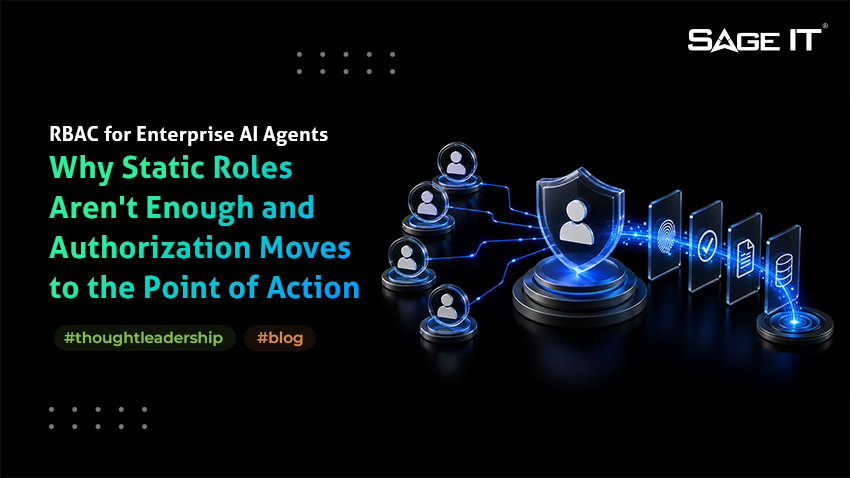
Securing AI agents is different because an agent takes actions across live systems, not just produces text. Traditional AI security hardens the model and the network around it; agent security has to control what the agent is allowed to do at the point of action, with real credentials, against real systems of record.
What is enterprise AI agent security?
Enterprise AI agent security is the practice of protecting the actions an autonomous AI agent can take across enterprise systems from being abused, whether by an attacker or by the agent’s own mistaken reasoning. It spans agent identity and authentication, least-privilege authorization, credential and token handling, runtime policy enforcement, and action-level audit. Unlike a model content filter, which shapes what a model outputs, agent security decides whether an agent may read a record, write to the ERP, move money, or call another system, and enforces that decision before the action lands. The population of agents that can act is growing fast: Gartner projects 40% of enterprise applications will embed task-specific AI agents by the end of 2026, up from less than 5% in 2025, so the number of privileged, non-human actors inside enterprise systems is climbing faster than most security models were built to handle.
Why aren’t model guardrails and network security enough for AI agents?
Model guardrails and network security are not enough because neither stops a malicious action at the point where the agent executes it. Model-level guardrails such as content filters and alignment constrain what a model says, and network and API security control who can reach an endpoint, but an authenticated agent with valid tokens can still issue a harmful write that looks entirely legitimate on the wire. A model-side filter can also be bypassed by instructions hidden inside otherwise trusted content, a pattern the NIST generative AI profile documents as indirect prompt injection, where the agent never sees an obviously malicious prompt. Our view is that the perimeter has moved: security has to apply to what the agent does across systems, not only to what the model generates or which port is open.
Why is an AI agent a new kind of privileged identity?
An AI agent is a new kind of privileged identity because it holds credentials and acts autonomously, and that population is growing faster than most identity programs can absorb. Gartner projects 40% of enterprise applications will embed task-specific AI agents by the end of 2026, up from less than 5% in 2025, which puts a wave of non-human actors inside enterprise systems. Gartner also names identity and access management for AI agents as a priority security trend, pointing to identity registration, credential automation, and policy-driven authorization for machine actors, and notes that current IAM tools are not yet mature for this use. In our engagements, the recurring problem is the standing credential: an agent handed a broad, long-lived token becomes an over-privileged identity, which is exactly the pattern behind the confused deputy problem that MITRE ATLAS catalogs for agentic systems, where a trusted agent is manipulated into using its access on an attacker’s behalf.
Where AI agents get attacked
The agent attack surface runs the length of the connection chain, from the prompt to the system of record. Each hop between the agent and enterprise data is a distinct place an attacker can inject, poison, steal, or over-reach.
What are the main ways attackers compromise enterprise AI agents?
Attackers compromise enterprise AI agents at four main points: the input, the tools, the credentials, and the execution. At the input, prompt injection, direct or indirect, plants instructions the agent follows; the NIST generative AI profile treats indirect prompt injection, where malicious instructions ride inside trusted data, as a core generative AI threat. At the tool layer, tool poisoning hides malicious instructions inside a tool’s own description, so the agent trusts metadata a user never sees. At the credential layer, stolen or over-scoped tokens let an agent be turned into a confused deputy, a technique MITRE ATLAS documents for agentic systems. At the execution layer, excessive autonomy means an agent with more permissions or reach than its task requires can take a harmful action no one authorized. Securing the model alone leaves three of those four surfaces exposed.
The AI agent attack surface: every hop between the agent and your systems is a target
Agent platform
Claude, ChatGPT,
custom agents
MCP servers
& tools
wrap NetSuite,
Salesforce, SAP
Integration
layer
above Boomi,
MuleSoft
Enterprise systems
ERP, CRM,
payments, data
Policy-enforced execution bridge (security control plane)
verifies the agent · checks each action against policy · brokers scoped tokens · logs and can block
What is a tool poisoning attack on MCP?
A tool poisoning attack on Model Context Protocol (MCP) hides malicious instructions inside a tool’s description, which the model reads but a user usually never sees. Because the agent trusts tool metadata, a poisoned schema can redirect its behavior, exfiltrate data, or reroute credentials, and a tool that looks safe when it is approved can later mutate its own definition. Public U.S. National Security Agency guidance on MCP treats tool discovery as untrusted ingress and recommends inspecting every tool schema before it reaches the model. In Sage IT deployments, that inspection and exposure management runs inside the execution bridge rather than being trusted to the agent, and agents get least-privilege access to only the tools a task requires.
How do stolen or over-scoped tokens turn an agent into an attacker?
Stolen or over-scoped tokens turn an agent into an attacker because the agent already holds valid credentials to real systems, so a hijacked or confused agent inherits that access. If an agent authenticates once with a broad, long-lived token to the ERP, the CRM, and a payment system, a single successful prompt injection can drive privileged writes across all three, and every request looks authenticated. This is the confused deputy problem that MITRE ATLAS flags for agentic systems, made worse when agents are issued standing credentials that are rarely scoped or rotated. The defense is to stop handing agents standing credentials: broker short-lived, task-scoped tokens per action, enforce least-privilege roles, and keep the human in the loop for consequential writes, so a compromised prompt cannot cash a standing check.
| Threat | What it is | Primary control |
|---|---|---|
| Prompt injection | Untrusted input plants instructions the agent follows | Dynamic policy gates + human approval on consequential actions |
| Tool poisoning (MCP) | Malicious instructions hidden in tool descriptions | MCP/API exposure management + zero-trust tool ingress |
| Stolen or over-scoped tokens | Agent credentials reused or inherited by an attacker | Scoped token and secret broker + least-privilege RBAC |
| Confused deputy | Trusted agent manipulated into using its access | Zero-trust agent authentication + per-action authorization |
| Excessive autonomy | Agent has more permission or reach than its task needs | Least-privilege roles + deny-by-default policy gates |
| Runaway or compromised agent | Agent chains harmful actions at machine speed | Action-level logging + emergency kill switch |
The controls that secure an AI agent at the point of action
Execution-layer security is the layer that turns a security policy into an enforced action. It sits between agent platforms and enterprise systems and checks every agent action against identity, permission, and policy before the action reaches a system of record.
What are the core security controls every enterprise AI agent needs?
Every enterprise AI agent needs seven controls: zero-trust agent authentication, least-privilege RBAC, dynamic policy gates, a scoped token and secret broker, MCP and API exposure management, action-level logging, and an emergency kill switch with multi-tenant isolation. Zero-trust authentication verifies every agent before access, so no agent is implicitly trusted. Least-privilege RBAC scopes each agent to its task. Dynamic policy gates set real-time boundaries and block an action at execution. A token and secret broker issues short-lived, task-scoped credentials instead of standing tokens. Exposure management inspects and gates the MCP tools and APIs an agent can see. Action-level logging makes every decision traceable, and a kill switch with multi-tenant isolation allows instant termination and keeps domains and their credentials separated. Together these convert a security policy into deny-by-default enforcement.
Seven controls a security control plane enforces on every agent action
Zero-trust
agent auth
Least-privilege
RBAC
Dynamic
policy gates
Scoped token
& secret broker
MCP / API
exposure mgmt
Action-level
logging
Kill switch +
multi-tenant isolation
What is a policy-enforced execution bridge?
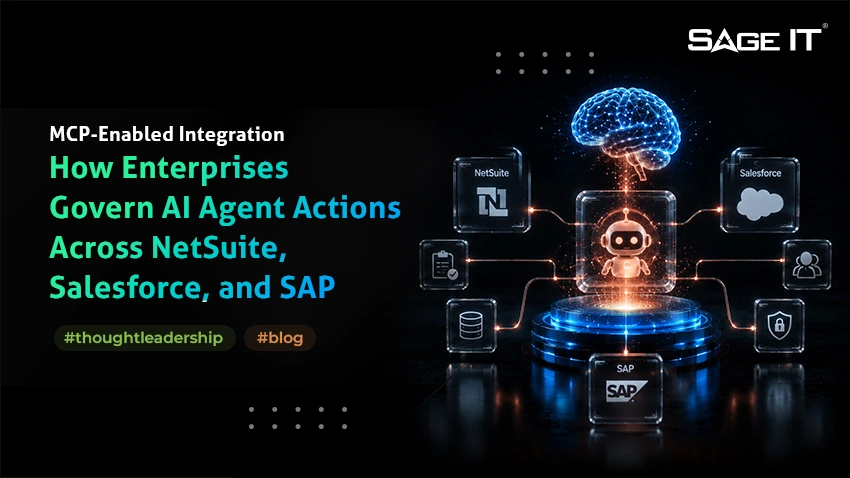
A policy-enforced execution bridge is a security control plane that sits between agent platforms and enterprise systems and enforces the seven controls on every action. It intercepts each agent action, verifies the agent, checks the action against active policy, brokers a scoped credential, allows or blocks it, and logs the decision. Sage IT builds and runs this pattern in production as a loosely coupled layer deployed on AWS or Azure that sits above the iPaaS, including Boomi and MuleSoft, rather than replacing it. Autonomous agents on platforms such as Claude, ChatGPT, or a custom agent reach enterprise CRM, ERP, and payment systems only through the bridge, which authenticates each agent and gates each action. Placing enforcement in that path is what lets security apply to what the agent does, not only to what the model says or which endpoint is reachable.
In a separate engagement, we governed AI agents acting across CRM and ERP through this bridge, and it earned its place the first time an agent got something wrong. Each agent authenticated as itself under zero trust, and the access it could exercise at any moment was scoped to its current step: a token-delegation chain narrowed authority hop by hop, with Okta at the identity edge and Boomi APIM enforcing scope at the action layer, so no agent held a standing credential to spend. When an agent proposed an incorrect write, the per-action gate stopped it before it reached the system of record, logged the decision, and left a clean audit trail. That is the confused-deputy problem being contained in practice, not in theory. We reached production on the first system in just a few weeks. The connection was never the hard part. Containing a wrong action was, and that is what point-of-action enforcement is for.
How to harden AI agents in stages
AI agent security rolls out in stages, from visibility to enforcement to controlled autonomy. The goal is to earn autonomy through evidence and testing, not to grant broad access on day one, because Gartner predicts that by 2028, organizations skipping preproduction offensive testing will face twice as many cybersecurity incidents.
How should you roll out AI agent security?
Roll out AI agent security in five stages: inventory and authenticate every agent, replace standing credentials with scoped tokens, gate consequential actions with human approval, turn on action-level logging and offensive testing, then expand autonomy only where the evidence is clean. Start by discovering which agents exist and enforcing zero-trust authentication, because an unknown agent with a standing token is the risk pattern behind most agent incidents. Replace broad, long-lived credentials with a per-action token broker. For any action with financial, legal, or safety consequence, keep a human in the loop with a propose-then-approve pattern. Only after logging, policy gates, and red-team testing are proven should an agent move toward autonomous execution, and the emergency kill switch stays in place throughout.
| Stage | Objective | Anchoring control |
|---|---|---|
| 1. Inventory and authenticate | Remove unknown and implicitly trusted agents | Zero-trust agent authentication |
| 2. Scope credentials | End standing, over-privileged tokens | Scoped token and secret broker + least-privilege RBAC |
| 3. Gate consequential actions | Keep humans on high-impact writes | Dynamic policy gates + human approval |
| 4. Log and test | Make every action auditable and probe for injection | Action-level logging + offensive testing |
| 5. Expand autonomy | Earn autonomy from evidence | Deny-by-default policy + emergency kill switch |
When native controls are enough
A full execution-layer security control plane is not required for every AI agent. Matching the control to the blast radius avoids overbuilding where a lighter approach is safe.
When do you not need an execution-layer security control plane?
You do not need an execution-layer control plane when an agent is read-only, single-system, and low-risk. A support assistant that summarizes tickets in one system, or an analyst agent that runs read-only queries against a data warehouse, can be secured with that system’s own role-based access, its native logging, and standard model guardrails. The control plane earns its place when agents can write, transact, or act across multiple systems, when actions carry financial or regulatory consequence, or when many agents share the same enterprise stack. Reach for execution-layer security when the blast radius of a hijacked action crosses a system boundary, and keep it proportionate when it does not.
Security decision reference
This reference maps common situations to a recommended security approach and where Sage IT fits.
| Situation | Recommended approach | How Sage IT helps |
|---|---|---|
| Single-system, read-only agent | Native RBAC, logging, model guardrails | Agent security assessment |
| Agent that writes or transacts in one system | Scoped tokens + policy gates + approval | Control-plane configuration |
| Agents acting across multiple systems | Full policy-enforced execution bridge | Security control plane above any iPaaS |
| Agents using many MCP tools | MCP/API exposure management + zero-trust ingress | Tool inspection inside the bridge |
| Many agents on a shared stack | Multi-tenant isolation + kill switch | Isolation and instant termination |
Quotable takeaways
Quotable takeaway: Model guardrails constrain what an agent says. Enterprise AI agent security constrains what an agent does, with real credentials, across real systems.
Quotable takeaway: Gartner predicts 25% of enterprise GenAI applications will see at least five minor security incidents a year by 2028, and that inadequate risk controls will help cancel over 40% of agentic AI projects by 2027.
Quotable takeaway: An AI agent is a privileged, non-human identity. Hand it a broad, standing token and one successful prompt injection inherits all of that access.
Quotable takeaway: The perimeter moved to the point of action. A model-side filter can be bypassed by instructions hidden in trusted data, so enforcement belongs where the agent acts.
Quotable takeaway: A policy-enforced execution bridge secures the agent at the point of action, above any iPaaS, so a hijacked prompt cannot cash a standing credential.
Common mistakes in AI agent security
What is the most common mistake in enterprise AI agent security?
The most common mistake is trusting model guardrails plus a standing credential, then granting the agent broad access and reviewing after the fact. An agent with a long-lived, over-scoped token is a standing privileged identity, and a content filter does nothing to stop it from being turned into a confused deputy by one successful prompt injection. In our engagements, unrotated, over-privileged agent credentials are the single most common gap. The fix is to authenticate every agent under zero trust, broker short-lived task-scoped tokens, gate consequential actions with human approval, and log every action, so security is something the system enforces rather than something a guardrail hopes for.
Why isn’t a security framework enough on its own?
A security framework is not enough on its own because frameworks describe risks and controls, not runtime enforcement. The NIST AI Risk Management Framework and its generative AI profile tell an organization which agent threats to manage, including indirect prompt injection, and MITRE ATLAS catalogs adversarial techniques across its knowledge base, with agent-focused techniques added in its 2026 updates. None of them intercepts an agent action across systems. Our position is to treat the frameworks as the specification and the execution bridge as the implementation. Mapping to the NIST AI RMF proves you understand the threats; zero-trust authentication, scoped tokens, policy gates, and a kill switch prove you can stop them in production.
FAQ
Next step
Map your AI agents against a security model before you expand their access. Sage IT’s AI agent security assessment inventories the agents already acting in your environment, flags unknown or over-privileged agents and standing credentials, maps your exposure to the NIST AI RMF and MITRE ATLAS techniques, and identifies where native controls are enough and where a policy-enforced execution bridge is warranted. The output is a prioritized hardening roadmap, with a scoped-token and policy-gate plan, that you can take to security, compliance, and the board.
Conclusion
Enterprise AI agent security is an enforcement problem, not a filtering problem. Model guardrails and network security are necessary, but agents act across systems with real credentials, so the controls have to live in the execution path: zero-trust authentication, least-privilege roles, scoped tokens, dynamic policy gates, MCP and API exposure management, action-level logging, and a kill switch. Secure the agent at the point of action, above any iPaaS, and a hijacked prompt has nothing to spend.
Sources used