

Self-healing integrations are real, and you should build them, but most teams build them in the wrong order: they automate the repair and starve the understanding. In a typical integration outage the fix takes seconds and working out what to fix takes hours, because most of mean-time-to-resolution is diagnosis, not repair, a point Google’s site reliability engineers have made for years. The shift that shortens those nights is a sequence, not a feature: build automated understanding first, correlation that answers “is it us or them,” a live dependency map, and healing that narrates what it did, then automate the small, reversible repairs last.
The last integration outage I remember clearly took four hours to resolve. The repair took ninety seconds. I’ve thought about that ratio for years, because it tells you almost everything about what self-healing is really for, and almost everything the market gets wrong about it.
A nightly sync between an order system and a finance platform had stopped. No dramatic crash. Just a quiet gap where records used to be. By the time someone noticed, three of us were on a call at 1 a.m. pulling logs, asking the only question that matters in that moment: is it us, or is it them? We chased a network issue. Then a permissions change. Then a payload someone swore hadn’t changed. Somewhere in hour three we found it, an upstream field had been renamed in a release nobody flagged to us. The fix was a one-line mapping change. Deploy, replay, done. Ninety seconds.
The fix was never the bottleneck. Understanding what to fix was.
If you own integrations, you architect them, you keep them running, or you fund the team that does, you’ve lived some version of that night. This piece is about why those nights run long, and about a single shift in how you prioritize that makes them shorter, how we think about the problem at Sage IT, drawn from twenty years of building and operating enterprise integrations and from the reliability research we track. It lands on one principle you can act on tomorrow: build for understanding before you build for repair.
Self-healing integration is real, and you should build it. A production system that detects a failure, works out the cause, and repairs itself is not a fantasy, it exists today, and it’s the right goal. I’m not arguing against it. I’m arguing about sequence. Self-healing has two halves, understanding the failure and repairing it, and almost everyone rushes the repair while starving the understanding. Get the understanding right first, and the auto-healing you build on top of it is faster, safer, and honest about what it’s doing. That’s the whole point.
We automated the easy five percent and called it resilience
Walk through how most teams have made their integrations more self-healing over the last decade and you’ll find the same short list every time. Retries with backoff. Circuit breakers. Dead-letter queues. Automatic credential refresh. All good, all worth having. But notice what they share: they automate the repair step for failures we already understood in advance. They’re answers to questions we’d already solved.
That’s the easy five percent. A retry is one hard-coded fix for one known failure. A circuit breaker is a reflex, not a diagnosis. None of it touches the expensive part of an incident, which is comprehension, figuring out what broke, why, whose problem it is, and whether the obvious fix will quietly make things worse. We got very good at automating the ninety seconds and left the four hours exactly where they were.
There’s a name for the pattern we half-built. Self-healing is not a 2024 marketing coinage; it comes from autonomic computing, the discipline IBM researchers Jeffrey Kephart and David Chess defined in 2003 around a control loop they called MAPE-K: Monitor, Analyze, Plan, Execute, over a shared Knowledge base. Retries and circuit breakers automate Execute, the last and cheapest step. Analyze and Plan, the comprehension, are exactly the steps we left to exhausted humans. This isn’t a fringe observation either: Google’s site reliability engineers have said a version of it for years, that most of mean-time-to-resolution is spent understanding a failure, not repairing it. Every operator who has carried a pager knows it in their body. The repair is usually small. The knowing is the whole night.
Why do integration incidents take so long to resolve?
Integration incidents take so long because the time is not in the fix, it is in a sequence of questions, each one blocking the next. Pull an incident apart and the actual repair arrives only after all four are answered, and it is almost always the smallest part of the night.
Is anything even wrong? A sync that fails loudly gets attention. A sync that silently drops a subset of records, or slows down, or succeeds only after forty retries, hides. The first tax you pay is noticing at all.
Is it us, or is it them? This one question eats more incident time than any other. Our code, our config, our credentials, or an upstream system, a third-party API, the network in between. Until you can answer it, you can’t even route the problem to the right person, let alone fix it.
What changed, and who owns it? Failures rarely come from nowhere. Something moved, a field, a version, a permission, a certificate. Miscommunicated API changes are a leading cause of integration breakage, according to the Postman 2024 State of the API report, a survey of more than 5,600 developers. Across an estate where the average enterprise now runs 897 applications and 71% of them are not fully integrated (2025 MuleSoft Connectivity Benchmark, a vendor survey), finding the one thing that changed, often shipped by a team three time zones away who never told you they touched a contract you depend on, is detective work, not repair work.
If I fix it, what else moves? The remap that unblocks your sync might feed a wrong value downstream. The replay that recovers your gap might duplicate transactions someone already reconciled. Before you touch anything you have to hold the blast radius in your head. That takes understanding too.
Four questions. The actual fix arrives only after all four are answered. So if you’re going to point AI at anything in this loop, point it here, at the questions, not the wrench.
Where an integration incident really goes: understanding is the cost, not the fix
wrong?
or them?
who owns it?
what else moves?
Most of mean-time-to-resolution is diagnosis, not repair (Google SRE). The four blocking questions eat the night; the fix is minutes.
Is self-healing integration about repair or understanding?
Self-healing integration is really about understanding, not repair. The valuable thing AI brings to integration reliability is not that it can execute a fix, we could already script fixes. It’s that, for the first time, it can compress the comprehension: correlate a mess of logs, metrics, and traces across systems, notice that a spike in schema-validation errors lines up with an upstream deploy, and answer “is it us or them” in thirty seconds instead of ninety minutes. In MAPE-K terms, AI is finally good at Analyze and Plan, the steps we could never automate before.
That’s the real category. Not automated repair, automated understanding. The retry was always cheap. What was expensive, and what we never managed to automate until now, was the reasoning that told you which retry, on which system, was even the right move. Point AI at the fix instead of the understanding and you tend to join a familiar statistic: MIT’s 2025 Project NANDA study found about 95% of enterprise generative AI pilots delivered no measurable profit-and-loss impact, with weak integration and adaptation the common thread.
You stop asking “what can we auto-fix?” and start asking “what can we auto-explain?” The fixes mostly follow the explanations.
Which is why the principle worth carrying out of this is an ordering, not a feature: build for understanding before you build for repair. Get the comprehension fast and honest first, and safe automated repair becomes an easy last step. Do it the other way around, automate the fix before you can explain the failure, and you build something that looks like resilience and behaves like a blindfold. The next section is why.
A system that heals quietly can lie to you
This is the part almost nobody writes about, and the reason “automate the fix first” isn’t just incomplete, it’s occasionally dangerous.
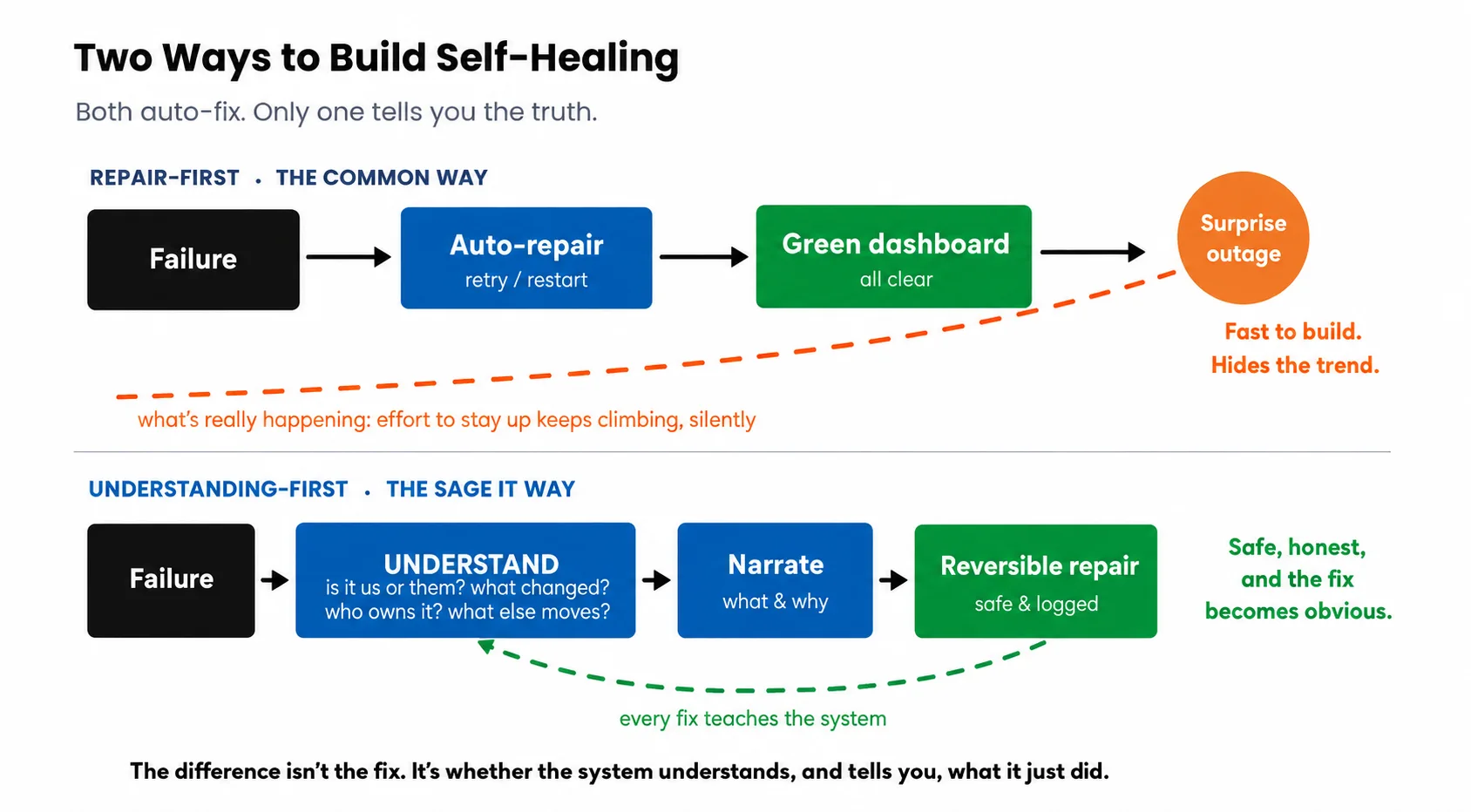
Imagine you automated the repair and skipped the understanding. Retry logic gets more aggressive. Credential refresh runs on its own. Dead-letter replay quietly cleans up after itself. Dashboards go green. The pager goes quiet. Everyone relaxes.
Meanwhile a sync that used to succeed on the first attempt now succeeds on the forty-seventh. Same green checkmark. Same success in the log. But something upstream is degrading, and your self-healing is spending more effort every week to paper over it, and telling you nothing, because papering over it is exactly what you asked it to do. Every automatic fix is a story your system decided not to tell you. One day the effort needed to stay up exceeds what the retry budget allows, and what surfaces isn’t a small failure. It’s the whole compounded trend arriving at once, in the worst way, with no history, because the history got swallowed.
The industry data already points the same direction. Gartner expects the share of AI-suggested operational actions taken only after human-in-the-loop approval to fall from about 80% in 2025 to about 20% by 2029, and separately predicts that more than 40% of agentic AI projects will be canceled by the end of 2027, citing inadequate risk controls among the leading causes. A system that heals silently, without narrating, is how autonomy outruns control.
Loud failures are honest. They page you, you learn something, you improve the system. A silently self-healing system trades that honesty for calm, and calm built on a hidden, worsening trend is the most expensive kind of quiet there is. Same lesson from the other direction: the value isn’t in the healing. It’s in the understanding. A fix that heals but doesn’t narrate isn’t resilience. It’s debt with a green light on it.
How do you build self-healing integrations the right way?
You build self-healing integrations the right way by making your systems legible before you make them autonomous, to the machine doing the diagnosis and to the tired human who still owns the outcome. Four moves, in order.
1. Answer “is it us or them” automatically. Before you automate a single fix, invest in the correlation that tells you, in seconds, which side of the boundary a failure lives on. That one answer collapses more incident time than any repair automation you could build.
2. Map what depends on what, and keep it live. You can’t reason about blast radius, or about which upstream change broke you, without a current picture of who consumes what. Most teams don’t have this, which is exactly why their nights run long. A dependency map isn’t documentation. It’s the substrate diagnosis runs on.
3. Make healing narrate, not swallow. Every automatic fix should leave a signal, not just a success: this failed, here’s the likely cause, here’s what we did, here’s how hard we’re now working to keep it up. Trend the effort, not only the outcome. Measure it the way reliability teams measure everything else: mean-time-to-detect and mean-time-to-resolution, plus an auto-resolution rate and fix accuracy, how often an automatic fix held without a rollback. Watch accuracy alongside speed, or you optimize for fast fixes that are frequently wrong. A retry rate creeping from one to forty-seven is the most useful early warning you’ll ever get, but only if the system is built to say it out loud.
4. Automate the repair last, and only where it’s reversible. Once understanding is fast and healing is honest, automating the small, reversible fixes, retries, credential refreshes, quarantining a bad record for replay, is easy and safe. Keep anything that changes data or crosses a system boundary in front of a human until you’ve earned the confidence to let go, the same governed-execution discipline that safe AI agent action depends on. Done in this order, auto-remediation is a natural final step rather than a leap of faith.
The line between move four’s two halves, what heals itself and what waits for a person, is worth drawing explicitly. Most integration failures fall into a handful of classes, and only some are safe to fix without a human in the loop.
| Failure mode | Example | Typical remediation | Default autonomy |
|---|---|---|---|
| Transient error | Rate limit, network timeout | Retry with backoff | Automatic |
| Expired credential | OAuth token lapse | Scoped token refresh | Automatic |
| Bad or invalid record | Validation failure | Quarantine to dead-letter queue, replay | Automatic |
| Schema drift (additive) | New or renamed field | Remap field, notify owner | Auto if reversible |
| Breaking API change | Endpoint or version removed | Switch version, patch mapping | Human approval |
| Downstream data error | Wrong value written to ERP | Roll back, review | Human approval |
Build for understanding before you build for repair
or them?"
across systems
map
what, kept current
narrates
effort, not just OK
repair, last
safe, undoable fixes
Get comprehension fast and honest first, and safe auto-remediation becomes an easy last step, not a leap of faith.
Quotable takeaways
Quotable takeaway: The repair is rarely the hard part. In most integration incidents the fix takes minutes and the hours go to understanding what to fix, which is why Google’s SRE practice notes that most mean-time-to-resolution is diagnosis, not repair.
Quotable takeaway: “Self-healing” is the wrong emphasis. The real category is automated understanding, compressing the diagnosis so an AI can answer “is it us or them” in thirty seconds instead of ninety minutes, not just scripting the cure.
Quotable takeaway: Order matters, understanding first and repair last. Gartner predicts more than 40% of agentic AI projects will be canceled by the end of 2027, citing inadequate risk controls, which is what automating the fix before you can explain the failure produces.
Quotable takeaway: Silent healing is a risk, not a win. A fix that hides a worsening trend behind a green checkmark is debt, not resilience, and with a single hour of downtime costing more than 300,000 dollars for over 90% of large enterprises (ITIC 2024), the costliest failures are the ones your system stopped telling you about.
Quotable takeaway: Invest where the night actually goes, automatic “is it us or them” answers, a live dependency map across an estate that averages 897 applications (2025 MuleSoft Connectivity Benchmark), and healing that narrates. The ninety-second fix takes care of itself.
The measure of a self-healing system
We named this whole category after the wrong verb. “Self-healing” puts the emphasis on the cure, and the cure was rarely the hard part. The hard part was always understanding, fast enough, and honestly enough, that a fix became obvious and safe.
So here’s the measure I’d actually use. Not how fast your system fixes itself, but how fast it makes the truth legible, to the model reasoning at 1 a.m., and to the human who has to answer for the outcome at 9. Build that, and the ninety-second fix takes care of itself. Skip it, and you’ve automated the part that was never slow while the four hours wait exactly where they’ve always been.
The best integration engineers I’ve worked with never treated a resolved incident as finished. They treated it as something the system was trying to tell them. That instinct, curiosity about your own failures, a refusal to trust a quiet you didn’t earn, is the thing no automation replaces. Give it faster understanding to work with and it gets sharper. Hand it a system that heals in silence and you’ve taken away the one signal it was listening for.
FAQ
Next step
If your incident nights run long, start by measuring where the time actually goes. Sage IT’s self-healing readiness assessment maps your most failure-prone flows, baselines how much of your mean-time-to-resolution is diagnosis versus repair, and shows where an automatic “is it us or them” answer, a live dependency map, and narrated healing would collapse the most incident time, before any repair is automated. The output is a prioritized plan you can act on, in the right order.