

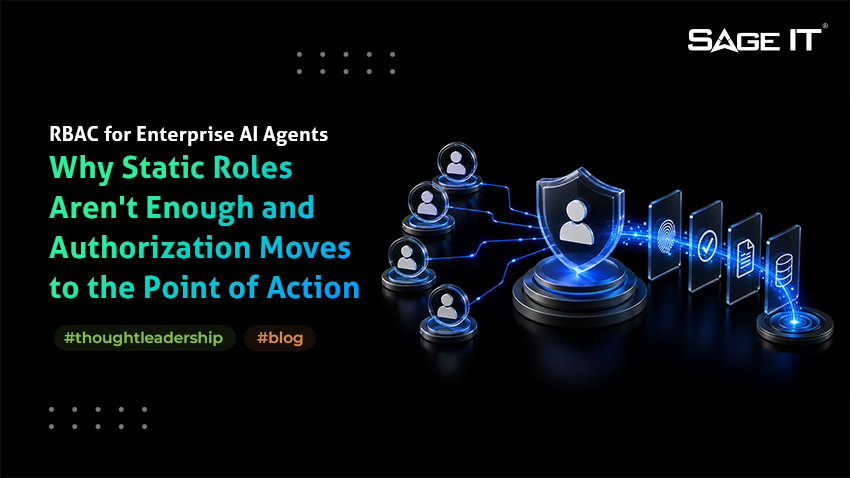
RBAC for enterprise AI agents is the practice of giving each agent a narrow, least-privilege role and then authorizing every action that role attempts at the moment it runs, not once at setup. Role-based access control is the right foundation, but a static role granted to a non-deterministic, non-human identity that acts across systems becomes standing privilege, which is exactly what attackers and mistakes exploit. Gartner projects that 40% of enterprise applications will embed task-specific AI agents by the end of 2026, up from less than 5% in 2025, and names identity and access management for AI agents as a priority security trend. The durable model combines least-privilege RBAC with attribute-based context and a per-action policy gate that verifies the agent, checks the role, evaluates the context, and mints a short-lived scoped token, aligned to the NIST Zero Trust Architecture (SP 800-207).
Most teams give an AI agent a role once and move on. That is the right first step and the wrong last one, because an agent decides its own sequence of actions at run time.
How this guide was created
This guide was prepared by Sage IT’s integration and AI practice, drawing first on our work designing role-based access, least-privilege authorization, credential handling, and audit for agentic AI across enterprise systems and iPaaS platforms such as Boomi and MuleSoft. We combined that delivery experience with authoritative, non-commercial sources: Gartner’s 2025 and 2026 IAM and agentic AI research, the NIST role-based access control model, NIST SP 800-162 on attribute-based access control, NIST SP 800-207 on zero trust architecture, and MITRE ATLAS. Access models and agent threats evolve quickly and should be validated against your own environment before production use.
Why RBAC for AI agents is different from RBAC for people
RBAC for AI agents is different because an agent is a non-human identity that acts autonomously and unpredictably across systems, while RBAC was designed for people whose behavior a review can anticipate. A role that is safe for a person who logs in occasionally can be dangerous for an agent that fires thousands of actions an hour.
What is RBAC for AI agents?
RBAC for AI agents is the assignment of permissions to agents through roles rather than direct grants, so each agent can only take the actions its role allows. The NIST role-based access control model, the basis for enterprise RBAC, ties permissions to roles and roles to identities, which keeps access consistent and auditable. Applied to agents, RBAC means every autonomous agent has its own role scoped to a specific job, such as read invoices or create support tickets, rather than broad system access. Gartner projects 40% of enterprise applications will embed task-specific AI agents by the end of 2026, up from less than 5% in 2025, so the number of roles an enterprise must define and enforce for non-human identities is rising sharply. RBAC gives agent access a structure, but structure alone does not decide whether a given action is safe right now.
Why does traditional RBAC fall short for autonomous agents?
An AI agent’s role is really a standing privilege because the agent holds it continuously and can invoke it autonomously, without a human initiating each use. Gartner identifies over-privileged and unmanaged non-human identities as a core risk as machine identities come to outnumber humans, and flags sharing human credentials with agents as a critical mistake, because it makes agent access impossible to scope, audit, or revoke on its own. A standing role on a non-human identity is the pattern behind the confused deputy problem that MITRE ATLAS catalogs for agentic systems, where a trusted agent is manipulated into using its access on an attacker’s behalf. NIST SP 800-207 answers this by requiring least-privilege access to be enforced dynamically and standing access to be minimized. For agents, that means the role is a baseline, and the live authorization decision belongs at the point of action.
Why is an AI agent’s role really a standing privilege?
An AI agent’s role is really a standing privilege because the agent holds it continuously and can invoke it autonomously, without a human initiating each use. Gartner identifies over-privileged and unmanaged non-human identities as a core risk as machine identities come to outnumber humans, and flags sharing human credentials with agents as a critical mistake, because it makes agent access impossible to scope, audit, or revoke on its own. A standing role on a non-human identity is the pattern behind the confused deputy problem that MITRE ATLAS catalogs for agentic systems, where a trusted agent is manipulated into using its access on an attacker’s behalf. NIST SP 800-207 answers this by requiring least-privilege access to be enforced dynamically and standing access to be minimized. For agents, that means the role is a baseline, and the live authorization decision belongs at the point of action.
The layers of AI agent authorization
Authorizing an AI agent well takes more than one control. Identity, role, context, and policy each decide part of the question, and a per-action gate combines them before an action reaches a system of record.
How should you authorize an AI agent’s action?
Authorize an AI agent’s action by checking four things in sequence at the moment it acts: identity, role, attributes, and policy. First verify the agent is a known, authenticated non-human identity. Then check that the requested action is within its least-privilege role (RBAC). Then evaluate the attributes of the request, the data, the time, and the context (ABAC). Finally apply active policy to decide whether the action is allowed right now, and if it is, mint a short-lived scoped token instead of relying on a standing credential. This is the NIST SP 800-207 pattern of a policy decision point and a policy enforcement point applied to agents, and it defaults to deny: an action executes only when the agent, the role, and the policy all check out.
How a policy-enforced bridge authorizes each agent action
Agent request
An action against
a system of record
Policy decision point
Identity
· is this a verified agent?
Role (RBAC)
· is the action in scope?
Attributes (ABAC)
· data, time, context?
Policy
· allowed right now?
Enforcement point
Mint a short-lived,
scoped token
Enterprise system
ERP, CRM,
payments, data
Deny by default · or route to human approval
No standing privilege: the token is minted per action and expires
Aligned to NIST Zero Trust (SP 800-207): verify identity, decide per request, enforce least privilege
What is the difference between RBAC and ABAC for agents?
The difference is that RBAC decides access from a role, while ABAC decides access from attributes evaluated at run time. RBAC answers whether an agent’s role permits an action type, such as posting a payment. ABAC, defined in NIST SP 800-162, answers whether this specific request should proceed given the amount, the counterparty, the time, and the data sensitivity. For agents the two are complementary, not competing: RBAC keeps the permission set small and auditable, and ABAC adds the context RBAC cannot see. An agent might hold a role that permits payment posting, yet ABAC and policy still block a six-figure payment to a new vendor outside business hours. Using both is what turns a coarse role into a decision that fits the moment.
Where does zero trust fit in AI agent RBAC?
Zero trust is the operating model that makes agent RBAC enforceable at run time. NIST SP 800-207 shifts access from implicit trust to an explicit, per-request decision that verifies identity, evaluates context, and enforces least privilege, with standing access minimized. Its reference architecture separates the policy engine that computes the decision from the policy enforcement point that carries it out on the data path. Applied to AI agents, zero trust means no agent is implicitly trusted because it authenticated once; every action is re-evaluated, and access is granted just in time through a scoped token rather than held continuously. RBAC supplies the role, ABAC supplies the context, and zero trust supplies the rule that the decision happens per action, at the point of action.
| Layer | What it decides | On its own it cannot |
|---|---|---|
| Identity (zero-trust auth) | Is this a known, verified agent? | Say what the agent may do |
| Role (RBAC) | Is the action type in the agent’s scope? | See the data, time, or context |
| Attributes (ABAC, SP 800-162) | Does this specific request fit the context? | Enforce itself without a gate |
| Policy gate (SP 800-207) | Is the action allowed right now? | Work without a role to reason about |
| Scoped token | Grants just-in-time, least-privilege access | Replace the decision that precedes it |
The controls that put agent RBAC into force
A model becomes real only when controls enforce it. A policy-enforced execution bridge applies agent RBAC on every action, above the iPaaS, so a role is not just declared but enforced at the point of action.
What controls does an enterprise need to enforce agent RBAC?
An enterprise needs six controls to put agent RBAC into force: zero-trust agent authentication, dynamic policy gates, action-level logging, regulatory mapping, an emergency kill switch, and multi-tenant isolation. Zero-trust agent authentication verifies every agent before access using RBAC and zero-trust propagation, so no agent is implicitly trusted. Dynamic policy gates set real-time permission boundaries and can block an action at execution. Action-level logging makes every decision fully traceable with a complete audit trail. Regulatory mapping auto-maps those access decisions to compliance frameworks for auditability. An emergency kill switch allows instant agent termination with execution interception, which is how you revoke a role in seconds. Multi-tenant isolation keeps secure boundaries and credentials separated between domains. Sage IT runs these as a loosely coupled bridge on AWS or Azure, above Boomi and MuleSoft, that also handles scoped token and credential handling, MCP and API exposure management, and human-in-the-loop approval.
In a separate engagement, we governed AI agents writing into CRM and ERP through this bridge, and it earned its place the first time an agent got something wrong. Each agent held its own least-privilege role, but the access it could exercise at any moment was smaller still: a token-delegation chain narrowed authority hop by hop, with Okta at the identity edge and Boomi APIM enforcing scope at the action layer, so no agent ever held more privilege than its current step required. When an agent proposed an incorrect write, the per-action gate stopped it before it reached the system of record, logged the decision, and left a clean audit trail. We reached production on the first system in ten weeks. The role was never the hard part. Containing a wrong action the role technically permitted was – and that is what per-action authorization is for.
From a shared human credential to per-action least privilege
1. Shared human credential
Agent inherits a person's access
2. Per-agent identity
Each agent is its own non-human ID
3. Least-privilege role (RBAC)
Narrow role scoped to the task
4. Context-aware gates (ABAC)
Action, data, and time refine access
5. Scoped, just-in-time token
Minted per action, expires after
Standing privilege shrinks at each step; action-level logging and a kill switch stay on throughout
How do scoped tokens replace standing agent privilege?
Scoped tokens replace standing privilege by granting access one action at a time instead of once at setup. Rather than issuing an agent a broad, long-lived credential to the ERP, the CRM, and a payment system, the bridge mints a short-lived token scoped to the single approved action, then lets it expire. This is the NIST SP 800-207 principle of minimizing standing access, applied to non-human identities. The effect on RBAC is significant: even if an agent’s role is broader than a specific task needs, the token it actually receives is not, so a hijacked or confused agent cannot reuse a standing credential across systems. Secure token and credential handling, paired with least-privilege roles, is what closes the gap between the role an agent holds and the access it can exercise at any given moment.
How to roll out AI agent RBAC
AI agent RBAC rolls out in stages, from ending shared credentials to per-action least privilege. The goal is to shrink standing privilege at every step while keeping audit and revocation on throughout.
How should you stage AI agent RBAC?
Stage agent RBAC in five steps: give every agent its own identity, assign a least-privilege role, add attribute and policy gates, issue scoped just-in-time tokens, and keep logging and a kill switch on the whole time. Start by ending shared human credentials so each agent is a distinct non-human identity that can be scoped, audited, and revoked on its own, which Gartner names a critical fix. Assign a narrow role per agent rather than broad access. Add ABAC attributes and dynamic policy gates so context, not just role, decides each action. Replace standing credentials with per-action scoped tokens. Throughout, keep action-level logging and an emergency kill switch active so every decision is traceable and any agent can be stopped instantly.
| Stage | Objective | Anchoring control |
| 1. Give each agent an identity | End shared human credentials | Zero-trust agent authentication |
| 2. Assign a least-privilege role | Scope each agent to its task | RBAC enforcement across all agents |
| 3. Add context and policy | Let context decide, not just role | ABAC attributes + dynamic policy gates |
| 4. Issue scoped tokens | Remove standing privilege | Scoped token and credential handling |
| 5. Log, map, and revoke | Stay auditable and reversible | Action-level logging, regulatory mapping, kill switch |
When native platform RBAC is enough
A policy-enforced execution bridge is not required for every AI agent. Matching the control to the blast radius avoids overbuilding where a platform’s own roles are sufficient.
When is your platform’s built-in RBAC enough for an agent?
Your platform’s built-in RBAC is enough when an agent is read-only, single-system, and low-risk. A support assistant that summarizes tickets in one system, or an analyst agent that runs read-only queries against a data warehouse, can rely on that system’s native roles and logging. The bridge earns its place when agents can write or transact, act across multiple systems, or carry financial or regulatory consequence, because native RBAC in one platform cannot enforce a role, evaluate context, and broker a scoped token across the whole stack. Reach for per-action authorization when a wrong action would cross a system boundary, and keep it proportionate when it would not.
RBAC decision reference
This reference maps common situations to a recommended access approach and where Sage IT fits.
| Situation | Recommended approach | How Sage IT helps |
| Single-system, read-only agent | Native platform RBAC and logging | Agent access assessment |
| Agent that writes in one system | Least-privilege role + policy gate + approval | Control-plane configuration |
| Agents acting across multiple systems | RBAC + ABAC + per-action policy gate | Policy-enforced execution bridge |
| Agents needing broad but occasional access | Scoped just-in-time tokens | Secure token and credential handling |
| Regulated workloads | Access decisions mapped to frameworks | Regulatory mapping + action-level logging |
| Many agents on a shared stack | Multi-tenant isolation + kill switch | Isolation and instant revocation |
Quotable takeaways
Common mistakes in AI agent RBAC
What is the most common RBAC mistake with AI agents?
The most common mistake is letting an agent inherit a human’s credentials and roles instead of giving it its own identity. Gartner flags this directly, because a shared credential makes agent access impossible to scope, audit, or revoke independently, and it blurs the line between what a person did and what an agent did. The second most common mistake is granting a broad role once and treating setup as the security decision. Both leave the enterprise with standing privilege on a non-human identity that acts autonomously. The fix is a distinct identity per agent, a least-privilege role, and a per-action policy gate that decides access at run time, so the role is a floor on access rather than the whole of it.
Why isn’t assigning a role enough?
Assigning a role is not enough because a role decides action types, not the specific action in front of the agent. An agent with a role that permits payment posting can still be driven, by a mistaken plan or a prompt injection, to post the wrong payment, and RBAC alone will allow it because the action type is in scope. NIST SP 800-162 and SP 800-207 exist precisely because static roles cannot evaluate context or enforce a per-request decision. Treat the role as the specification of what an agent may ever do, and the policy gate as the decision about what it may do now. Assigning the role is the start of agent authorization, not the end of it.
FAQs
Next step
Map your AI agents to a least-privilege access model before you widen what they can reach. Sage IT’s AI agent access assessment inventories the agents already acting in your environment, flags shared credentials and over-privileged roles, aligns your model to the NIST RBAC, SP 800-162, and SP 800-207 guidance, and identifies where native platform roles are enough and where a policy-enforced execution bridge is warranted. The output is a prioritized RBAC roadmap, with a role, policy-gate, and scoped-token plan, that you can take to security and compliance.
Conclusion
RBAC for enterprise AI agents is a starting point, not the finish line. A role tells you what an agent may ever do, but an autonomous, non-human identity needs the specific action decided at the moment it acts. Combine least-privilege RBAC with ABAC context and a per-action policy gate, grant access just in time through scoped tokens, and keep logging and a kill switch on throughout. Assign the role, then gate the action, and the agent’s access matches its job rather than exceeding it.
Sources used