

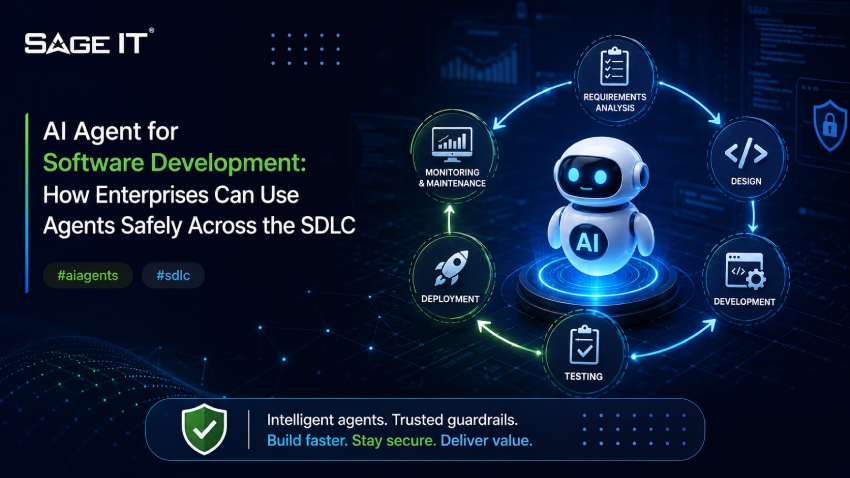
An AI agent for software development is a goal-driven software assistant that can plan, write, test, review, document, or prepare code changes across the software development lifecycle under human supervision. Unlike basic autocomplete tools, coding agents such as GitHub Copilot coding agent, OpenAI Codex, Claude Code, Cursor, and Devin can work across files, repositories, tasks, and pull requests. Enterprise teams should use them with approval gates, CI/CD controls, security checks, and traceability because adoption is rising, but trust remains the main bottleneck. In the Stack Overflow Developer Survey, 84% of respondents said they use or plan to use AI tools in development, while 66% said their biggest frustration is AI outputs that are “almost right.”
For software leaders, the real question is not whether AI can generate code. It is whether AI agents can reduce delivery delays without increasing defects, review load, security exposure, or release risk.
That is where enterprise adoption must shift from tool experimentation to a governed agentic SDLC.
What Is an AI Agent for Software Development?
Developer Goal
Fix bug, write test, update docs, or prepare PR
AI Software Development Agent
SDLC Outputs
AI accelerates defined SDLC tasks, but humans stay accountable.
An AI agent for software development is a software-focused AI system that can take a goal, understand codebase context, plan steps, use development tools, and produce an output such as a code change, test case, documentation update, pull request, bug fix, or release note.
A simple AI coding assistant usually helps a developer write code in the editor. An AI software development agent goes further. It can operate across the workflow. It may read repository files, inspect issues, propose implementation steps, run tests, create a draft pull request, respond to reviewer feedback, and prepare supporting documentation.
That does not make the agent a replacement for a developer. In an enterprise setting, the agent is better understood as a supervised SDLC participant. It can accelerate defined tasks, but engineering leaders still own architecture, security, code quality, compliance, and release accountability.
AI Coding Assistant vs AI Coding Agent vs AI Software Engineer
| Category | What it does | Enterprise role |
|---|---|---|
| AI coding assistant | Suggests code, explains snippets, completes functions, supports developers inside an IDE | Useful for individual developer productivity |
| AI coding agent | Takes a task, works across repository context, produces changes, tests, or pull requests | Useful for bounded SDLC work under review |
| AI software engineer | A broader market phrase for autonomous engineering systems | Should be treated carefully because enterprise accountability still requires human oversight |
GitHub’s Copilot coding agent shows the shift clearly. GitHub describes it as an agent that can work on issues, create draft pull requests, preserve branch protections, and require human approval before CI/CD workflows run.
OpenAI describes Codex as a cloud-based software engineering agent that can work on tasks in parallel, answer questions about a codebase, fix bugs, write features, and propose pull requests from isolated repository sandboxes.
The difference is not only technical. It changes the operating model. Developers are no longer only prompting for code. They are assigning bounded work, reviewing outputs, approving changes, and tracking whether the agent improves the delivery system.
Why AI Agents Matter for Software Development in 2026
AI coding capability has moved quickly. The Stanford AI Index reported that SWE-bench performance increased from 4.4% in 2023 to 71.7% in 2024, showing why expectations around software engineering agents changed so fast.
But capability growth does not automatically create enterprise value.
DORA’s State of AI-assisted Software Development report found that AI acts as an amplifier across the software delivery system. It can strengthen mature engineering practices, but it can also magnify weak workflows, unclear ownership, poor testing, and fragile release processes. DORA concludes that the greatest returns come from improving the underlying organizational and delivery system rather than relying on AI tools alone.
This is why enterprise leaders need a different question.
Instead of asking, “Which AI coding tool writes the most code?” ask:
Where can agents reduce SDLC friction without weakening quality, security, or release control?
That question moves the conversation from AI hype to delivery value.
How AI Agents Work Across the SDLC
AI Agents Work Safely Inside the SDLC
From task intake to traceability, every agent action needs context, validation, and human approval.
Task Intake
Receives a story, bug, tech debt item, or modernization task.
Context Retrieval
Reviews repository files, tickets, standards, tests, and dependencies.
Plan Generation
Proposes steps, affected files, assumptions, and risks.
Artifact Creation
Drafts code, tests, documentation, configuration, or a pull request.
Validation
Runs tests, linting, security scans, and dependency checks.
Human Review
Developers, architects, QA, or release owners approve the output.
Traceability
Links requirements, code, tests, approvals, and release activity.
AI agents reduce SDLC friction when context, quality gates, approvals, and traceability stay connected.
A software development agent works best when it is connected to a specific task, a trusted context layer, and a clear approval model.
A typical enterprise workflow looks like this:
- 1
Task intake: The agent receives a user story, bug, technical debt item, or modernization task from Jira, GitHub Issues, Azure DevOps, or a similar system.
- 2
Context retrieval: It reviews repository files, architecture notes, coding standards, tickets, test expectations, and dependency information.
- 3
Plan generation: It proposes steps, affected files, assumptions, and risks.
- 4
Code or artifact creation: It writes code, creates tests, updates documentation, prepares configuration changes, or drafts a pull request.
- 5
Validation: It runs tests, checks linting, scans for security risks, and reports failures.
- 6
Human review: Developers, architects, QA leads, or release managers approve, reject, or modify the output.
- 7
Traceability: The workflow links requirements, code, tests, approvals, and release activity for future audits.
This model is very different from uncontrolled code generation. The agent does not sit outside the SDLC. It works inside the delivery system.
Where AI Agents Can Support the SDLC
AI agents can help across several software delivery stages, but every use case carries a different risk level.
| SDLC stage | Agent use case | Risk level |
|---|---|---|
| Requirements | Summarize tickets, identify missing acceptance criteria, convert business requirements into technical tasks | Low to medium |
| Planning | Break epics into implementation tasks, estimate dependencies, flag unclear inputs | Medium |
| Development | Generate code, refactor modules, fix bugs, migrate APIs, update dependencies | Medium to high |
| Testing | Create unit tests, expand regression coverage, explain failed tests, generate edge cases | Medium |
| Code review | Identify risky changes, summarize pull requests, check coding standards | Medium |
| CI/CD | Prepare workflow changes, interpret pipeline failures, suggest remediation | High |
| Documentation | Update README files, API docs, release notes, and runbooks | Low |
| Maintenance | Analyze logs, suggest fixes, identify repeated defects or technical debt | Medium |
A practical starting point is not the most autonomous task. It is the most measurable and reviewable task.
For many enterprises, that means starting with documentation updates, test generation, codebase Q&A, defect triage, or low-risk refactoring before moving into CI/CD or production-facing actions.
A 2026 study comparing AI coding agents across 7,156 pull requests found that task type matters more than tool choice. Documentation tasks reached 82.1% acceptance, while new features reached 66.1%, and no single agent led every category. That finding matters for leaders. The first use case should be selected by verifiability, not excitement.
Benefits of AI Agents in Software Development
AI agents can create measurable SDLC value when they are applied to the right workflow and evaluated with the right metrics.
Faster cycle time
Agents can reduce time spent on repetitive coding, test creation, documentation, and issue analysis. This can shorten delivery cycles when developers spend less time moving between tools and more time making decisions.
Lower review friction
Agents can summarize pull requests, explain changed files, generate test evidence, and prepare reviewer context. This helps senior engineers focus on risk and design rather than reading every low-value detail manually.
Better test coverage
Testing is one of the strongest near-term use cases. Agents can generate unit tests, suggest edge cases, and explain failing tests. This does not remove the need for QA ownership, but it can increase test depth when paired with review.
Reduced rework
When agents are grounded in acceptance criteria, architecture standards, and coding rules, they can reduce incomplete or inconsistent implementation attempts. The value comes from context, not just code generation.
More complete documentation
Documentation is often delayed because teams prioritize delivery. AI agents can update technical notes, API descriptions, release notes, and runbooks as part of the development workflow. Human review remains necessary to confirm that the documentation reflects the released code, current architecture, and operational requirements.
Risks: Where AI Agents Can Break Software Delivery
The strongest enterprise AI agent strategy starts with risk. Software delivery risk usually appears in five areas.
Almost-Right Code
Looks correct. Fails edge cases, business rules, or integrations.
Security & Privacy Exposure
Uncontrolled access to repos, logs, credentials, and customer data.
Tool Sprawl & BYOAI
Unapproved AI tools create governance blind spots.
AI Iteration Weakens Security
Repeated AI-only refinement can introduce more vulnerabilities.
Excessive Agency
Agents need strict limits on what they can read, change, and approve.
1. Almost-right code
AI-generated code can look correct but fail on edge cases, business rules, security requirements, or integration behavior. This is why Stack Overflow’s “almost right” frustration is so important. The danger is not obviously wrong output. The danger is plausible output that passes a quick review.
2. Security and privacy exposure
Stack Overflow also reported that 87% of respondents are concerned about AI agent accuracy and 81% have security and privacy concerns.
3. Tool sprawl and personal-account risk
The 2026 State of Code report from SonarSource found that development teams use an average of four AI tools, and 35% of developers access top AI coding tools through personal accounts.
For enterprises, this creates a BYOAI problem. If teams use unapproved tools with sensitive code, governance becomes reactive instead of controlled.
4. Security degradation from repeated AI iteration
In a controlled study of iterative AI code generation, critical vulnerabilities increased by 37.6% after five AI-only refinement rounds. The researchers found that repeated attempts to improve code could introduce new security weaknesses, reinforcing the need for static analysis and human validation between iterations.
5. Excessive agency
OWASP’s LLM application risks include prompt injection, insecure output handling, excessive agency, and overreliance. These map directly to SDLC agent risks.
How to Govern AI-Generated Code
Governance should be built into the delivery workflow, not added after a problem occurs.
| Risk | Control |
|---|---|
| Wrong or incomplete code | Mandatory test execution, reviewer approval, acceptance criteria validation |
| Security flaws | SAST, dependency scanning, secure coding checks, OWASP risk mapping |
| Sensitive data exposure | Approved tools, access boundaries, private deployment options, policy-based context sharing |
| Uncontrolled CI/CD actions | Branch protections, approval gates, restricted workflow permissions |
| Poor traceability | Link every agent output to ticket, code change, test result, reviewer, and release |
| Tool sprawl | Approved AI tool catalog, identity controls, audit logs, usage policy |
| Overreliance | Human ownership for architecture, production release, security exceptions, and business-critical logic |
NIST AI 600-1 recommends empirical validation of model capability claims, pre-deployment testing, risk-aware vendor assessment, and AI red-teaming for prompt injection and malicious-code risks.
For software teams, this means every AI agent rollout should answer four questions:
- 1
What is the agent allowed to do?
- 2
What evidence proves the output is correct?
- 3
Who approves high-risk actions?
- 4
How will the team detect failure patterns?
How AI Agents Fit Into CI/CD
CI/CD is one of the highest-risk areas for software development agents because small configuration changes can affect build, test, deployment, and release behavior.
But production-facing actions should remain controlled.
A 2026 study of 8,031 agentic pull requests found that AI agents rarely modify CI/CD configuration files, but when they do, 96.77% target GitHub Actions, and merge rates for CI/CD changes are slightly lower than non-CI/CD changes.
That supports a practical rule: agents can assist CI/CD, but workflow changes need stricter review than documentation or test-generation tasks.
What Metrics Should Track Agentic SDLC Performance?
Do not measure AI agents only by lines of code generated. That metric can reward noise, rework, and risk.
Use a balanced scorecard:
| Metric | Why it matters |
|---|---|
| Lead time for change | Shows whether delivery is actually faster. |
| Pull request acceptance rate | Shows whether agent output is usable. |
| Rework hours | Shows whether AI creates hidden correction cost. |
| Defect leakage | Shows whether quality is improving or degrading. |
| Test coverage change | Shows whether validation is improving. |
| Security findings | Shows whether generated code introduces risk. |
| Change failure rate | Shows whether releases remain stable. |
| MTTR | Shows whether agents help recovery and maintenance. |
| Review time | Shows whether agents reduce or increase senior engineer burden. |
| Agent task success rate | Shows which use cases should scale. |
The goal is not to prove AI activity. The goal is to prove delivery improvement.
How to Implement AI Agents Safely in Enterprise SDLC
A safe rollout starts small, measured, and governed.
Step 1: Pick one measurable bottleneck
Start with a specific pain point such as slow test creation, delayed documentation, repeated PR review friction, bug triage, legacy code understanding, or backlog refinement.
Step 2: Select low-risk, high-verification tasks first
Documentation, test generation, code explanation, issue summarization, and simple refactoring are better first use cases than autonomous feature development or CI/CD modification.
Step 3: Define agent permissions
Decide what the agent can read, write, execute, and recommend. Avoid broad repository or pipeline access at the start.
Step 4: Ground the agent in trusted context
Connect the agent to coding standards, architecture rules, test expectations, business requirements, and repository context.
Step 5: Keep humans in the approval path
Humans should approve pull requests, release-impacting changes, production actions, architecture decisions, and security exceptions.
Step 6: Add quality and security gates
Use automated tests, SAST, dependency scanning, code review rules, and CI checks before any agent-generated work progresses.
Step 7: Measure value and failure patterns
Track review acceptance, rework, defects, security issues, and cycle-time movement. If the agent increases speed but also increases review burden, the workflow is not ready to scale.
Step 8: Expand into a multi-agent SDLC model
Once one workflow proves value, expand into specialized agents for requirements, coding, testing, documentation, release preparation, and maintenance.
Tool Landscape: GitHub Copilot, Codex, Claude Code, Cursor, Devin
The AI coding agent market is changing quickly. Tool selection should be based on workflow fit, governance needs, security model, integration options, and task performance.
| Tool | Useful enterprise lens |
|---|---|
| GitHub Copilot coding agent | Strong fit for GitHub-native teams that want issue-to-PR workflows with branch protection and approval controls. |
| OpenAI Codex | Useful for parallel software engineering tasks, codebase questions, bug fixes, and sandboxed repository work. |
| Claude Code | Relevant for terminal, IDE, GitHub Actions, VS Code, and JetBrains workflows. |
| Cursor | Useful for AI-assisted coding inside developer workflows. |
| Devin | Relevant for autonomous software engineering task experimentation. |
Anthropic reported Claude Opus 4 at 72.5% on SWE-bench and 43.2% on Terminal-bench, while positioning Claude Code across terminal IDEs, GitHub Actions, VS Code, and JetBrains.
Benchmark claims are useful, but they should not be the only buying criterion. Enterprise teams need proof in their own repositories, workflows, risk model, and review process.
What a Governed Agentic SDLC Looks Like
A governed agentic SDLC is not one all-purpose agent doing everything. It is a controlled system where specialized agents support defined parts of software delivery.
A mature model may include:
The control plane matters more than the agent list.
A strong control plane includes identity, access limits, approved tools, secure context sharing, audit trails, human approvals, policy-based execution, test validation, and release traceability.
This is the difference between experimenting with AI coding tools and building an enterprise-ready agentic SDLC.
When Should Enterprises Use AI Agents for Software Development?
AI agents are worth considering when teams have:
They are not ready for broad rollout when teams lack test coverage, code ownership, review capacity, access controls, or release discipline.
A good rule: if a workflow cannot be reviewed, measured, and rolled back, it is not ready for agentic execution.
How Sage IT Answers Each of These Risks
The article identifies five ways AI agents can break software delivery. A governed agentic model addresses each risk directly.
Almost-Right Code
Nothing progresses based only on an agent’s recommendation. Mandatory test execution, acceptance-criteria validation, and reviewer approval gate every output before it reaches the merge stage.
Security and Privacy Exposure
Agents operate within scoped permissions and defined access boundaries. With BYOT deployment, code, data, and development context remain inside the enterprise environment rather than being transferred to an external vendor environment.
Tool Sprawl and BYOAI
BYOT brings sanctioned development tools under one governed control plane. Governance is applied through access policies, workflow controls, and code-level enforcement rather than relying only on teams to police which accounts or tools developers use.
Security Degradation From Repeated Iteration
The human security review missing from uncontrolled AI-only refinement loops is built into the delivery process. Static analysis, security validation, and human checkpoints sit between refinement rounds rather than being applied only after the agent completes its work.
Excessive Agency
Every agent receives explicit and bounded permissions covering what it can read, write, execute, and recommend. High-risk actions require human approval by design, preventing agents from making uncontrolled changes to repositories, pipelines, or production environments.
The controls are easy to claim. Proof is harder.
On a financial services modernization engagement, moving defined SDLC work into a governed agentic model changed the delivery math. Regression test creation cycle time decreased from five days to two days, while defect leakage remained flat or improved.
The gain did not come from generating more code. It came from grounding the agent in acceptance criteria and repository context while keeping the review gate intact.
Sage IT’s View: AI Agents Should Work Inside Delivery Governance
For enterprise software delivery, AI agents should not bypass the SDLC. They should work inside it.
Sage IT’s Sagent™ model is built around a governed agentic SDLC with BYOT integration, human-in-the-loop controls, audit-ready traceability, and support across tools such as Jira, GitHub, Jenkins, Azure, and AWS. The Sagent™ page positions the model around 2x to 5x faster delivery cycles, 30% lower cost, 20% to 40% fewer defects, and traceability across requirements, code, tests, and release.
The practical value is not “AI writes more code.” The value is helping software teams move from requirements to release with more speed, fewer blind spots, and stronger control over quality and risk.
For leaders evaluating AI agents, the first step should be an agentic SDLC readiness assessment: identify the best workflow to automate, define the governance model, connect the right tools, and prove the impact before scaling.
Final Takeaway
AI agents for software development are becoming practical, but enterprise value depends on governance. The winning model is not an autonomous coding experiment. It is a supervised agentic SDLC where agents support requirements, code, tests, reviews, CI/CD, documentation, and maintenance inside human-approved controls.
When agents operate with context, quality gates, security review, and release traceability, they can reduce SDLC friction without turning speed into risk.
FAQs