
Why AI Agent Creation Still Feels Too Complex
AI agent creation still sounds simpler than it usually feels in practice. The tooling has improved, but the slowdown rarely starts at the idea stage.
It starts showing up once a team tries to turn that idea into something production-ready. A framework has to be chosen and understood well enough to use correctly.
Template code often needs adaptation. Tools have to be identified and configured. The system prompt has to be specific enough to produce reliable behavior.
Then the agent still has to be packaged, deployed, and connected correctly. If one part of that setup goes wrong, the work often circles back into rework instead of moving forward.
That is where the real limitation starts showing up for enterprises. The issue is no longer whether teams can imagine useful agent use cases.
It is whether they can move those use cases into deployment fast enough without depending on scarce specialist expertise every time.
How Archestra Makes AI Agent Creation Simpler
Once you see where AI agent creation starts slowing down, the requirement usually becomes more specific. It is not only about finding a faster way to define an agent.
You also need clearer control across workflows, safer runtime execution, better visibility into cost and latency, and less fragmentation across the systems and approvals the work still has to move through. Those are often the concerns that slow adoption in the first place.
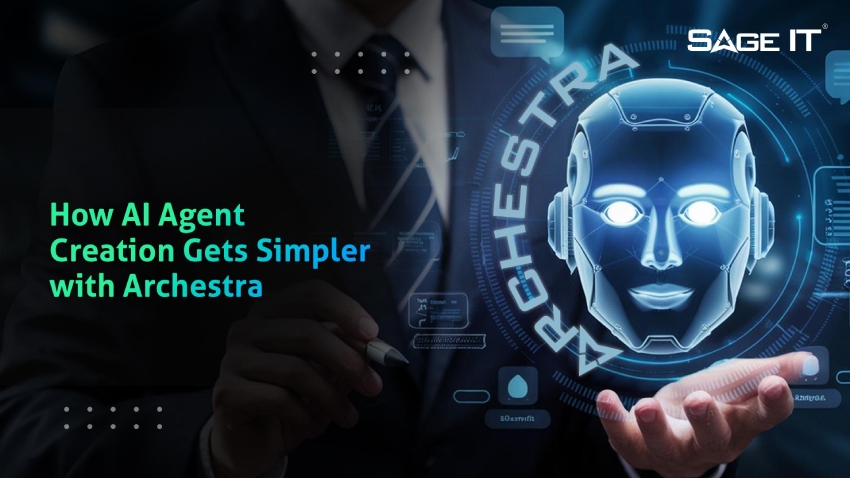
That is where our Archestra agentic business automation solution fits in. It starts with natural-language objectives, so your team can move into AI agent creation without having to manage every framework detail themselves.
It brings native multi-agent orchestration, so the workflow does not stay split across disconnected tools and hand-coded dependencies. It applies guardrails during runtime execution, so governance becomes part of the operating layer rather than something added later.
It also gives you visibility into cost, latency, and behavior from the start. The result is a more dependable path into governed agent execution at scale.
How the 5-Step AI Agent Creation Flow Simplifies Building
1. Intent analysis
Archestra begins by interpreting the natural-language objective to identify the solution’s purpose, the agents involved, the complexity of the workflow, the capabilities each agent needs, and any domain-specific constraints that shape how the solution should be built.
2. Template recommendation
That intent is then matched against Archestra’s template library using a weighted scoring model based on workflow type, complexity, capability requirements, and keyword matching. This helps select the framework best suited to the solution instead of forcing teams to choose one manually from the start.
3. System prompt generation
Once the template is selected, Archestra uses the extracted intent and the template’s behavioral context to generate a tailored system prompt. That prompt defines each agent’s role, guidelines, capabilities, and tone so the output is shaped around the function the agent is meant to perform.
4. Configuration synthesis
Archestra then generates the remaining configuration variables needed for the agent, including tool selections, model parameters, and guardrail profiles. These are aligned to the intended function of each agent rather than being left as separate manual setup tasks.
5. Iterative refinement
The process also supports iterative refinement, so users can give feedback and adjust generated elements without restarting the full pipeline. That keeps the creation flow flexible while reducing unnecessary rebuild cycles.
What this changes
This kind of structure makes AI agent creation more usable for product managers, business analysts, and domain experts who understand what the agent should do but do not have framework-level expertise. It also helps organizations scale agent creation with business understanding, not only with specialist coding capacity.
Who Benefits When AI Agent Creation Gets Simpler
If you are trying to move AI agents into real business workflows, the first people who benefit are usually the ones already closest to the work. Product managers, business analysts, and domain experts often understand the process, the constraints, and the points where execution tends to slow down.
What they have not always had is a practical way to shape agent creation without being pulled through the same technical surface as the implementation team.
That is where our Archestra changes the operating model. It supports role-differentiated views, so developers can work with the technical configuration they need while business users and product teams stay focused on the operational view relevant to their role.
That makes collaboration more practical during rollout and reduces the friction that usually builds when every team has to work through the same layer.
The result is not just easier participation. It is a more workable path for bringing business understanding into agent creation without overloading the people closest to the workflow.
Why Simpler AI Agent Creation Matters for Enterprise Adoption
When evaluating AI agents for real business use, simpler creation is just one part of the equation. What truly matters is whether your organization can move from a useful idea to a working deployment without getting bogged down by frameworks, fragmented tools, governance gaps, and unnecessary handoffs. This is where many AI initiatives tend to lose momentum.
Archestra changes this by offering more than just simplified agent definitions. It provides a unified operating layer for building, deploying, connecting, monitoring, and governing agents. This removes the integration burden of relying on separate tools for creation, orchestration, observability, and control, and ensures consistent governance and visibility across all agents.
This streamlined approach has a direct impact on adoption. With built-in cost attribution, latency profiling, and behavioral monitoring, your teams gain crucial visibility from the start, not after problems have already surfaced. Guardrail enforcement is integrated into the operating layer, ensuring compliance and closing the runtime-control gaps that often slow enterprise rollouts.
The outcome is clear: a more dependable path from identifying use cases to successfully executing governed agents at scale.